TiHKAL
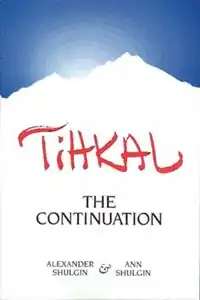 Cover of TiHKAL, 1st ed. | |
| Author | Alexander and Ann Shulgin |
|---|---|
| Subject | Pharmacology, Autobiography, Psychedelic drugs |
| Publisher | Transform Press |
Publication date | 1997 |
| Publication place | United States |
| Media type | Paperback |
| Pages | xxviii, 804 p. |
| ISBN | 0-9630096-9-9 |
| OCLC | 38503252 |
| Preceded by | PiHKAL (1991) |
TiHKAL: The Continuation, also known as Tryptamines I Have Known and Loved, is a 1997 book written by Alexander Shulgin and Ann Shulgin.[1][2] It is about a family of psychoactive drugs known as tryptamines, which includes psychedelics, other hallucinogens, and entactogens.[1][2] The book has two halves, and the second part of the book contains detailed entries on 55 tryptamines.[2] TiHKAL is a sequel to PiHKAL: A Chemical Love Story (Phenethylamines I Have Known and Loved) (1991).[1][2]
Content
TiHKAL, much like its predecessor PiHKAL, is divided into two parts.[2] The first part, for which all rights are reserved, begins with a fictionalized autobiography, picking up where the similar section of PiHKAL left off; it then continues with a collection of essays on topics ranging from psychotherapy and the Jungian mind to the prevalence of DMT in nature, ayahuasca and the War on Drugs.[2]
The second part of TiHKAL, which may be conditionally distributed for non-commercial reproduction , is a detailed synthesis manual for 55 tryptamines (many discovered by Alexander Shulgin himself), including their chemical structures, doses, durations, and commentary.[2] It includes entries on compounds including simple tryptamines like dimethyltryptamine (DMT), psilocin, and 5-MeO-DMT, α-alkyltryptamines like α-methyltryptamine (AMT), β-carbolines or harmala alkaloids like harmaline, the iboga alkaloid ibogaine, and lysergamides like LSD.[2] Whereas PiHKAL had 179 entries on phenethylamines, TiHKAL has only 55 entries.[3][2] Shulgin has made the second part freely available on Erowid while the first part is available only in the printed text.
Response
As with PiHKAL, the Shulgins were motivated to release the synthesis information as a way to protect the public's access to information about psychedelic compounds, a goal Alexander Shulgin has noted many times.[4] Following a raid of his laboratory in 1994 by the United States DEA,[5] Richard Meyer, spokesman for DEA's San Francisco Field Division, stated that "It is our opinion that those books [referring to the previous work, PiHKAL are pretty much cookbooks on how to make illegal drugs. Agents tell me that in clandestine labs that they have raided, they have found copies of those books."
Notable compounds
Some compounds in TiHKAL, including dimethyltryptamine (DMT), psilocybin (4-PO-DMT), psilocin (4-HO-DMT), bufotenin (5-HO-DMT), 5-MeO-DMT, α-methyltryptamine (AMT), lysergic acid diethylamide (LSD), harmaline, and ibogaine, are widely known and/or used hallucinogens.[2]
Tryptamines listed
| # | Substance | Chemical name | Group | Link |
|---|---|---|---|---|
| 1 | AL-LAD (6-allyl-6-nor-LSD) | 6-Allyl-N,N-diethyl-NL | Lysergamide | |
| 2 | DBT (dibutyltryptamine) | N,N-Dibutyl-T | Tryptamine | |
| 3 | DET (diethyltryptamine) | N,N-Diethyl-T | Tryptamine | |
| 4 | DiPT (diisopropyltryptamine) | N,N-Diisopropyl-T | Tryptamine | |
| 5 | α,O-DMS (5-MeO-AMT) | 5-Methoxy-α-methyl-T | α-Alkyltryptamine | |
| 6 | DMT (dimethyltryptamine) | N,N-Dimethyl-T | Tryptamine | |
| 7 | 2,α-DMT (2-methyl-AMT) | 2,α-Dimethyl-T | α-Alkyltryptamine | |
| 8 | α,N-DMT (N-methyl-AMT) | α,N-Dimethyl-T | α-Alkyltryptamine | |
| 9 | DPT (dipropyltryptamine) | N,N-Dipropyl-T | Tryptamine | |
| 10 | EiPT (ethylisopropyltryptamine) | N-Ethyl-N-isopropyl-T | Tryptamine | |
| 11 | α-ET (AET; α-ethyltryptamine) | α-Ethyl-T | α-Alkyltryptamine | |
| 12 | ETH-LAD (6-ethyl-6-nor-LSD) | 6,N,N-Triethyl-NL | Lysergamide | |
| 13 | Harmaline (dihydroharmine) | 3,4-Dihydro-7-methoxy-1-methyl-BC | β-Carboline | |
| 14 | Harmine | 7-Methyoxy-1-methyl-BC | β-Carboline | |
| 15 | 4-HO-DBT | N,N-Dibutyl-4-hydroxy-T | 4-Hydroxytryptamine | |
| 16 | 4-HO-DET | N,N-Diethyl-4-hydroxy-T | 4-Hydroxytryptamine | |
| 17 | 4-HO-DiPT | N,N-Diisopropyl-4-hydroxy-T | 4-Hydroxytryptamine | |
| 18 | 4-HO-DMT | N,N-Dimethyl-4-hydroxy-T | 4-Hydroxytryptamine | |
| 19 | 5-HO-DMT (bufotenin) | N,N-Dimethyl-5-hydroxy-T | 5-Hydroxytryptamine | |
| 20 | 4-HO-DPT | N,N-Dipropyl-4-hydroxy-T | 4-Hydroxytryptamine | |
| 21 | 4-HO-MET | N-Ethyl-4-hydroxy-N-methyl-T | 4-Hydroxytryptamine | |
| 22 | 4-HO-MiPT | 4-Hydroxy-N-isopropyl-N-methyl-T | 4-Hydroxytryptamine | |
| 23 | 4-HO-MPT | 4-Hydroxy-N-methyl-N-propyl-T | 4-Hydroxytryptamine | |
| 24 | 4-HO-pyr-T | 4-Hydroxy-N,N-tetramethylene-T | Pyrrolidinylethylindole | |
| 25 | Ibogaine | A complexly substituted-T | Azepinoindole | |
| 26 | LSD (METH-LAD) | N,N-Diethyl-L | Lysergamide | |
| 27 | MBT (methylbutyltryptamine) | N-Butyl-N-methyl-T | Tryptamine | |
| 28 | 4,5-MDO-DiPT | N,N-Diisopropyl-4,5-methylenedioxy-T | Other | |
| 29 | 5,6-MDO-DiPT | N,N-Diisopropyl-5,6-methylenedioxy-T | Other | |
| 30 | 4,5-MDO-DMT | N,N-Dimethyl-4,5-methylenedioxy-T | Other | |
| 31 | 5,6-MDO-DMT | N,N-Dimethyl-5,6-methylenedioxy-T | Other | |
| 32 | 5,6-MDO-MiPT | N-Isopropyl-N-methyl-5,6-methylenedioxy-T | Other | |
| 33 | 2-Me-DET (2-methyl-DET) | N,N-Diethyl-2-methyl-T | Other | |
| 34 | 2-Me-DMT (2-methyl-DMT) | 2,N,N-Trimethyl-T | Other | |
| 35 | Melatonin (5-MeO-NAcT) | N-Acetyl-5-methoxy-T | N-Acetyltryptamine | |
| 36 | 5-MeO-DET | N,N-Diethyl-5-methoxy-T | 5-Methoxytryptamine | |
| 37 | 5-MeO-DiPT | N,N-Diisopropyl-5-methoxy-T | 5-Methoxytryptamine | |
| 38 | 5-MeO-DMT | 5-Methoxy-N,N-dimethyl-T | 5-Methoxytryptamine | |
| 39 | 4-MeO-MiPT | N-Isopropyl-4-methoxy-N-methyl-T | Other | |
| 40 | 5-MeO-MiPT | N-Isopropyl-5-methoxy-N-methyl-T | 5-Methoxytryptamine | |
| 41 | 5,6-MeO-MiPT | 5,6-Dimethoxy-N-isopropyl-N-methyl-T | Other | |
| 42 | 5-MeO-NMT | 5-Methoxy-N-methyl-T | 5-Methoxytryptamine | |
| 43 | 5-MeO-pyr-T | 5-Methoxy-N,N-tetramethylene-T | Pyrrolidinylethylindole | |
| 44 | 6-MeO-THH | 6-Methoxy-1-methyl-1,2,3,4-tetrahydro-BC | β-Carboline | |
| 45 | 5-MeO-TMT | 5-Methoxy-2,N,N-trimethyl-T | Other | |
| 46 | 5-MeS-DMT | N,N-Dimethyl-5-methylthio-T | Other | |
| 47 | MiPT (methylisopropyltryptamine) | N-Isopropyl-N-methyl-T | Tryptamine | |
| 48 | α-MT (AMT; α-methyltryptamine) | α-Methyl-T | α-Alkyltryptamine | |
| 49 | NET (N-ethyltryptamine) | N-Ethyl-T | Tryptamine | |
| 50 | NMT (N-methyltryptamine) | N-Methyl-T | Tryptamine | |
| 51 | PRO-LAD (6-propyl-6-nor-LSD) | 6-Propyl-NL | Lysergamide | |
| 52 | pyr-T (pyrrolidinyltryptamine) | N,N-Tetramethylene-T | Pyrrolidinylethylindole | |
| 53 | T (tryptamine) | Tryptamine | Tryptamine | |
| 54 | Tetrahydroharmine (THH) | 7-Methoxy-1-methyl-1,2,3,4-tetrahydro-BC | β-Carboline | |
| 55 | α,N,O-TMS (5-MeO-α,N-DMT) | α,N-Dimethyl-5-methoxy-T | α-Alkyltryptamine | |
Subsequently, while not included in the published version of TiHKAL, two additional entries were released by Shulgin in 2004:[6]
| # | Substance | Chemical name | Group | Link |
|---|---|---|---|---|
| 56 | 5-MeO-DALT | 5-Methoxy-N,N-diallyl-T | 5-Methoxytryptamine | |
| 57 | DALT (diallyltryptamine) | N,N-Diallyl-T | Tryptamine |
See also
- PiHKAL (Phenethylamines I Have Known and Loved) (1991)
- The Shulgin Index, Volume One: Psychedelic Phenethylamines and Related Compounds (2011)
- List of psychedelic literature
- Substituted tryptamine
- Substituted β-carboline and harmala alkaloid
- Azepinoindole and iboga alkaloid
- Substituted lysergamide
References
- 1 2 3 Ben Sessa (2015). "Continuing History of Psychedelics in Medical Practices: The Renaissance of Ps chedelic Medical Research". In Ellens, J.H.; D, T.B.R.P. (eds.). The Psychedelic Policy Quagmire: Health, Law, Freedom, and Society. Psychology, Religion, and Spirituality. Bloomsbury Publishing. p. 50. ISBN 979-8-216-13356-8. Retrieved January 30, 2025.
- 1 2 3 4 5 6 7 8 9 10 Alexander T. Shulgin; Ann Shulgin (1997). TiHKAL: The Continuation (1st ed.). Berkeley, CA: Transform Press. ISBN 978-0-9630096-9-2. OCLC 38503252. Retrieved January 30, 2025.
- ↑ Shulgin, Alexander; Shulgin, Ann (September 1991). PiHKAL: A Chemical Love Story. Berkeley, California: Transform Press. ISBN 0-9630096-0-5. OCLC 25627628.
- ↑ Bennett, Drake (January 30, 2005). "Dr. Ecstasy". New York Times Magazine. Retrieved July 8, 2006.
- ↑ "DEA Raid of Shulgin's Laboratory". Erowid. January 8, 2004. Retrieved July 8, 2006.
- ↑ Morris H, Smith A (May 2, 2010). "The Last Interview With Alexander Shulgin". VICE.
External links
- Erowid Online Books: TiHKAL: The Continuation by Alexander & Ann Shulgin
- "Shulgin in Spanish" Project – Information on the first complete translation of PiHKAL and TiHKAL into Spanish
- TiHKAL • Info: A visual index and map of TiHKAL, including the formatted text of Book II. Includes over 300 corrections to the original HTML version.
- Transform Press – Publisher of TiHKAL