2C-G
 | |
 | |
| Clinical data | |
|---|---|
| Other names | 2C-G-0; 2,5-Dimethoxy-3,4-dimethylphenethylamine; 3,4-Dimethyl-2,5-dimethoxyphenethylamine |
| Legal status | |
| Legal status |
|
| Identifiers | |
IUPAC name
| |
| CAS Number | |
| PubChem CID | |
| ChemSpider | |
| UNII | |
| ChEMBL | |
| CompTox Dashboard (EPA) | |
| Chemical and physical data | |
| Formula | C12H19NO2 |
| Molar mass | 209.289 g·mol−1 |
| 3D model (JSmol) | |
SMILES
| |
InChI
| |
  (what is this?) (verify) (what is this?) (verify) | |
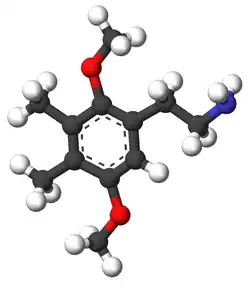
2C-G, or 2C-G-0, also known as 3,4-dimethyl-2,5-dimethoxyphenethylamine, is a psychedelic phenethylamine of the 2C-series. First synthesized by Alexander Shulgin,[1] it is sometimes used as an entheogen. It has structural and pharmacodynamic properties similar to 2C-D and Ganesha. Like many of the phenethylamines in PiHKAL, 2C-G and its homologs have only been taken by Shulgin and a small test group, making it difficult to ensure completeness when describing effects.
Use and effects
In Shulgin's book PiHKAL, the dosage range is listed as 20 to 35 mg.[1] Effects are similar to the related Ganesha, and are extremely long lasting; the duration is 18 to 30 hours. Visual effects are muted or absent, and it is described in PiHKAL as an "insight-enhancer".[1] Unlike other members of the 2C-series, 2C-G is nearly as potent as its amphetamine form.
Interactions
Chemistry
2C-G is 3,4-dimethyl-2,5-dimethoxyphenethylamine, with the formula C
12H
19NO
2.
Homologues
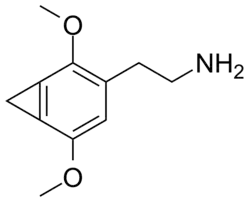
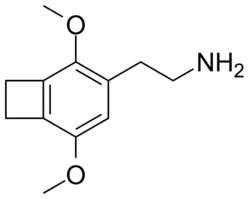
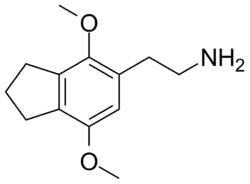
Several homologues of 2C-G were also synthesized by Alexander Shulgin. These include 2C-G-3, 2C-G-5, and 2C-G-N. Some, such as 2C-G-1, 2C-G-2, 2C-G-4, and 2C-G-6 are possible to synthesize in principle but impossible or extraordinarily difficult to do so in practice.
| Compound | Details | Structure |
|---|---|---|
| 2C-G-1 | CAS: 2888537-47-9 The synthesis of this compound has not been reported, but it is described prophetically in WO2022271982 |
 |
| 2C-G-2 | CAS: 2888537-48-0 The synthesis of this compound has not been reported, but it is described prophetically in WO2022271982 |
 |
| 2C-G-3 | CAS: 207740-19-0 Dosage: 16–25 mg |
 |
| 2C-G-4 | CAS: 952006-59-6 Synthesized but not tested. |
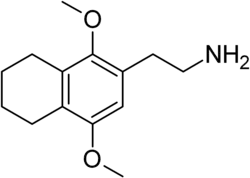 |
| 2C-G-5 | CAS: 207740-20-3 Dosage: 10–16 mg |
 |
| 2C-G-6 | CAS: 2888537-49-1 The synthesis of this compound has not been reported, but it is described prophetically in WO2022271982 |
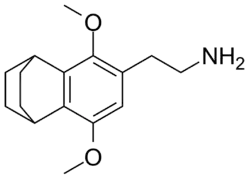 |
| 2C-G-N | CAS: 207740-21-4 Dosage: 20–40 mg |
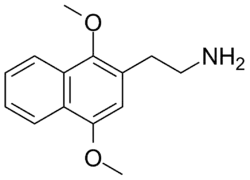 |
Society and culture
Legal status
Canada
As of October 31, 2016; 2C-G is a controlled substance (Schedule III) in Canada.[2]
United Kingdom
2C-G and all other compounds featuring in PiHKAL are Class A drugs in the United Kingdom.
United States
In the United States 2C-G is considered a Schedule 1 controlled substance as a positional isomer of 2C-E and 2,5-Dimethoxy-4-methylamphetamine (DOM).[3]
See also
- 2C (psychedelics)
- Ganesha
- DOTMA
References
- 1 2 3 PiHKAL entry on 2C-G
- ↑ "Regulations Amending the Food and Drug Regulations (Part J — 2C-phenethylamines)". 4 May 2016.
- ↑ "Lists of: Scheduling Actions - Controlled Substances - Regulated Chemicals" (PDF). Drug Enforcement Administration. February 2023.
External links
- 2C-G PiHKAL entry: Erowid and Isomer Design
- 2C-G-3 PiHKAL entry: Erowid and Isomer Design
- 2C-G-4 PiHKAL entry: Erowid and Isomer Design
- 2C-G-5 PiHKAL entry: Erowid and Isomer Design
- 2C-G-N PiHKAL entry: Erowid and Isomer Design