Tutorial:Turtle farming
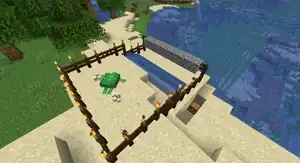
A turtle farm, turtle shell farm, or scute farm is a means of breeding turtles to harvest turtle scutes, which are used to craft a turtle shell. In addition to having the same defense value as an iron helmet, it has greater durability than an iron helmet, and grants the water breathing status effect for 10 seconds. Also, a turtle helmet can be enchanted with Respiration for an additional 15 seconds underwater. Turtle scutes are also required for brewing the potion of the Turtle Master. This tutorial describes a turtle farm that can reasonably be built in survival mode.
Preparation
First you need to obtain turtle eggs. Turtle eggs do not generate naturally and are obtained by breeding turtles. Turtles are bred using seagrass, which can be found in any ocean or river biome. Turtles themselves can be found on regular beaches.
After breeding, one of the turtles becomes pregnant, causing it to be slightly taller than normal. To lay eggs, a pregnant turtle must be near its home block or the spot where it first spawned, and the egg must be laid on sand, red sand, or suspicious sand.
Once the turtle has laid its eggs, you can either leave them in their regular location or break them with any silk touch tool and place somewhere else to move the farm elsewhere. It may take a few in-game days for them to hatch, and they hatch only at night. Building some form of shelter around them is advised, because undead like to trample and break turtle eggs.
Construction
Design considerations
There are many variations of turtle farms. At the most basic level, one needs
- An area of sand for the turtles to spawn
- A means of protection against undead mobs from finding and destroying the turtle eggs. The farm should be well-lit to prevent mobs from spawning inside it, and should employ fencing or other barriers to make the farm inaccessible to hostile mobs that may approach from land or from the water.
Also, baby turtles always try to go to the nearest water source. This can be used to your advantage, to lead the turtles.
Optionally, it's also good to have several hoppers and a chest. If you're attempting a survival mode build, you may first want to build a survival-mode iron golem farm to collect enough iron to craft as many hoppers as you need, as well as iron tools, weapons, and armor.
During construction, it may be a good idea to have a bed and shelter nearby to get some occasional sleep, to prevent phantoms from spawning while you work.
Prepare the area
Remember that turtles need to spawn on sand, so be sure to replace non-sand blocks in your desired location. It's a good idea to include a means of getting in and out of the farm easily, such as a door. Without a way, you shouldn't be able to climb inside (if you can, then so can mobs).
Build the farm
 Side view cross-section of blocks used in a basic turtle farm. A body of water is on the left and spawning beach on the right. Spillover from the water source blocks is not shown, and neither are mob-protection features or the collection chest at the end of the row of hoppers.
The basic turtle farm shown as a side-view cross-section in the diagram on the right can be built easily in survival mode. This slice can be repeated any number of times to create a farm of any width, preferably at least 5 blocks wide (8 blocks wide is a practical size), with a chest at the end of the line of hoppers along the bottom.
- A solid wall on either side
- Hoppers and a chest to collect the scutes dropped by baby turtles as they grow
- Water source blocks arranged to create a waterfall toward the hoppers
- A sand beach to allow the turtles to spawn (this can be expanded depending on how many turtles are kept)
In addition to these features, other features not shown in the diagram can also be included:
- An extra hopper may be used to position the chest outside the farm
- Fencing or barriers all around the farm
- Lighting to prevent mobs from spawning in the farm
- A way to let adult turtles leave the farm
Managing the farm
The eggs hatch after a few day-night cycles. After the turtles hatch for the first time, you're basically done. As each baby turtle grows up, it drops a scute and the hoppers collect it. Just continue feeding turtles so that they continue to lay eggs. You may want to expand the farm by keeping more adult turtles and expanding the area in which they can lay their eggs.
A turtle farm does not work while you're away from the keyboard. However, if many turtle eggs are already laid, it may take many in-game days for them to hatch, and the player does not need to be present for this to happen.
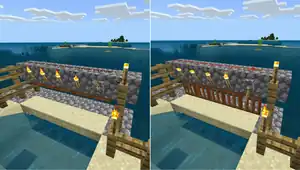
You can modify the barrier by installing a gate made from trapdoors under the barrier. The trapdoors can be operated manually, or you can lay a line of redstone dust on top of the barrier with a lever somewhere to power all the trapdoors at once. This can be used to keep adult turtles from leaving until you have fed them and got them to mate.
If you venture away from your farm further than the despawn range (128 blocks in Java Edition, 44-128 blocks in Bedrock Edition depending on simulation distance), the turtles in the farm despawn if you have not interacted with them by feeding them seagrass.


.png)


.png)


