Movie:Block
|
Details | |
|---|---|
| Designation |
Matter |
| Material |
Varies |
| Current location | |
| First appearance | |
| Latest appearance | |


{
    "title": "Block",
    "rows": [
        {
            "field": "",
            "label": "Details"
        },
        {
            "field": "Matter",
            "label": "Designation"
        },
        {
            "field": "Varies",
            "label": "Material"
        },
        {
            "field": "\n* <span class=\"nowrap\"><span class=\"sprite-file\" style=\"\">(link to File:MovieSprite overworld.png article, displayed as 16x16px|link=AMCM:Overworld|alt=|class=pixel-image|)</span>(link to AMCM:Overworld article, displayed as <span class=\"sprite-text\">Overworld</span>)</span>\n* <span class=\"nowrap\"><span class=\"sprite-file\" style=\"\">(link to File:MovieSprite nether.png article, displayed as 16x16px|link=AMCM:Nether|alt=|class=pixel-image|)</span>(link to AMCM:Nether article, displayed as <span class=\"sprite-text\">Nether</span>)</span>",
            "label": "Current location"
        },
        {
            "field": "''(link to Movie:Uproar in Midport Village article, displayed as Uproar in Midport Village)''",
            "label": "First appearance"
        },
        {
            "field": "''(link to A Minecraft Movie article, displayed as A Minecraft Movie)''",
            "label": "Latest appearance"
        }
    ],
    "invimages": [],
    "images": [
        "AMCM Steve builds.jpeg"
    ]
}
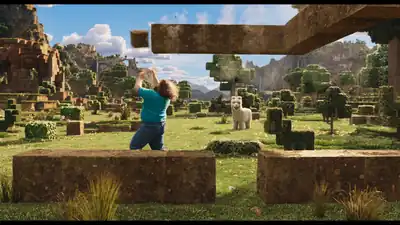
A block is a type of object that makes up everything in the Overworld. Everything, ranging from plants, rocks, and even creatures are composed of cubes, with curious properties.
Appearance
Blocks can take the shape of anything from full cubes of varying sizes to objects with silhouettes similar to a normal object, but made of cubic parts.
Properties
Blocks are the product of an underlying crystalline physical force, turning everything in a square shape for unclear optimization.[1] When broken, instead of visible damage blocks revert to a smaller version of themself, floating in mid-air. This process can be reversed by placing them, causing them to grid back to full size in a grid formation.
Types
Soil
Different types of soil, including dirt, can be found throughout the world. These make up the majority of their land, serving as the foundation, up to portions of mountains. In turn, dirt appears to be among the weakest blocks, easily claimable with minimal effort. Soil can harbor plant life and fungi.
Plant
There are multiple species of plant. There are two different grasses: a shorter variety that never grows more than two inches high and is a favorite of sheep, and a taller variety that only occasionally pops up and reaches a full block i height, providing nutrition for llamas. Wheat is a crop grown by villagers. It is not tasty on its own and must be cooked into bread. Potatoes are crops grown by villagers and humans on Earth and in the Overworld. On Earth, it can be cooked into tater tots. In the Overworld they are eaten raw. Beetroots, broccoli, leeks, and pumpkins are crops grown by villagers. Tall trees grow across the Overworld as well. There are six varieties: oak, birch, spruce, jungle, cherry, and dark oak. Bamboo also grow in the Overworld and is the choice of food for pandas.
Fungi
There are two known species of fungi. In the Overworld, red mushrooms grow to massive proportions. They have white stems and red caps with white spots. They have hollow insides that make good living spaces. Their red caps are an ingredient in mushroom hats. Nether wart grow in the Nether. It emits Nether spores, a fungal gas that allows piglins to breathe. It is edible and can be brewed.
Liquid
Two different types of liquid materials have been seen, water and lava. Water is common throughout the Overworld, flowing through rivers and oceans. It can be easily collected using a bucket, and is efficient at breaking falls. Lava is common throughout the Nether, being a red hot substance that burns anything it touches. Both liquids compress themselves when stored in buckets, allowing a lot to be contained in a small space.
Ore
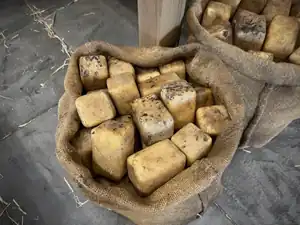
Ore blocks are stone blocks that store gemstones inside them. There are four known ores. Redstone ore carries redstone, glowing red rocks that can be processed into dust to conduct energy. Iron presumably comes from ores, though they are not seen in-film. It comes out as raw iron that can be smelted into a very useful metal that can be formed into swords, pickaxes, axes, shovels, hoes, and armor. Gold ore exists across the dimensions, though it is not seen in-film on Earth or in the Overworld. In the Nether the gold comes out in miniature blocks, slightly bigger than dirt in miniature form. Gold is a weak metal but can still be used for most of the same purposes as iron, as well as golden apples. Diamond ore carries diamonds, glittering gems with immense sharpness and durability, making excellent weapons and armor. It also has great monetary value on Earth.
Construction
There are several blocks that are processed from raw materials for construction purposes. Terracotta can be dyed in muted colors and used for statues and the floor of fighting rings. Bricks can be made of clay, stone, and blackstone and used for walls and floors. Wood planks can be crafted into doors, fences, tables, stairs and slabs. They are dominantly used in villages. Obsidian is a mysterious black block used in the construction of obsidian gateways. Glass is a transparent block used in windows. Cobblestone is a product of stone used in walls.
Utility
There are many blocks that have special purposes, from creation to destruction. TNT is an explosive block. In large numbers, it can pull off mammoth destruction. Crafting tables are workbenches with tools hanging at their side and a 3x3 grid on top. By arranging ingredients in combinations on the grid and smashing a hammer atop them, new implements can be created, such as swords, the buck-chuckets, and the tot launcher. The same function will work even if the ingredients are not arranged on the grid, creating unconventional tools and weapons. Furnaces are stone blocks with hollow insides separated into two slots for fuel and raw material. Anvils are only seen in the background and early storyboards. They may be used to repair tools. Lecterns are podiums that can store books. A book can be placed atop them to be read. Chains are many iron rings linked together. Lanterns are small blocks that hang from chains and emit light. Armor stands are used to display armor.
Storage
A few blocks are used to store items. Chests are wooden boxes with metal clasps that can store a limited number of items. Bigger chests called double chests can store twice the amount and longer items, such as swords and axes. Shelves are wooden cubicles stacked atop each other. They can store items in these. Crates are wooden boxes with openings on the bottom, so they can be lowered with chains to drop the contents.
Trivia
- Bamboo is classified as a grass on Earth, though it is unknown whether the same classification applies here.
Gallery
Screenshots
-
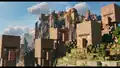 Block statues.
 -
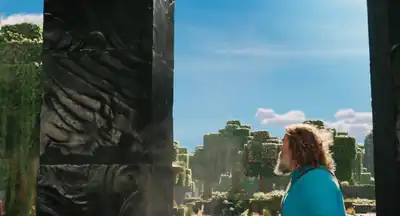 Obsidian compared to Steve.
 -
 Blocks from a side profile.
 -
 A tree's lack of gravity.
 -
 A floating log.
 -
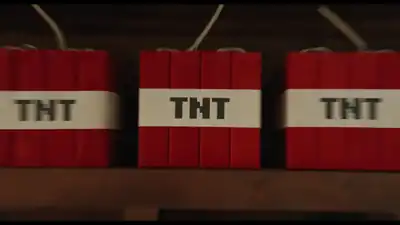 TNT blocks.
 -
 Steve and Garrett standing in front of pillars and chiseled blocks.
 -
 A massive structure of blocks.
 -
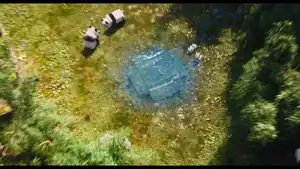 Liquid blocks.
 -
 A suspended crate block.
 -
 A block formation.
Official artwork
-
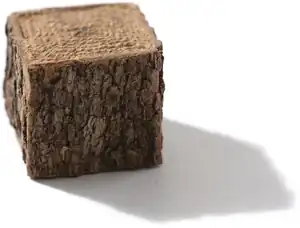 A block of wood log.
 -
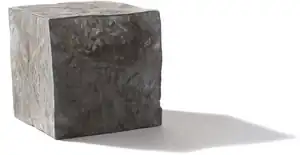 A block of stone.
 -
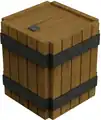 A barrel.
Production images
-
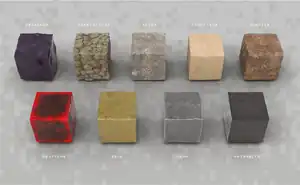 Designs of some blocks
 -
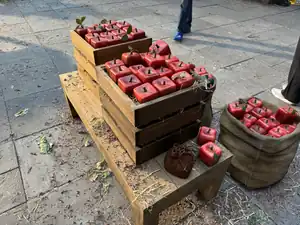
-
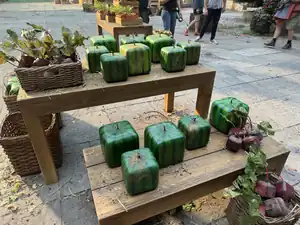
-
-
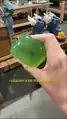 An itemized slime cube.
 -
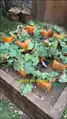 Pumpkin crop props.
 -
 Several grass blocks of varying sizes.
 -
 LDShadowLady with several cubic crops.
 -
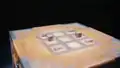 Iron ingots and blocks on a crafting table.
In other media
-
 Henry building a happy meal.
Videos
References
- ↑ "Blocky apples in @AMinecraftMovie. In the game, apples aren’t blocky, but it didn’t fit into the cubic film Overworld. We imagined that there is an underlying crystalline physics force, making a cube the ideal shape unlike our world where water in zero G makes a sphere." – @torfi_f_olafss on X (formerly Twitter), April 12, 2025
| Installments | |||||||||
|---|---|---|---|---|---|---|---|---|---|
| Cast | |||||||||
| Crew |
| ||||||||
| Narrative |
| ||||||||
 A Minecraft Movie A Minecraft Moviesoundtrack soundtrack |
|||||||||
| Events | |||||||||
| Promotions |
| ||||||||
| Miscellaneous |
| ||||||||


 Blocks Blocks
|
||
|---|---|---|
 Tools Tools
|
||
 Artifacts Artifacts
|
||
 Machines Machines
|
||
 Organic Organic
|
| |
| See also | ||


