Stadium card (TCG)
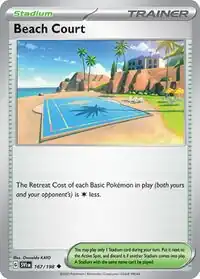
Stadium cards (Japanese: スタジアム Stadium) are one of the four primary subclasses of Trainer cards in the Pokémon Trading Card Game, alongside Item cards, Pokémon Tool cards, and Supporter cards. Stadium cards typically represent a field of battle. Some depict locations from the Pokémon games, such as Pewter City Gym or Mesagoza, while others feature locations original to the TCG, such as Holon Research Tower or Giant Hearth. Stadium cards are color-coded as light green, as highlighted on its Trainer type and Trainer rule.
Stadium cards were first introduced in the Gym Heroes and Gym Challenge expansions. Between Diamond & Pearl and Call of Legends, Stadium cards were instead a distinct card type. From Black & White onward, Stadium returned to being a subtype of Trainer cards.
Only one Stadium card may be in play at any given time, and its effects apply to both players during a game. When a Stadium card is played, it is placed next to the Active Spot and stays in play, unless removed by the play of a new Stadium card or the effect of certain non-Stadium cards. A player may play only one Stadium card during their turn, and if a Stadium card is already in play, any Stadium cards with the same name cannot be played. There are currently 211 different Stadium cards, though many have received multiple prints.
Information
Stadiums can have a wide variety of effects:
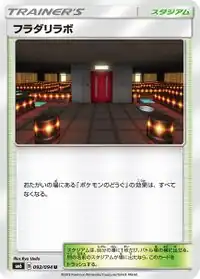
- Some Stadiums modify the characteristics of Pokémon in play. For example, Magnetic Storm removes the Resistance of all Pokémon in play. In most cases, this kind of effect only modifies the characteristics of Pokémon that meet certain requirements.
- This can be based on characteristics inherent to the card such as its Stage, Type, or name. For example, Training Center boosts the HP of Stage 1 Pokémon and Stage 2 Pokémon by 30, while Devoured Field causes Dragon and Dark-type Pokémon's attacks to deal 10 more damage to the Defending Pokémon. Path to the Peak is another good example, as it removes the Abilities of any Pokémon with a Rule Box but leaves Pokémon without a Rule Box unaffected.
- In other cases, the criteria for which Pokémon are affected by a Stadium can be based on the current state of a Pokémon in play. For example, Lake Acuity reduces the damage taken by Pokémon with
 or
or  Energy cards attached by 20, and Blizzard Town prevents Pokémon that have 40 HP or less from attacking.
- These effects can also affect non-Pokémon cards, such as how Lysandre Labs removes the effect of Pokémon Tool cards and Temple of Sinnoh causes all Special Energy cards to only provide
 Energy and removes their other effects.
- These effects can also affect non-Pokémon cards, such as how Lysandre Labs removes the effect of Pokémon Tool cards and Temple of Sinnoh causes all Special Energy cards to only provide
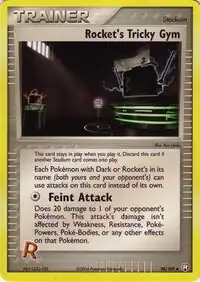
- The Stadiums Holon Lake and Rocket's Tricky Gym allow for Pokémon that meet their criteria to use one of the attacks printed on the Stadium card.
- Some Stadiums modify the characteristics of Special Conditions. For example, Wela Volcano Park prevents Pokémon from recovering from Burned even if the coin flip for curing Burned during Pokémon Checkup has a heads result. Slumbering Forest makes it so that two coin flips occur during Pokémon Checkup for Asleep, and either coin returning a tails result prevents the Pokémon from recovering from Asleep.
- Some Stadiums affect properties that players have. For example, Collapsed Stadium reduces the number of Benched Pokémon a player can have from five to four. In comparison, Sky Field increases the number of allowed Benched Pokémon to eight.
- Some Stadiums modify the effects of certain game actions. For instance, Sea of Nothingness changes how Evolution works, as it prevents Pokémon from recovering from Special Conditions when they evolve or devolve. Skaters' Park changes retreating to return Basic Energy used to pay for the retreat cost to their owner's hand instead of discarding them. In some cases, this can prevent certain actions from occurring, such as how Dyna Tree Hill prevents Pokémon from healing.
- Some Stadiums cause new events to happen. For example, while Frozen City is in play, either player attaching an Energy from their hand to a Pokémon causes two damage counters to be put on that Pokémon, unless its a Team Plasma Pokémon. Shrine of Punishment is another example, which causes Pokémon-EX and Pokémon-GX to receive a damage counter during Pokémon Checkup.
- Some Stadiums allow players to take an additional action, akin to activating an Ability or Pokémon Power. Examples of this include Cycling Road allowing each player to discard a Basic Energy from their hand to draw a card, Rough Seas allowing each player to heal 30 damage from their Water-type and Lightning-type Pokémon, and Rose Tower giving each player the option to draw cards until they have three cards in their hand. Usually, the action provided has a once per turn restriction, which is true of all of these examples.
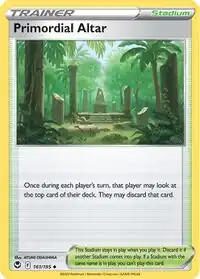
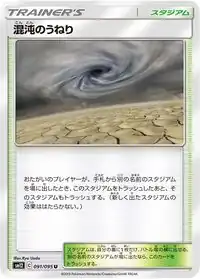
Stadium cards have some limitations. Only one Stadium card may be in play at any time, so if either player plays a Stadium card while another Stadium is in play, the Stadium that is currently in play is discarded to make room for the newer Stadium. Some non-Stadium card effects can remove Stadiums from play as well. Each player can only play one Stadium card per turn. Players cannot play a Stadium card that has the same name as the one currently in play, which prevents players from using a Stadium with a once per turn activation twice in the same turn. (There is one caveat to this. Should such a Stadium be removed from play through a means other than playing a Stadium, then a Stadium of that name can be played again. As the second stadium is a different object, its action would not be prevented by having used the action of the first Stadium.)[1]
Some cards check for the presence of any Stadiums in play, while other cards check for if a Stadium with a specific name or specific phrase in their name is in play. Some cards even check if their owner has a Stadium in play, ignoring the presence of a Stadium played by the opponent.
The Stadium Chaotic Swell is particularly odd, as it has no effect while it is in play. Rather, its effect is to discard a Stadium card that is played to discard Chaotic Swell, preventing that Stadium from having any effect.
Prism Star Stadium
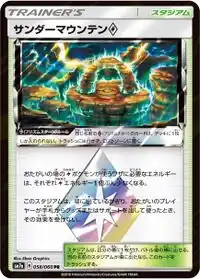
Prism Star Stadium cards were introduced in the Lost Thunder expansion, which target a specific type. These cards have a shared effect that protects them from the effects of Item cards and Supporter cards. As such, the only way to remove these Stadium cards from play is through playing a different Stadium card or using the effect of an attack, Pokémon Power, or Ability. Only five of these cards were printed:
Stadiums with two effects
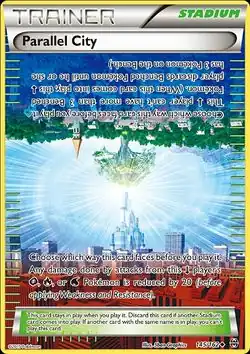
The BREAKthrough expansion introduced the Parallel Worlds narrative, which featured juxtaposing dimensions on the brink of coalescence. This arc would continue in the subsequent BREAKpoint and Fates Collide expansions, which collectively included three unconventional Stadium cards: Parallel City, Reverse Valley, and Chaos Tower. These cards all have two effects, but have unique templating where one effect is written upside down. This is because when playing these cards, the direction the card is being played in is specified. Each effect's text will only face one player, and only the effect facing a player is applied to that player and/or their Pokémon.
Parallel City has two negative effects. The other two cards have two positive effects.
The rule preventing players from playing a Stadium with the same name as the Stadium that is in play still applies to these cards, even if they are in an unfavorable direction.[2]
These cards have artwork spanning the entire card, with the text for one effect being paired with a section using cool colors and the text for the other effect being paired with a section using warm colors. The art is done such that the upside down portion of the text is accompanied by an upside down portion of artwork.
List of Stadium cards

|
The following is a dynamic list. Its subject matter requires frequent updates to remain current and complete. This list should typically be updated every month. The last time this page was edited was on July 19, 2025. |


References

|
This article is part of Project TCG, a Bulbapedia project that aims to report on every aspect of the Pokémon Trading Card Game. |