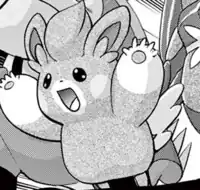
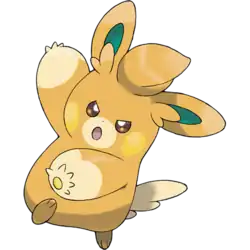
Pawmo is a stout, bipedal, rodent-like Pokémon. Compared to Pawmi and Pawmot, its fur is almost entirely light orange, with tan colorations on its forepaws, snout, and long, fluffy tail, and green on the insides of its ears. Its face has beady brown eyes, a tiny nose, and yellow electric sacs on its cheeks. It has tufts of fur on its forehead and near its ears. Pawmo has five fingers on its forelimbs which are considerably large, and stretches down to its tiny feet. Pawmo's forepaws contain yellow pads that turn teal-blue when releasing electricity. It uses these paw pads for its signature fighting technique, where it simultaneously strikes and zaps foes with its forepaws. Pawmo are known to travel in groups. When attacked, Pawmo will be the first to fight back, defeating foes with its electricity. As mentioned in Pokémon Sleep, Pawmo will sometimes maintain its characteristic battle stance while sleeping, possibly because it is dreaming of training its fighting moves.
Restores 5 Energy to each helper Pokémon on your team
Evolution requirements:
Pawmi Candy ×80, 9000 minutes of sleep logged with Pawmo
Pawmo uses a unique fighting technique in which it uses its forepaws to strike foes and zap them with electricity from its paw pads simultaneously. It sometimes sleeps in its characteristic battle stance-perhaps it's training its fighting moves in its dreams.
Pawmi and Pawmo are the only Pokémon with this category to not be introduced in Generation I, and the only ones whose evolutionary line has no Alolan forms.
Pawmo evolving into Pawmot by using the Let's Go! feature, which requires its Trainer to walk with it outside its Poké Ball, might allude to its design as an electric rodent (commonly known as a Pikachu clone), as a reference to how Ash's Pikachu is always outside his Poké Ball.
Name origin
Pawmo may be a combination of Pawmi, marmot, and dynamo.
Pamot may be a combination of パモ Pamo (Pawmi) and marmot.
This Pokémon article is part of Project Pokédex, a Bulbapedia project that aims to write comprehensive articles on each Pokémon species, as well as Pokémon groups and forms.
























 For other sprites and images, please see Pawmo images on the Bulbagarden Archives.