Generation I
| Generation I | |||||||||||||||||||||||||
|---|---|---|---|---|---|---|---|---|---|---|---|---|---|---|---|---|---|---|---|---|---|---|---|---|---|
| |||||||||||||||||||||||||
| |||||||||||||||||||||||||
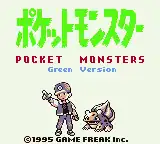
The first generation (Japanese: 第一世代 first generation; ポケットモンスター赤・緑シリーズ Pocket Monsters Red and Green Series) of Pokémon games, commonly referred to by fans as Generation I, is the initial set of Pokémon games released.
This generation released several core games, beginning with the Japanese games Pokémon Red and Green on February 27, 1996,[1] followed by Blue later that year.[2][3] Internationally, these three games were repackaged as Pokémon Red and Blue, which were released in North America on September 28, 1998.[4] The final Generation I core game released was the special edition Pokémon Yellow, which was released in Japan on September 12, 1998[5] and in North America on October 19, 1999.[6] These core games were all released for Nintendo's Game Boy handheld console.
Two battle arena side games were also released during Generation I: the Japan-only Pokémon Stadium, and its sequel, released internationally as Pokémon Stadium. These side games were released for the Nintendo 64 home console. Additionally, various spin-off Pokémon games were released during Generation I, including other handheld games (like Pokémon Trading Card Game, released for the Game Boy Color) and home console games (like Pokémon Snap, released for the Nintendo 64).
Terminology
The term "Generation I" is usually considered fan terminology. While official sources have used the term "generation" to refer to later groups of Pokémon games, they typically have not referred to generations with Roman numerals. However, the cast of POKÉMON Detective Pikachu uses the term in their commentary, and the associated subtitles use the Roman numeral "I," following the fan terminology convention.[citation needed]
The Japanese Pokémon website, pokemon.co.jp, uses the name 「ポケットモンスター赤・緑シリーズ」 (Pocket Monsters Red and Green Series) to refer to the core games Pokémon Red, Green, Blue, and Yellow, as well as the side games Stadium (Japanese) and Stadium (English).[7][8][9]
History
Origins
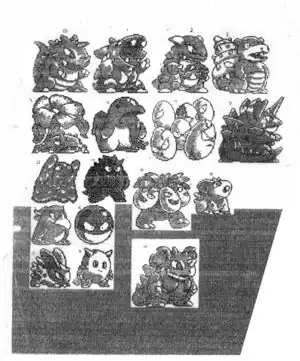
In 1990, Satoshi Tajiri pitched the idea for Capsule Monsters to Nintendo, with the help of Shigeru Miyamoto. The Capsule Monsters idea ultimately evolved to become the Generation I games, and the Pokémon franchise generally. The pitch for Capsule Monsters already included key mechanics that would appear in the final Generation I games, with many based on Tajiri's childhood interest in bug collecting. For example, in designing the trading system between two Game Boys, he imagined a caterpillar crawling across the Game Link Cable.
Initial releases
Nintendo, Game Freak, and Creatures, Inc. released the Generation I for the Game Boy in Japan in 1996, with the paired games Pokémon Red and Green in February[1] and the updated game Pokémon Blue later that year.[2][3] These games were released with the name "Pocket Monsters" due to issues with trademarking the Capsule Monsters name. Similar issues arose when localizing this generation's games into English. Because of issues using the Pocket Monsters name outside Japan (due to the unrelated, North American franchise Monster in My Pocket), the Generation I (and all subsquent games) have been released under the name "Pokémon" internationally.
Internationally, the Generation I games were released in September 1998.[4] However, the original three games were recombined and repackaged for the international release as Pokémon Red and Blue. The international versions use the version-exclusive wild Pokémon encounter lists from the Japanese Red and Green games, while both games use the slightly improved graphics from the Japanese Blue game.
After the animated series, Pokémon the Series, began airing (in Japan in 1997 and internationally in 1998), the Generation I games experienced major surges in popularity.[citation needed] The explosive popularity of the Generation I games firmly cemented the Pokémon franchise as a Nintendo mainstay, like the Super Mario and The Legend of Zelda franchises before it.
The final Generation I core games, Pokémon Yellow (formally known as "Pokémon Yellow Version: Special Pikachu Edition"), is based on Pokémon the Series. Released in Japan in September 1998[5] and internationally in October 1999,[6] the game made several changes from the original games. It features Pikachu as the player's first partner Pokémon (though the other Kanto starters are all obtainable without player-to-player trading), and it made a number of aesthetic, storyline, and location changes. Pokémon Yellow also made a number of gameplay changes, including introducing the mechanic that would become friendship exclusively for the partner Pikachu.
Two battle arena games were released in this generation, becoming the franchise's first side games. The first, Pokémon Stadium, was released in Japan in 1998;[10] this game, which was mostly incomplete (e.g., only allowing players to use 40 Pokémon), never got an international release. Its sequel Pokémon Stadium, known in Japan as "Pocket Monsters' Stadium 2," was released in April 1999 in Japan[11] and in February 2000 internationally.[12] This improved game features several special battle modes and a Gym Leader Castle, where players could take their fully-trained teams for matches against the Kanto Gym Leaders, Elite Four, and Champion. As with subsequent side games, Pokémon Stadium allows for direct connections to the core games, allowing players to transfer Pokémon from the Generation I core games.
Legacy
All Generation I core games have received remakes in later generations:
- Pokémon Red and Green/Blue were remade during Generation III as Pokémon FireRed and LeafGreen. These games were released in 2004 for the Game Boy Advance[13][14] and were the first remakes of any Pokémon game.
- Pokémon Yellow was remade during Generation VII as two paired games, Pokémon: Let's Go, Pikachu! and Let's Go, Eevee!. These games were released in 2018[15][16] as the first core series games on the Nintendo Switch. They also mark the first (and, as of Generation IX, only) time that a second set of core game remakes has been released from the same original generation.
Later Pokémon games have storylines that either connect to or follow up on the Kanto region storyline from the Generation I games. The Johto story in the Generation II games (and their Generation IV remakes) is a direct sequel to the Kanto story, taking place three years after the events of the Generation I games. The Hoenn story in the Generation III games takes place contemporaneously with the Kanto story, as revealed both in Generation III's games based in Hoenn (Pokémon Ruby and Sapphire) as well as its remake games based in Kanto.
Gameplay
Generation I introduced the "standard formula" of Pokémon games: The player character, from a small town in the region, gets a first partner Pokémon from a friendly, local authority figure and sets out on a Pokémon adventure, culminating in defeating a team of enemies, a Legendary Pokémon, the Elite Four, and the player's own rival. The Generation I games also introduced the early generation formula of game releases, namely a paired set of games (with different sets of available Pokémon), followed by a special follow-up game. However, this formula wasn't as standardized as it would be in subsequent generations, given the release of both Pokémon Blue and Pokémon Yellow following Pokémon Red and Green in Japan.
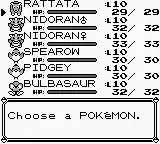
Key Pokémon gameplay elements and mechanics from the Generation I games include the following:
- A chooseable first partner Pokémon that is given to the player by Professor OakRGBRB
- Exception: While Professor Oak still gives the player their first partner Pokémon in Pokémon Yellow, only Pikachu is available.
- A region of multiple cities, routes, and natural environments, which can be traversed on foot, via bicycle, and using Pokémon moves
- Poké Balls of varying strengths that allow the player to catch wild Pokémon in certain locations, such as tall grass and caves
- A party of up to six Pokémon, which can be used in battle against opponent Pokémon Trainers or wild Pokémon
- A PC-based Pokémon Storage System for storing reserve Pokémon not in the party, with space for up to 12 boxes of 20 Pokémon each (240 Pokémon total)
- 151 species of Pokémon, with many related to each other by way of Evolution
- Most Pokémon that evolve do so by leveling up, though some require additional items or must be traded to evolve.
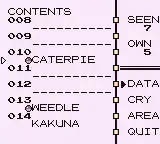
- A Pokédex that automatically registers information about caught and seen Pokémon
- A complex Pokémon battle system, with each Pokémon having the following:
- 5 stats—HP, Attack, Defense, Speed, and Special—which vary for different Pokémon, even those of the same species;
- 1 or 2 of the 15 Pokémon types, which affect the power and effectiveness of moves; and
- 4 of the 165 unique moves, which each have a separate type, accuracy, and base power.
- The Pokémon League challenge, with two main parts:
- Defeating the Gym Leaders of Kanto's eight Gyms, scattered across the region and each specializing in a different type; and
- The Elite Four and Pokémon Champion, awaiting challengers who have beaten the eight Gyms at Indigo Plateau.
- A linked trade and battle system between two Game Boy systems, allowing players to exchange Pokémon with one another or to battle against each other.
- Some Pokémon are only obtainable in one game version, and have to be traded to be obtained in the other version(s).
Many of these gameplay elements have persisted through later game generations, with some remaining nearly or even entirely unchanged across games. For example, while the number of types has grown to 18* (as of Generation IX), each Pokémon may still only have one or two types at a time.
Region
Kanto
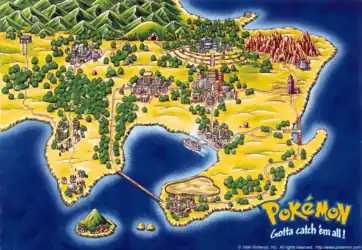
- Main article: Kanto
Generation I introduced the first region to the Pokémon series, which, though unnamed in the original English games, is named in Japanese as Kanto, after the region of Japan it is based on. The name has since passed into English, first being used in Super Smash Bros., and subsequently being noted in all games since.
First partner Pokémon
At the outset of the player's journey, he will have no Pokémon on hand, and venturing outside of Pallet Town is impossible, as Professor Oak will stop him and bring him back to his lab, where three Pokémon await both the player and his rival.
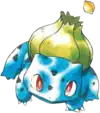
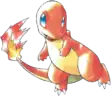
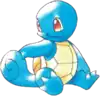
The first partner Pokémon of the Kanto region began the recurring three-type trio of Grass, Fire, and Water, with the player's choice being between Bulbasaur, Charmander, and Squirtle. Much as in later generations as well, the rival will choose whichever of the three has the type that is super effective against that of the player.
The choice of a first partner Pokémon can make the beginning few Gyms change in difficulty, but it does not affect much in the long run aside from the rival's party. Bulbasaur is known by many to be the easiest to start with, as its Grass-type weakens the first two Gyms and resists the attacks of the third. Squirtle is known as the second easiest, as Water types also weaken the first Gym; however, it can prove difficult mid-game if the player has not caught a Pokémon that can resist the later Gyms. Charmander is widely regarded as the hardest of the trio, as Fire-type moves do little damage against the first two Gyms' Pokémon, and there are few opportunities to capture a Pokémon that can counterbalance its weaknesses against the first several Gyms.
 Bulbasaur |
 Charmander |
 Squirtle | |||||
|---|---|---|---|---|---|---|---|
| Grass | Poison | Fire | Water | ||||

|
Ivysaur | 
|
Charmeleon | 
|
Wartortle | ||
| Grass | Poison | Fire | Water | ||||

|
Venusaur | 
|
Charizard | 
|
Blastoise | ||
| Grass | Poison | Fire | Flying | Water | |||
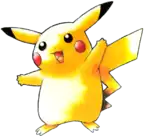
In Pokémon Yellow, instead of the normal trio found in Red, Green, and Blue, players can only start with the Electric-type Pikachu, which likewise has difficulty with the first Gym. The rival will take Oak's Eevee and evolve it into one of its three stone-based Evolutions depending on the results of the player's battles against him.
 Pikachu |
|---|
| Electric |
Gym Leaders
The eight Kanto Gym Leaders each specialize in a different type of Pokémon. Each gives the player a Badge and a TM after their defeat.
| Indigo League | |||||
|---|---|---|---|---|---|
| Gym Leader Japanese |
Location Japanese |
Type | Badge | ||
 Brock タケシ Takeshi |
Pewter City ニビシティ Nibi City |
Rock |  Boulder Badge | ||
 Misty カスミ Kasumi |
Cerulean City ハナダシティ Hanada City |
Water |  Cascade Badge | ||
 Lt. Surge マチス Matisse |
Vermilion City クチバシティ Kuchiba City |
Electric |  Thunder Badge | ||
 Erika エリカ Erika |
Celadon City タマムシシティ Tamamushi City |
Grass |  Rainbow Badge | ||
 Koga キョウ Kyou |
Fuchsia City セキチクシティ Sekichiku City |
Poison |  Soul Badge | ||
 Sabrina ナツメ Natsume |
Saffron City ヤマブキシティ Yamabuki City |
Psychic |  Marsh Badge | ||
 Blaine カツラ Katsura |
Cinnabar Island グレンじま Guren Island |
Fire |  Volcano Badge | ||
 Giovanni サカキ Sakaki |
Viridian City トキワシティ Tokiwa City |
Ground |  Earth Badge | ||
Comparison
Generation I can be considered the template for every generation since. Many mainstays of the main series games were introduced in Generation I.
Some aspects introduced in this generation are found in every generation since, unless otherwise stated:
- The choice between three first partner Pokémon that have Grass, Fire, and Water as their primary types.
- A Pokémon Professor named after a tree who gives the first partner Pokémon and a Pokédex to the player.
- A villainous team serving as the main antagonists of the game.
- A rival who starts their journey at the same time as the player, and is fought multiple times throughout the game. Some later games include more than one rival.
- The player challenges eight Gym Leaders, as well as the Elite Four and Pokémon Champion.
- This is not the case in Pokémon Sun and Moon, and Pokémon Ultra Sun and Ultra Moon, where Gym Leaders are replaced by the island challenge. There is also no current champion in these games, so the player battles Professor KukuiSM/HauUSUM instead.
- This is not the case in Pokémon Sword and Shield, where the Elite Four is replaced by the Champion Cup.
- The player is able to have six Pokémon with them at most, while additional Pokémon can be kept in the Pokémon Storage System.
- The ability to battle and trade between games.
- Evolution via leveling up, trade, and Evolution stones. Other Methods of Evolution were introduced in later generations.
- 151 species of Pokémon. Other species were introduced in later generations.
- 15 types. Other types were introduced in later generations.
- 165 moves. Other moves were introduced in later generations.
- A prototype of the friendship system was introduced in Pokémon Yellow, which only worked on the player's Pikachu (specifically, any Pikachu with the same Original Trainer and Trainer ID as the player in that game). In Generation II, the friendship system was expanded to cover all Pokémon.
Some aspects introduced in this generation have been revised since:
- In Generation I, the Bag had only 20 slots, and each item or stack of items occupied one slot. This forced the player to constantly store obsolete Key Items, TMs, and HMs in the Item Storage System in order to obtain new items. Later games would expand the Bag's storage space and provide additional Bag pockets to organize items. Starting in Generation IV, the Bag's storage is effectively limitless and can store all obtained items, obviating the need for the Item Storage System.
- In Generations I and II, the player was unable to capture any more Pokémon if the current box in the Pokémon Storage System was full. Starting in Generation III, the player could use Poké Balls while the current box was full. If a wild Pokémon was captured in this circumstance, the next box would become the current box, and the captured Pokémon would be sent there.
- In Generations I-IV, TMs are single-use while HMs can be used an unlimited number of times. Starting in Generation V, TMs have unlimited uses as well (outside of Pokémon Brilliant Diamond and Shining Pearl).
- In the Generation I, the HMs Cut, Surf, and Strength are required for completion of the games. They may also be used to access optional areas. All Generation II–VI games also require some HMs for completion. Starting in Generation VII, HMs are not present at all, being replaced by the Poké RideSMUSUM/Secret TechniquesPE. In Pokémon Sword and Shield, there is nothing akin to HMs, except for the Galar Flying Taxi, a service where a cab flown by a Corviknight can bring the player anywhere with an open roof. In Pokémon Brilliant Diamond and Shining Pearl, HMs can be accessed through the Pokétch.
- In Generations I-III, physical and special moves are determined by the move type. For instance, all Fire moves are special. Starting in Generation IV, physical and special moves are determined by the move itself, rather than their type.
- Special is a stat that existed only in this generation. In Generation II, Special was split into Special Attack and Special Defense.
Battle system flaws
The battle system of the original games had some game balance issues, mainly due to the limited variety of Pokémon type combinations and movesets. Additionally, the behavior of multiple mechanics was inconsistent with their implementations in later games. Issues and mechanics that were fixed or altered in either the Pokémon Stadium series or in Generation II are listed below.
Balancing issues
- Psychic-type Pokémon were strong because their moves were resisted only by other Psychic types and their only weakness was to the Bug type, of which there were only three damaging moves: Leech Life, Pin Missile, and Twineedle. Additionally, most of the Pokémon that learned these moves were part Poison and therefore weak to Psychic moves. Ghost-type moves, while meant to be super effective, were completely ineffective against Psychic types due to what may be a programming bug. Even if this were to be disregarded, the only supereffective Ghost-type move would be Lick, whose power was only 20 at the time, and the only Ghost-type Pokémon that existed at the time were also part Poison-type.
- Normal-type Pokémon were strong, as their only weakness was to the Fighting type. Most Fighting-type Pokémon couldn't learn many STAB moves other than Submission, which was inaccurate and dealt recoil damage, and they were difficult to use due to the presence of strong Psychic-type Pokémon. Normal-type Pokémon learn many moves of other types and could often use moves such as Earthquake or Blizzard to defeat Ghost-types and Rock-types that resisted their Normal-type moves.
- The only damaging Dragon-type move was the set-damage Dragon Rage. This meant that Dragon-type Pokémon could never take advantage of STAB, and that the only moves that could hit them with supereffective damage were Ice-type moves.
- The strongest Poison-type move was Sludge, which only had a base power of 65 and can only be learned by a few Poison-type Pokémon.
- The Special stat represented both Special Attack and Special Defense, giving Pokémon with a high Special stat an edge in battle. For example, Venusaur had a base Special stat of 100, used Grass-type (considered "Special") moves, and was weak to mostly Special types.
- Critical hit ratios were based on a Pokémon's base speed, allowing faster Pokémon to deal critical hits more frequently.
- One-hit knockout moves were also based on speed, making them useless if the user was slower than the target.
Battle glitches
- Main article: List of battle glitches in Generation I
- Leech Seed and Toxic used the same damage counter, allowing Leech Seed to drain twice as much damage when a Pokémon was affected by both at the same time.
- Focus Energy and Dire Hit divided the user's critical hit rate by 4 instead of multiplying it by 4.
- Using Agility or Swords Dance while paralyzed or burned, respectively, would negate the status impairments from those effects and then double the enhanced stat.
- If Hyper Beam knocked out a Pokémon or destroyed a substitute, the user would not need to recharge on the succeeding turn.
- Selfdestruct and Explosion did not make the user faint if they destroyed a Substitute.
- Although Rest removed status conditions, it would not alleviate the stat debuffs caused by a burn or paralysis.
- If a Bide user was hit with a status move before its attacking turn, the damage dealt would equal that of the last attack used against it.
- If a Pokémon's HP was 255 or 511 (or any number that leaves a remainder of 255 when divided by 256) points below its maximum, HP recovery moves like Recover and Softboiled would fail. This is because the game only checks the low byte of the 16-bit value.
- When a Pokémon was hit by a move that did not deal neutral damage, the message that displayed would reflect only the matchup against one of the target's types.
Mechanical issues
- Critical hits would ignore all stat changes, including increases to the attacking Pokémon's Attack or Special and decreases to the target's Defense or Special. This can result in a critical hit dealing less damage than an attack that does not land a critical hit.
- Counter could be used in response to Guillotine or Horn Drill to instantly defeat an enemy Pokémon, even if the move hit the user's Substitute.
- Moves lost their additional effect after they broke a substitute, preventing a Pokémon from fainting after using Explosion to break a substitute.
- With the exception of Swift, every attack had at least a 1/256 chance of missing.
- Wrap, Bind, Fire Spin, and Clamp immobilized the target for 2 to 5 turns as a side effect. If a Pokémon that used one of these moves switched out, the target would still be considered trapped during that turn.
- Struggle was programmed with Normal-type offensive properties instead of being programmed to ignore type matchups, making it ineffective against Ghost types.
- Waking up from sleep took a full turn.
- Using Substitute while having 25% or less of one's maximum HP left would cause the user to faint.
- As soon as Rage connected, the user would become unable to use any other move until it fainted. Subsequent uses of Rage would not consume PP, and if the user misses a subsequent Rage due to accuracy reduction or the target's increased evasion, the move's accuracy would become 1/256.
- Multistrike moves dealt the same amount of damage for each hit in a turn, meaning that if the first hit was a critical hit, the other hits would be critical hits as well.
- In-game opponents had infinite PP, meaning they could use moves without limit.
- In-game opponents with certain AI patterns will always use moves typed to be super effective against the target, even when those moves do not deal damage directly.
Kanto thematic motif
The first generation of Pokémon games dealt with genetics and engineering. Several Pokémon in this generation revolve around this theme: Eevee is capable of evolving into multiple forms due to its unstable DNA; Voltorb is the result of a Poké Ball experiment gone awry; and Porygon is a virtual reality Pokémon. These games also introduce three Fossils which can be resurrected into prehistoric Pokémon: Aerodactyl, Kabuto, and Omanyte. Finally, out of the four legendaries that appeared, the most powerful was man-made through genetic engineering: Mewtwo. The uncatchable Mythical Pokémon, Mew, also has the DNA of every Pokémon in existence.
Bill himself invented the sophisticated PC used in most regions and accidentally turned himself into a Pokémon. Ditto could also mimic the abilities and structure of any Pokémon it encountered, making it capable of breeding with most Pokémon from Generation II onwards. The Master Ball is the most powerful Poké Ball in the franchise, and was first engineered by Kanto scientists. With this generation being the very foundation of the Pokémon franchise, most successors have only expanded upon Kanto's basics.
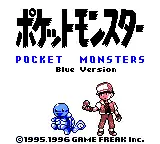
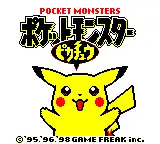
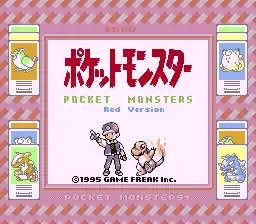
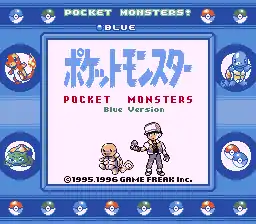
Title screens

|
The picture used in this section is unsatisfactory. Please feel free to replace it so it conforms to Bulbapedia conventions. Reason: Replace with APNGs if and when appropriate |
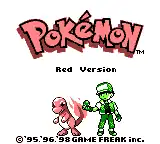
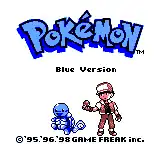
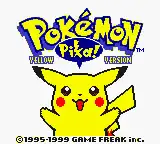
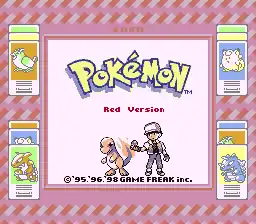
When played on the Super Game Boy, Super Game Boy 2, Game Boy Tower, Game Boy Color, Game Boy Advance, or Game Boy Player, the games use predefined color palettes based on the game version instead of displaying in monochrome.
On the Nintendo 3DS Virtual Console releases of the Western versions of Pokémon Yellow, Game Boy Color mode is enforced.
English title screens
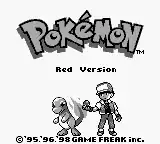
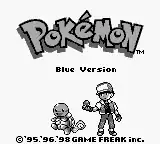
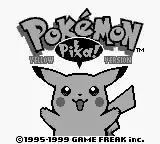
Game Boy, Game Boy Color, Game Boy Advance, and Game Boy Player
| Pokémon Red Game Boy |
Pokémon Blue Game Boy |
Pokémon Yellow Game Boy |
|
|
|
| Pokémon Red Game Boy Color, Game Boy Advance, Game Boy Player |
Pokémon Blue Game Boy Color, Game Boy Advance, Game Boy Player |
Pokémon Yellow Game Boy Color, Game Boy Advance, Game Boy Player |
|
|
|
Super Game Boy, Super Game Boy 2, and Game Boy Tower
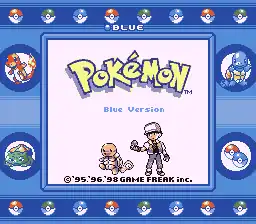
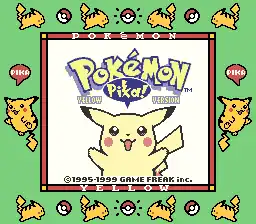
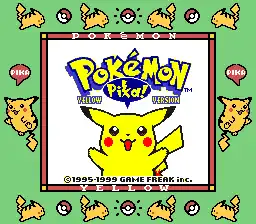
| Pokémon Red | Pokémon Blue | Pokémon Yellow Super Game Boy & Super Game Boy 2 |
Pokémon Yellow Game Boy Tower |
|
|
|
|
Japanese title screens
Game Boy, Game Boy Color, Game Boy Advance, and Game Boy Player
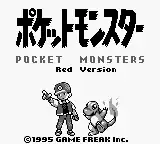
| Pocket Monsters Red Game Boy |
Pocket Monsters Green Game Boy |
Pocket Monsters Blue Game Boy |
Pocket Monsters Pikachu Game Boy |
|

|
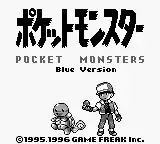
|
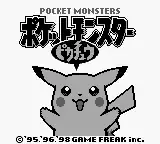
|
| Pocket Monsters Red Game Boy Color, Game Boy Advance, Game Boy Player |
Pocket Monsters Green Game Boy Color, Game Boy Advance, Game Boy Player |
Pocket Monsters Blue Game Boy Color, Game Boy Advance, Game Boy Player |
Pocket Monsters Pikachu Game Boy Color, Game Boy Advance, Game Boy Player |
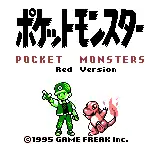
|
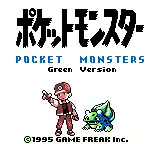
|
|
|
Super Game Boy, Super Game Boy 2, and Game Boy Tower
| Pocket Monsters Red | Pocket Monsters Green | Pocket Monsters Blue | Pocket Monsters Pikachu |
|

|
|

|
Trivia
- Of all the generations, Generation I introduced the most moves to the core series, with 165. It is also the only generation in which the total number of moves is greater than the total number of Pokémon.
- Alongside Generations II and V, Generation I is one of the shortest generations in the West and is currently the shortest.
- Prior to Generation VI, Generation I had the most extra space in the Pokémon Storage System if the player captures one of each Pokémon, with 240 spots available for 151 Pokémon, therefore leaving 89 extra spots.
- Prior to Generation VIII, Generation I was the only generation not to feature the paired versions' mascots on the title screens, but instead included the first evolutionary stages of two first partner Pokémon.
- Generation I is the only generation in which:
- There is no female player character.
- None of the game mascots are Legendary Pokémon.
- Pokémon by index number order are in order of creation instead of by Pokédex number. The last Generation I Pokémon to be created, Mew, was instead placed in the first slot that was dummied out prior to release.
- Water was not the most common type, as a plurality of Pokémon are Poison-type.
- The Japanese releases of the Generation I games mark the only generation where two solitary core titles were released (Pokémon Blue and Pokémon Yellow).
- Generation I is the only generation to have multiple pairs of remakes of its core series games.
Character names
- Red, Blue, Daisy, Baoba, and Reina were introduced as unnamed characters in this generation.
- Red, Blue, and Daisy had their names introduced in Generation II. Daisy was previously named May in The Electric Tale of Pikachu manga before she received her definitive name in the games.
- Baoba had his name introduced in Generation IV.
- Reina remained unnamed in the games, but was named in Pokémon Origins.
- The members of the Team Rocket were simply referred to as "Rocket", with no mention of the word "Grunt" in this generation.
- In Generation II, the designation "Rocket Grunt" was introduced. In Generation III, this was expanded to "Team Rocket Grunt".
- Jessie and James appear as unnamed characters in Pokémon Yellow, although their names were already known from Pokémon the Series: The Beginning.
- In the core series, Jessie and James were first named in Pokémon: Let's Go, Pikachu! and Let's Go, Eevee!.
- In this generation, the individuals from each Trainer class such as Youngster, Lass, etc. are not named.
- In the Japanese games of this generation, there is a shorter name for most Trainer classes that is seen when the respective Trainer is defeated in battle. For instance, the Youngster (たんパンこぞう Shorts Youngster) and Lass (ミニスカート Miniskirt) are abbreviated as たんパン Shorts and ミニスカ Miniski, respectively.
References
- ↑ 1.0 1.1 ポケットモンスター 赤・緑 - Pokemon.co.jp
- ↑ 2.0 2.1 ポケットモンスター 青 - Pokemon.co.jp
- ↑ 3.0 3.1 Translation: Forgotten Story of Pokemon Blue’s Release - LavaCutContent.com
- ↑ 4.0 4.1 Pokémon Red Version and Pokémon Blue Version - Pokemon.com
- ↑ 5.0 5.1 ポケットモンスター ピカチュウ - Pokemon.co.jp
- ↑ 6.0 6.1 Pokémon Yellow Special Pikachu Edition - Pokemon.com
- ↑ Pocket Monsters Red and Green Series - Pokemon.co.jp
- ↑ Games - Pokemon.co.jp
- ↑ Game List - Pokemon.co.jp
- ↑ ポケモンスタジアム - Pokemon.co.jp
- ↑ ポケモンスタジアム2 - Pokemon.co.jp
- ↑ Pokémon Stadium - Pokemon.com
- ↑ ポケットモンスター ファイアレッド・リーフグリーン - Pokemon.co.jp
- ↑ Pokémon FireRed Version and Pokémon LeafGreen Version - Pokemon.com
- ↑ 『ポケットモンスター」シリーズがNintendoSwitch™に初登場! - Pokemon.co.jp
- ↑ Pokémon: Let’s Go, Pikachu! and Pokémon: Let’s Go, Eevee! - Pokemon.com
Related articles
Core series • Side series • Spin-off series • Standalone spin-offs • Pokémon mini • Betas • Demos

|
This game-related article is part of Project Games, a Bulbapedia project that aims to write comprehensive articles on the Pokémon games. |