Pacific Coast tick fever
| Pacific Coast tick fever | |
|---|---|
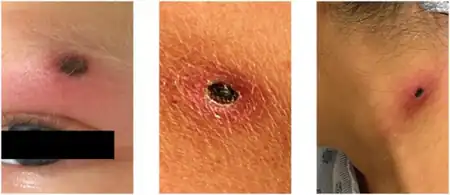 | |
| Eschars identified on the eyebrow, shoulder, and neck of laboratory-confirmed Pacific Coast tick fever individual(s) | |
 | |
| Causes | Rickettsia philipii spread by the Pacific coast tick[1] |
| Differential diagnosis | Rickettsia parkeri rickettsiosis, Rocky Mountain spotted fever, rickettsialpox[2] |
| Pacific Coast tick fever | |
|---|---|
Scientific classification 
| |
| Domain: | Bacteria |
| Kingdom: | Pseudomonadati |
| Phylum: | Pseudomonadota |
| Class: | Alphaproteobacteria |
| Subclass: | "Rickettsidae" |
| Order: | Rickettsiales |
| Family: | Rickettsiaceae |
| Genus: | Rickettsia |
| Species group: | Spotted fever group |
| Species: | R. philipii
|
| Binomial name | |
| Rickettsia philipii Kato et al. 2010[3]
| |
Pacific Coast tick fever is an infection caused by Rickettsia philipii.[1]
The disease is spread by the Pacific coast ticks.[1]
Symptoms may include an eschar.[1] It is within a group known as spotted fever rickettsiosis together with Rickettsia parkeri rickettsiosis, Rocky Mountain spotted fever, and rickettsialpox.[2] These infections can be difficult to tell apart.[2]
References
- ↑ 1.0 1.1 1.2 1.3 "Spotted Fever Group Rickettsia (Rocky Mountain Spotted Fever and Pacific Coast Tick Fever)". www.cdph.ca.gov. Archived from the original on 27 September 2022. Retrieved 20 January 2019. Archived 27 September 2022 at the Wayback Machine
- ↑ 2.0 2.1 2.2 "Epidemiology and Statistics Rocky Mountain Spotted Fever (RMSF)". CDC. 26 October 2018. Archived from the original on 9 January 2019. Retrieved 19 January 2019. Archived 9 January 2019 at the Wayback Machine
- ↑ Kato, C.Y., Robinson, L.K., White, F.H., Slater, K., Karpathy, S.E., Eremeeva, M.E. and Dasch, G.A. "Insertion/deletion (INDEL) typing of isolates of Rickettsia rickettsii." Georgia Research Alliance Collaboration Roundtable. February 26, 2010. Poster Abstracts no. 10. pp. 5-6