Brill–Zinsser disease

Brill–Zinsser disease
Other names: Recrudescent typhus[1]
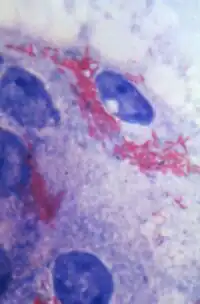
Image reveals the presence of Rickettsia prowazekii bacteria in a yolk sac smear specimen
SpecialtyInfectious disease

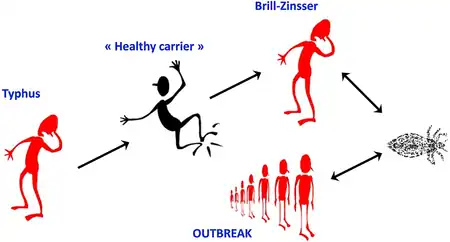
Brill–Zinsser disease is a delayed relapse of epidemic typhus, caused by Rickettsia prowazekii. After a patient contracts epidemic typhus from the fecal matter of an infected louse (Pediculus humanus), the rickettsia can remain latent and reactivate months or years later, with symptoms similar to or even identical to the original attack of typhus, including a maculopapular rash.[2] At such times, typhus can be transmitted to other individuals through fecal matter of the louse vector, and generate a new epidemic of the disease.

Body lice as cause of typhus reemergence[3]

See also

References

  1. "Brill-Zinsser disease (Concept Id: C0006181) - MedGen - NCBI". www.ncbi.nlm.nih.gov. Archived from the original on 4 February 2025. Retrieved 5 July 2025.
  2. Rapini, Ronald P.; Bolognia, Jean L.; Jorizzo, Joseph L. (2007). Dermatology: 2-Volume Set. St. Louis: Mosby. p. 1130. ISBN 1-4160-2999-0.
  3. Sekeyová, Zuzana; Danchenko, Monika; Filipčík, Peter; Fournier, Pierre Edouard (29 August 2019). "Rickettsial infections of the central nervous system". PLOS Neglected Tropical Diseases. 13 (8): e0007469. doi:10.1371/journal.pntd.0007469. ISSN 1935-2735.{{cite journal}}: CS1 maint: unflagged free DOI (link)

External links

Classification