Far East scarlet-like fever
| Far East scarlet-like fever | |
|---|---|
| Other names: FESLF[1],Scarlatinoid fever | |
  | |
| |
 | |
| Specialty | Infectious disease |
| Symptoms | Fever,rash[2] |
| Complications | Reactive arthritis, erythema nodosum, iritis[2] |
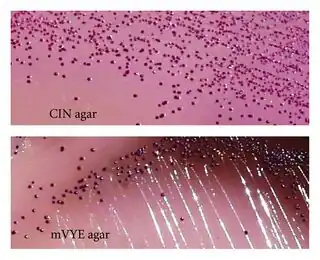
| Causes | Yersinia pseudotuberculosis[2] |
| Diagnostic method | Blood or stool cultures and serological tests[2] |
| Differential diagnosis | Scarlet fever[2] Toxic shock syndrome Pancreatitis Inflammatory bowel disease |
| Treatment | Doxycycline[2] |
| Frequency | Sporadic(Rusia,Japan)[3] |
Far East scarlet-like fever is an infectious disease caused by the gram negative bacillus Yersinia pseudotuberculosis. In Japan it is called Izumi fever.[4][5]
The disease is primarily transmitted through the consumption of contaminated food(vegetables). It is important to note that this disease is different from scarlet fever, which is caused by Streptococcus pyogenes.[2][6]
Treatment of this disease, we find that ampicillin, ceftriaxone, and doxycycline[2]
Signs and symptoms
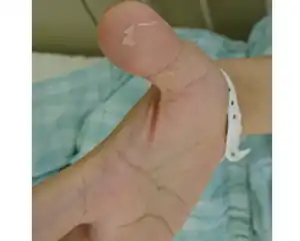
Among the symptoms demonstrated are the following which include[8][9]
- Red skin rash of face, elbows, and knees
- Skin desquamation
- Exanthema
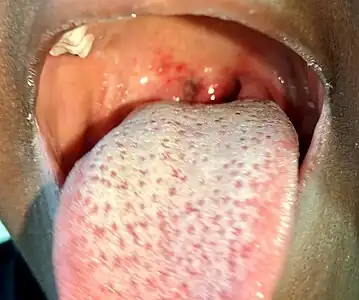
- Red tongue
Complications
In terms of complications we find the affected individual may have:[2]
- Intestinal obstruction
- Septic arthritis
- Uveitis
- Acute tubulointerstitial nephritis
- Severe GI bleeding
- Intestinal abscess
Cause
The cause of this disease is Yersinia pseudotuberculosis serotype O1. A very high percentage of Far East scarlet-like fever infections are subtype O1b.[10][6]
Yersinia pseudotuberculosis has been divided into 6 genetic groups: group 1 has only been isolated from the Far East.[11]
Molecular mechanism
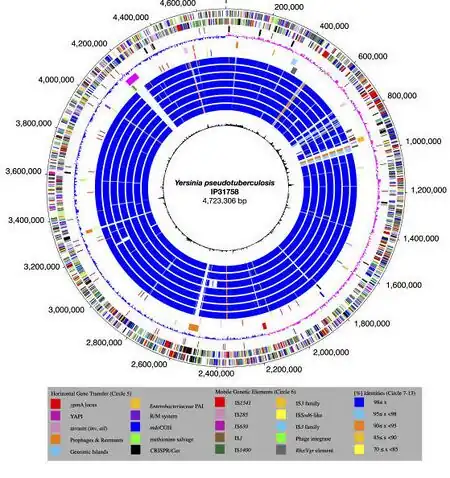
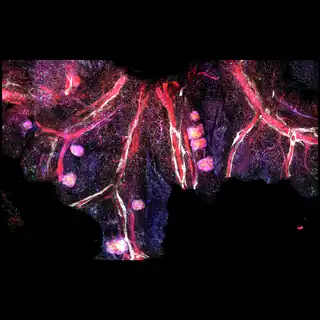
Y. pseudotuberculosis has a single circular chromosome and carries two plasmids. The chromosome size is 4.7 Mb, and the plasmids are 59 kb and 153 kb.It harbors a 70-kb virulence plasmid called pYV, which encodes a type III secretion system important for its pathogenicity.Several strains of Y. pseudotuberculosis have been sequenced, including IP2666pIB1, IP31758, and MD672. [13][14][15]
The clinical features of this disease appear to be due—at least in part—to the production of a superantigen—YpM (Yersinia pseudotuberculosis-derived mitogen). This is present in almost all strains from the Far East but only 20% of European isolates.[16]
The antigen was discovered in 1993 and is encoded by a 456-base gene. The protein has 151 amino acids, with a signal sequence of 20 amino acids.[17]
The mitogenic antigens are scattered across the protein but two cysteine residues (residues 32 and 129) which form a disulfide bridge are critical.[3]
The G+C content of this gene is 35%—lower than the genomic average (47%) suggesting that this gene has been acquired from some other organism.[16]
The organism from which this gene originated has not yet been identified. This gene seems likely to have been introduced into the genome by a bacteriophage, given the nearby presence of a phage integration site, but the mechanism of entry into the genome is not currently known.[12][3]
Diagnosis
In terms of the diagnosis of East scarlet-like fever, we find evaluation is on basis on the following:[18][2]
- Blood
- Stool
- Other organ-based biopsy
Differential diagnosis
In terms of the differential diagnosis we find the following:[19][2]
- Toxic shock syndrome
- Inflammatory bowel disease
Treatment
In terms of the treatment of Far East scarlet-like fever this disease is managed via:[2]
- Ampicillin
- Ceftriaxone
- Doxycycline
- Gentamycin
Prognosis
We find that most cases are mild and self-limited; however in those who are immunocompromised or have chronic liver disease, the prognosis can be very poor.[2]
Epidemiology
_-_Primorsky_Krai.svg.png)
In terms of the epidemiology we find that Yersinia pseudotuberculosis infection occurs worldwide and cases happen more in winter time.[2]
Y. pseudotuberculosis outbreaks have happened in Russian Far East, and Japan; while only sporadically in Europe.[2]The disease is often seen in clusters within specific geographic regions with higher incidences in areas like the Russian Far East, with lower case numbers reported in central Russia and other regions with milder climates[3][2]
History
The first outbreak of this disease was reported from the Pacific coastal areas (Primorsky Krai) of Russia in the 1950s.[6]
The disease was first described in 1959 during an outbreak in Vladivostok, Russia [6]
References
- ↑ "Far-East scarlet-like fever (Concept Id: C0277513) - MedGen - NCBI". www.ncbi.nlm.nih.gov. Archived from the original on 4 February 2025. Retrieved 14 February 2025.
- ↑ 2.00 2.01 2.02 2.03 2.04 2.05 2.06 2.07 2.08 2.09 2.10 2.11 2.12 2.13 2.14 2.15 Brady, Mark F.; Yarrarapu, Siva Naga S.; Anjum, Fatima (2025). "Yersinia Pseudotuberculosis". StatPearls. StatPearls Publishing. Archived from the original on 2022-06-15. Retrieved 2025-02-14.
- ↑ 3.0 3.1 3.2 3.3 Amphlett, A. (17 December 2015). "Far East Scarlet-Like Fever: A Review of the Epidemiology, Symptomatology, and Role of Superantigenic Toxin: Yersinia pseudotuberculosis-Derived Mitogen A". Open Forum Infectious Diseases. 3 (1). doi:10.1093/ofid/ofv202. ISSN 2328-8957. PMC 4728291.
- ↑ Sato K, Ouchi K, Taki M (1983) Yersinia pseudotuberculosis infection in children, resembling Izumi fever and Kawasaki syndrome. Pediatr Infect Dis 2: 123–126
- ↑ "Yersinia enterocolitica and Yersinia pseudotuberculosis Infections (Enteritis and Other Illnesses)". Red Book: 2024–2027 Report of the Committee on Infectious Diseases. American Academy of Pediatrics345 Park Blvd, Itasca, IL 60143. 2024-04-25. pp. 960–963. doi:10.1542/9781610027373-s3_023_001. ISBN 978-1-61002-737-3.
- ↑ 6.0 6.1 6.2 6.3 Timchenko, Nelly F.; Adgamov, Ruslan R.; Popov, Alexander F.; Psareva, Ekaterina K.; Sobyanin, Konstantin A.; Gintsburg, Alexander L.; Ermolaeva, Svetlana A. (March 2016). "Far East Scarlet-Like Fever Caused by a Few Related Genotypes of Yersinia pseudotuberculosis , Russia". Emerging Infectious Diseases. 22 (3): 503–506. doi:10.3201/eid2203.150552. Archived from the original on 12 February 2025. Retrieved 25 February 2025.
- ↑ Hashimoto, Takehiro; Takenaka, Ryuichi; Fukuda, Haruka; Hashinaga, Kazuhiko; Nureki, Shin-ichi; Hayashidani, Hideki; Sakamoto, Teruo; Shigemitsu, Osamu (7 January 2021). "Septic shock due to Yersinia pseudotuberculosis infection in an adult immunocompetent patient: a case report and literature review". BMC Infectious Diseases. 21 (1): 36. doi:10.1186/s12879-020-05733-w. ISSN 1471-2334.
- ↑ Zalmover IIu, Znamenskiĭ VA, Ignatovich VO, Vishniakov AK, Serov GD (1969) Clinical aspects of Far Eastern scarlatina-like fever. Voen Med Zh 1:47–51
- ↑ Solozhenkin VG (1978) Scarlet fever-like disease in children. Pediatriia (1):27–28
- ↑ Kenyon, Johanna J.; Cunneen, Monica M.; Reeves, Peter R. (1 March 2017). "Genetics and evolution of Yersinia pseudotuberculosis O-specific polysaccharides: a novel pattern of O-antigen diversity". FEMS Microbiology Reviews. 41 (2): 200–217. doi:10.1093/femsre/fux002. ISSN 1574-6976. PMID 28364730. Archived from the original on 2 February 2025. Retrieved 26 February 2025.
- ↑ Fukushima H Matsuda Y, Seki R, Tsubokura M, Takeda N, Shubin FN, Paik IK, Zheng XB (2001) Geographical heterogeneity between Far Eastern and Western countries in prevalence of the virulence plasmid, the superantigen Yersinia pseudotuberculosis-derived mitogen, and the high-pathogenicity island among Yersinia pseudotuberculosis strains. J Clin Microbiol 39:3541–3547
- ↑ 12.0 12.1 Eppinger, Mark; Rosovitz, M. J.; Fricke, Wolfgang Florian; Rasko, David A.; Kokorina, Galina; Fayolle, Corinne; Lindler, Luther E.; Carniel, Elisabeth; Ravel, Jacques (August 2007). "The complete genome sequence of Yersinia pseudotuberculosis IP31758, the causative agent of Far East scarlet-like fever". PLoS genetics. 3 (8): e142. doi:10.1371/journal.pgen.0030142. ISSN 1553-7404. Archived from the original on 2025-03-06. Retrieved 2025-03-20.
{{cite journal}}: CS1 maint: unflagged free DOI (link) - ↑ Zoubeidi, Adam; Schwiesow, Leah; Auerbuch, Victoria; Lam, Hanh N. (14 February 2019). "Complete Genome Assembly of Yersinia pseudotuberculosis IP2666pIB1". Microbiology Resource Announcements. 8 (7): 10.1128/mra.01592–18. doi:10.1128/mra.01592-18. Retrieved 17 February 2025.
- ↑ "KEGG GENOME: Yersinia pseudotuberculosis MD67". www.genome.jp. Archived from the original on 22 September 2022. Retrieved 17 February 2025.
- ↑ "KEGG GENOME: Yersinia pseudotuberculosis IP 31758 (serotype O:1b)". www.genome.jp.
- ↑ 16.0 16.1 Yoshino K, Ramamurthy T, Nair GB, Fukushima H, Ohtomo Y, Takeda N, Kaneko S, Takeda T (1995) Geographical heterogeneity between Far East and Europe in prevalence of the ypm gene encoding the novel superantigen among Yersinia pseudotuberculosis strains. J Clin Microbiol 33(12) 3356–3358
- ↑ Carniel, Elisabeth; Autenrieth, Ingo; Cornelis, Guy; Fukushima, Hiroshi; Guinet, Francoise; Isberg, Ralph; Pham, Jeannette; Prentice, Michael; Simonet, Michel; Skurnik, Mikael; Wauters, Georges (2006). "Y. enterocolitica and Y. pseudotuberculosis". The Prokaryotes: A Handbook on the Biology of Bacteria Volume 6: Proteobacteria: Gamma Subclass. Springer: 270–398. doi:10.1007/0-387-30746-x_13. ISBN 978-0-387-25496-8.
- ↑ Somova, Larisa M.; Antonenko, Fedor F.; Timchenko, Nelly F.; Lyapun, Irina N. (2 June 2020). "Far Eastern Scarlet-Like Fever is a Special Clinical and Epidemic Manifestation of Yersinia pseudotuberculosis Infection in Russia". Pathogens. 9 (6): 436. doi:10.3390/pathogens9060436. ISSN 2076-0817. PMC 7350351.
- ↑ Antonov VS (1978) Differential diagnosis of scarlet fever-like forms of pseudotuberculosis and scarlet fever in children. Pediatriia 52(1):6–9