Severe fever with thrombocytopenia syndrome
| Severe fever with thrombocytopenia syndrome | |
|---|---|
| Other names: SFTS virus infection[1] | |
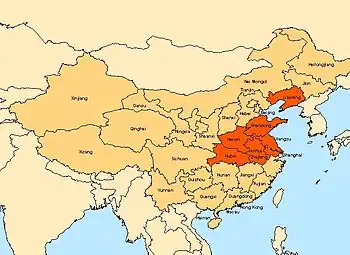 | |
| SFTS isolated in Central and Northeast provinces of China (red) | |
 | |
| Specialty | Infectious disease |
Severe fever with thrombocytopenia syndrome (SFTS) is a tick-borne infection.[2] Symptoms may include fever, vomiting, diarrhea, bleeding, and loss of consciousness.[2] Complications may include multiple organ failure, low platelets, low white blood cells, and elevated liver enzymes.
It is caused by Dabie bandavirus, also known as the SFTS virus.
Death occurs in 12% to 30% of cases.
SFTS was first reported between late March and mid-July 2009 in rural areas of Hubei and Henan provinces in Central China.[3]
Signs and symptoms
The presentation are:[4]
Virology
SFTS virus (SFTSV) is a virus in the order Bunyavirales. Person-to-person transmission was not noted in early reports[3] but has since been documented.[5]
The life cycle of the SFTSV most likely involves arthropod vectors and animal hosts. Humans appear to be largely accidental hosts. SFTSV has been detected in Haemaphysalis longicornis ticks.
Mechanism
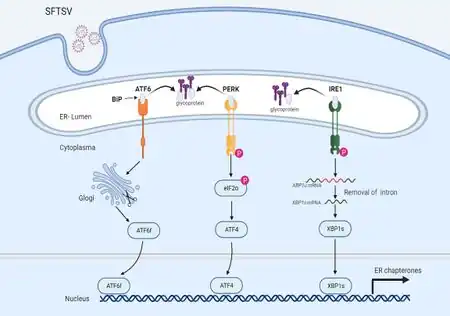
The pathophysiology of Severe fever with thrombocytopenia syndrome is not understood well. However it seems to be linked to:[4]
- High viral load
- Inflammatory responses (interleukin 1 receptor antagonist (IL-1RA), IL-6, IL-10, the granulocyte colony stimulating factor)
Diagnosis
In terms of the diagnosis Severe fever with thrombocytopenia syndrome can be evaluated via:[4]
Differential
Other conditions that may appear similar include:[4]
- Hemorrhagic fever with renal syndrome
- Dengue
- Thrombocytopenic purpura
- Leptospirosis
- Lyme disease
- Human granulocytic anaplasmosis
Treatment
There is no specific treatment; however hydration, transfusion, and administration of antipyretics may help.[4]
Epidemiology
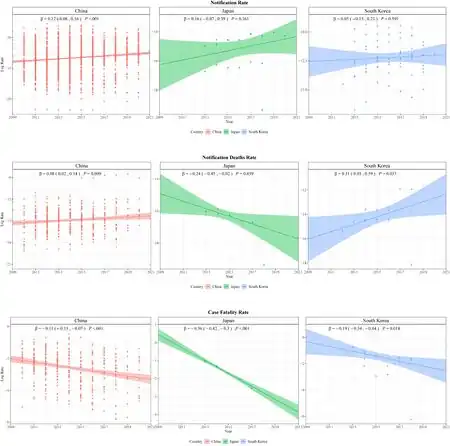
SFTS occurs in China's rural areas from March to November with the majority of cases from April to July. In 2013, Japan and Korea also reported several cases with deaths.[8]
In July 2013, South Korea reported a total of eight deaths since August 2012.[9]
In July 2017, Japanese doctors reported that a woman had died of SFTS after being bitten by a cat that may have itself infected by a tick. The woman had no visible tick bites, leading doctors to believe that the cat — which died as well — was the transmission vector.[10][11]
In early 2020 an outbreak occurred in East China, more than 37 people were found with SFTS in Jiangsu province, while 23 more were found infected in Anhui province in August 2020.[12] Seven people have died.[13]
History
In 2009 Xue-jie Yu and colleagues isolated the SFTS virus (SFTSV) from SFTS patients’ blood.
The virus originated 50–150 years ago and has undergone a recent population expansion.[14]
See also
References
- ↑ "Severe fever with thrombocytopenia syndrome (Concept Id: C4284413) - MedGen - NCBI". concept id. Retrieved 8 November 2025.
- ↑ 2.0 2.1 Saijo, Masayuki (2019). "1. Introduction". In Saijo, Masayuki (ed.). Severe Fever with Thrombocytopenia Syndrome. Singapore: Springer. pp. 1–14. ISBN 978-981-13-9561-1. Archived from the original on 2023-07-02. Retrieved 2023-01-17.
- ↑ 3.0 3.1 Yu, Xue-Jie; Liang, Mi-Fang; Zhang, Shou-Yin; Liu, Yan; Li, Jian-Dong; Sun, Yu-Lan; Zhang, Lihong; Zhang, Quan-Fu; Popov, Vsevolod L.; Li, Chuan; Qu, Jing (2011-04-21). "Fever with Thrombocytopenia Associated with a Novel Bunyavirus in China". New England Journal of Medicine. 364 (16): 1523–1532. doi:10.1056/NEJMoa1010095. ISSN 0028-4793. PMC 3113718. PMID 21410387.
- ↑ 4.0 4.1 4.2 4.3 4.4 Seo, JW; Kim, D; Yun, N; Kim, DM (23 June 2021). "Clinical Update of Severe Fever with Thrombocytopenia Syndrome". Viruses. 13 (7). doi:10.3390/v13071213. PMID 34201811. Archived from the original on 2 July 2023. Retrieved 17 May 2023.
{{cite journal}}: CS1 maint: unflagged free DOI (link) - ↑ Liu, Yan; Li, Qun; Hu, Wanfu; Wu, Jiabin; Wang, Yubi; Mei, Ling; Walker, David H.; Ren, Jun; Wang, Yu (February 2012). "Person-to-person transmission of severe fever with thrombocytopenia syndrome virus". Vector Borne and Zoonotic Diseases (Larchmont, N.Y.). 12 (2): 156–160. doi:10.1089/vbz.2011.0758. ISSN 1557-7759. PMID 21955213. Archived from the original on 2023-06-30. Retrieved 2023-01-17.
- ↑ Zhou, Chuan-Min; Yu, Xue-Jie (2021). "Unraveling the Underlying Interaction Mechanism Between Dabie bandavirus and Innate Immune Response". Frontiers in Immunology. 12: 676861. doi:10.3389/fimmu.2021.676861. ISSN 1664-3224.
{{cite journal}}: CS1 maint: unflagged free DOI (link) - ↑ Cui, Haoliang; Shen, Shijing; Chen, Lin; Fan, Zhiyu; Wen, Qian; Xing, Yiwen; Wang, Zekun; Zhang, Jianyi; Chen, Jingyuan; La, Bin; Fang, Yujie; Yang, Zeping; Yang, Shuhan; Yan, Xiangyu; Pei, Shaojun; Li, Tao; Cui, Xiaoming; Jia, Zhongwei; Cao, Wuchun (1 July 2024). "Global epidemiology of severe fever with thrombocytopenia syndrome virus in human and animals: a systematic review and meta-analysis". The Lancet Regional Health – Western Pacific. 48. doi:10.1016/j.lanwpc.2024.101133. ISSN 2666-6065.
- ↑ "Promed Post". Archived from the original on 2020-02-05. Retrieved 2023-01-17.
- ↑ "S. Korea says death toll from tick-borne virus rises to 8 | YONHAP NE…". Archived from the original on 2013-07-05.
- ↑ "Japanese woman dies from tick disease after cat bite". BBC News. 2017-07-25. Archived from the original on 2017-07-25. Retrieved 2017-07-25.
- ↑ "Japanese woman died from tick-borne illness after cat bite, health ministry says". Japan Times. 2017-07-25. Archived from the original on 2017-07-25. Retrieved 2017-07-25.
- ↑ Explained: What is the new tick-borne virus spreading across China? Archived 2022-05-23 at the Wayback Machine 15 August 2020 indianexpress.com, accessed 24 October 2020
- ↑ Seven dead, 60 infected by new infectious disease in China: Report Archived 2022-08-21 at the Wayback Machine 7 August 2020 indianexpress.com, accessed 24 October 2020
- ↑ Lam, Tommy Tsan-Yuk; Liu, Wei; Bowden, Thomas A.; Cui, Ning; Zhuang, Lu; Liu, Kun; Zhang, Yao-Yun; Cao, Wu-Chun; Pybus, Oliver G. (March 2013). "Evolutionary and molecular analysis of the emergent severe fever with thrombocytopenia syndrome virus". Epidemics. 5 (1): 1–10. doi:10.1016/j.epidem.2012.09.002. PMC 4330987. PMID 23438426.
External links
| Classification |
|---|