Pokémon Trading Card Game
- This article is about the Trading Card Game itself. For the Game Boy Color game, see Pokémon Trading Card Game (video game).

The Pokémon Trading Card Game (Japanese: ポケモンカードゲーム, Pokémon Card Game), often abbreviated as Pokémon TCG or just PTCG (Japanese: ポケカ Pokéca), is a tabletop game developed by Creatures, Inc. that involves collecting, trading and playing with Pokémon-themed playing cards. It has its own set of rules but uses many motifs and ideas derived from the video games. There are Pokémon cards for every species of Pokémon, as well as Trainer cards featuring characters, items and other themes of the franchise (each with a different use) and Energy cards to power attacks. The artwork for the cards is often created specifically for the TCG by numerous artists, though occasionally pre-existing art made for the core series is used.
The Pokémon TCG is a popular and steady aspect of the Pokémon franchise and is played and enjoyed by many fans. As of March 31, 2025, over 75 billion Pokémon Trading Card Game cards have been produced worldwide in 15 languages and sold in 93 countries and regions.[1] The game is part of the Play! Pokémon organized play along with the video game series and is also used in the Pokémon Trading Card Game Live.
History
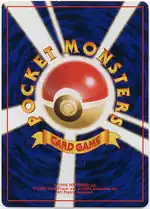
The Pokémon Trading Card Game was originally published in Japan in October 1996 by Media Factory. While other series of collectable Pokémon cards existed in the past (such as the Pocket Monsters Carddass Trading Cards released in September 1996), this was the first card game based on the Pokémon series. The first Pokémon TCG sets took inspiration from the then released Pokémon Red, Green, and Blue video games and initially featured illustrations by Ken Sugimori, Mitsuhiro Arita and Keiji Kinebuchi. Soon new expansions began to release with many new artists contributing artwork, while also introducing new mechanics - Team Rocket introduced Dark Pokémon, and Gym Heroes introduced the concept of Owner's Pokémon. Both mechanics were primarily relevant due to other cards referencing them by name. Three years later in 1999, Pokémon TCG was introduced in North America by Wizards of the Coast with the Base Set, and worldwide soon after. In 2003, Wizards of the Coast's license was transferred to The Pokémon Company International.
With the release of Pokémon Gold and Silver video games, the Neo Series, the second series of expansions, brought several new Pokémon into play. New mechanics were also added, reflecting changes to the video games: Darkness and Metal were added as types, to represent the new Dark and Steel types, Pokémon Tool cards reflected the new held items mechanic, and Shining Pokémon - extremely rare cards you could, by the rules, only have one of in your deck - represented the new Shiny Pokémon. Light Pokémon were also introduced in Neo Destiny expansion as a short-lived counterpart to Dark Pokémon. The e-Card Series used Game Boy Advance add-on e-Reader to display Pokédex data about the Pokémon, play a minigame, play various tunes in a Melody Box, or activate a special attack for that Pokémon.
The EX Series was released next, the first series produced by The Pokémon Company International instead of Wizards of the Coast, which introduced the stronger Pokémon-ex into the game. These powerful cards came with a price - if they were Knocked Out, your opponent took two Prize cards instead of one, a concept that would be repeated in many future card types. With the release of the EX Series worldwide, Pokémon TCG was published by Pokémon USA and distributed by Nintendo of America, instead of Wizards of the Coast.[2] In 2006, Nintendo of America transferred distribution responsibilities to Pokémon USA.[3] In 2000, The Pokémon Company replaced Media Factory in publishing the cards in Japan starting with the Awakening Legends expansion. Media Factory continued to distribute the cards until the DP era.[citation needed]
The Diamond & Pearl Series brought Pokémon LV.X as a different take on Pokémon-ex - rather than replace the final evolution entirely, the player instead played the LV.X card on top of their normal evolved form. In exchange for the extra steps, only one Prize card was taken when they were Knocked Out. The Platinum series would follow up with many of the same concepts, as well as reintroducing Owner's Pokémon as Pokémon SP - powerful, always-Basic Pokémon representing those used by Trainers in the games. Unlike Owner's Pokémon, however, the actual Trainer was mechanically irrelevant - card effects only cared if they were a Pokémon SP at all or not. The HeartGold & SoulSilver Series retired both, in favor of two more types of card, Pokémon LEGEND, two-part cards that featured Legendary Pokémon (and, after the first set, always featured two Pokémon, causing them to reward two Prize cards when Knocked Out as well), and Pokémon Prime, Pokémon with powerful and/or tactical attacks.
With the release of the Black & White expansion, Poké-Powers (Poké-POWERs and Poké-BODYs) were combined into one mechanic and renamed Abilities. The concept of Pokémon-ex returned as Pokémon-EX in the Black & White Series starting with the Next Destinies expansion. Pokémon-EX were always Basic Pokémon (though this wasn't relevant until Legendary Treasures, as all Pokémon-EX released before then were Legendary or Mythical Pokémon), unlike Pokémon-ex. The Dragon Pokémon type was introduced in the Dragon Vault expansion of the Black & White Series; unlike all other types, they did not have their own type of Energy, and instead typically used two different types of Energy.
M Pokémon-EX were introduced in the XY expansion, introducing the Mega Evolution mechanic featured in the Pokémon X and Y video games to the TCG. These cards came with a severe drawback - once you played them, your turn immediately ended, though this caveat could be avoided with certain cards. The XY Series also introduced the Fairy type Pokémon, again reflecting the new type added.
Pokémon-GX was introduced in the Sun & Moon Series. Like Pokémon-ex, Pokémon-GX used the normal Evolution Stage of a Pokémon, and gave two Prize Cards to the opponent when they were Knocked Out. Their primary feature was a GX attack - a powerful attack that you could only use one of each game, similarly to the Z-Move mechanic from the video games.
Two Game Boy Color video games based on the card game were created: Pokémon Trading Card Game was released in 1998 and worldwide in 2000, and its sequel, Pokémon Trading Card Game 2: The Invasion of Team GR!, was released three years later. Pokémon Card Game: How to Play DS was released in Japan in 2011 and taught players how to play the Pokémon TCG. In 2011, the Pokémon Trading Card Game Online was introduced as a browser-based game but later became a downloadable game for PC, Mac, and iPad. Other media related to Pokémon TCG include several manga titles, such as the series How I Became a Pokémon Card.
How to play

|
This section is incomplete. Please feel free to edit this section to add missing information and complete it. Reason: More detail, especially as part of game flow. |

- See the Appendix:Glossary for a definition of most the Pokémon Trading Card Game terms.
- Also see the FAQ Video Series on Pokémon.com for a visual introduction to the card game.
The Pokémon Trading Card Game is a two player game for all ages. Each player builds a Deck of sixty (60) cards using a combination of various "Pokémon cards" (the main type of cards used to battle), "Trainer cards" (cards with special effects), and "Energy cards" (cards that are required to perform most "Attacks"). New cards and decks are constantly being released, and players may purchase "Booster packs" to integrate these cards into their own decks or purchase pre-made "Trainer kits" or "Theme Decks" that already have all the cards needed to play. The Pokémon Trading Card Game officially requires a deck of 60 cards for Standard or Expanded play, though shorter Matches can be held with "Half Decks" consisting of 30 cards instead. During a 60 card match, only four of any one card, excluding Basic Energy cards, are allowed in each deck. This is further limited to two of any one card in a Half Deck match. Many fans have also created their own game rules and playing methods and have websites devoted to providing alternative playing methods. These rules and methods are not allowed in Play! Pokémon competitions.
Setting Up to Play
To begin a match, players need a coin or a six-sided die (where the even-numbered sides represent "heads" and the odd-numbered sides represent "tails"). One player calls heads or tails, while the other player flips the coin or rolls the die. If the player calling the coin flip gets their choice (heads or tails), that player gets to choose which player goes first. If the player calling the coin flip does not get their choice, the player flipping the coin gets to choose which player goes first. The player who goes first is not allowed to attack or play any Supporter cards on that player's first turn. In best-of-three match play, after a game has been completed, the loser of that game decides who goes first in the next game instead of determining it by a coin flip. This decision is made at the same point during setup that the coin flip would take place.
After determining which player goes first, both players must shuffle their own decks and allow their opponent to make a deck cut; alternatively, the opponent may choose to shuffle the other player's deck and allow the deck owner to make a deck cut. Each player then places their deck faces-down in the play area or "field" in a north/south orientation, with the short sides of cards facing each player, and any card sleeve openings facing the opponent. The players then each take seven cards from the top of their respective decks. These cards go into their hand. Players then place at least one Basic Pokémon from their hand face down into play: one to the Active Spot and up to five onto the Bench. Next, each player sets aside six cards from the top of their deck face down as Prize cards. Finally, each player flips over their Active and Benched Pokémon and the game starts.
Mulligan
If a player does not have any Basic Pokémon in their hand while setting up to play, after their opponent sets aside the Prize cards, they must take a mulligan. For each mulligan a player takes, that player’s opponent may draw a card.
If both players had to take mulligans, the player that took fewer mulligans may draw a number of cards up to the difference in the numbers of mulligans. This means if the player took 1 mulligan and the opponent took 3, the player may draw up to 2 cards.
Turns
At the start of each player's turn, they must draw a card. Then, they may take any of the following actions in any order they like.
- Attach up to one Energy card from their hand to one of their Pokémon
- Play as many Basic Pokémon from their hand onto their Bench as they like
- Evolve as many of their Pokémon as they like
- Retreat their Active Pokémon up to one time
- Play as many Trainer cards in their hand as they like (but only one Supporter card and one Stadium card)
- Use any Abilities or Pokémon Powers
Attacking will end a player's turn regardless of how many other actions they have taken, but a player may choose to end their turn without attacking.
Pokémon Checkup
- Main article: Pokémon Checkup
After every turn, before the next player's turn starts, Pokémon Checkup takes place. During this time, Special Conditions and other explicitly stated effects are applied. Poisoned and Burned Pokémon have damage counters placed on them, Asleep and Burned Pokémon toss a coin to check if they are cured, and Paralyzed Pokémon are cured (if the previous turn was that Pokémon's player's).
Pokémon whose HP drops to 0 during this step are Knocked Out at the end of this step, after all checks have been performed.
Finishing a match
To finish a match, players must take their six Prize cards by Knocking Out their opponent's Pokémon by using attacks to reduce the opponent's HP to zero. The player that does so wins the game.
One player may also run out of Pokémon in play, i.e. they have no Active Pokémon or Benched Pokémon. The player that runs out of Pokémon in play loses the game.
At the beginning of a turn, if a player must draw a card from an empty deck, that player loses the game. Winning or losing can also be achieved directly with the effect of certain cards.
Card types
Pokémon card
|
Trainer cards
Energy cardsRarityOn the bottom right corner of most cards, there is a small logo that indicates its rarity. Below is a list of these rarities:
No symbol usually denotes a card that is part of a promotional set or a Basic Energy card. In addition, some cards are rarer than the symbol alone indicates, including due to it being a Holographic version, Secret Rare or alternate art print. |


International sets
Generation IOriginal SeriesGeneration IINeo SeriesLegendary Collection Seriese-Card Series |
 Promotional series
Unreleased sets |












Japanese sets
Exclusive sets
Original era
 Vending Machine cards Series 1 (Blue)
- Vending Machine cards Series 2 (Red)
- Vending Machine cards Series 3 (Green)
VS era
 Pokémon VS — minor expansion
Web era
 Pokémon Web — minor expansion




Logo
-
 TCG logo in Indonesian
 -
 TCG logo used in Indonesian TCG products since October 27, 2023
 -
 TCG logo in Traditional Chinese
 -
 TCG logo in Korean
 -
 TCG logo in Thai
In other languages
| ||||||||||||||||||||||||||||||||||||||||||||||||||||
Related articles
- Play! Pokémon Pokémon Organized Play
- Appendix:Glossary of TCG terms
- Category:Pokémon Trading Card Game for a categorized list of all articles related to the TCG
- Pokémon Trading Card Game Online
- Pokémon Trading Card Game Live
- Pokémon Card Channel
- Pokémon Card Game Rule Song
- Pokémon Card Game Rule Song – Sword & Shield Ver
- Pokémon Card Game Rule Song – Scarlet & Violet Ver
References
External links
- Pokémon.com The official United States Pokémon TCG website
- Step-by-step Web Browser TCG Tutorials (on official website)
- forums.pokemontcg.com Official English TCG Forums
- Pokémon-Card.com Official Japanese TCG Website (Japanese)

|
This article is part of Project TCG, a Bulbapedia project that aims to report on every aspect of the . |