Pokémon Trading Card Game Live

|
This article is incomplete. Please feel free to edit this article to add missing information and complete it. |
| Pokémon Trading Card Game Live | |
|---|---|
 Logo of Pokémon Trading Card Game Live | |
Basic info
| |
| Platform: | Windows, macOS, iOS, iPadOS, Android |
| Category: | Strategy card game |
| Players: | 1-2 |
| Connectivity: | Internet |
| Developer: | The Pokémon Company International |
| Publisher: | The Pokémon Company International |
| Part of: | Generation VIII miscellaneous |
Ratings
| |
| CERO: | N/A |
| ESRB: | E |
| ACB: | G |
| OFLC: | |
| PEGI: | 3 |
| GRAC: | N/A |
| GSRR: | N/A |
Release dates
| |
| Japan: | N/A |
| North America: | February 22, 2022 (Canadian beta) June 8, 2023 (global launch) |
| Australia: | July 19, 2022 (beta) June 8, 2023 (global launch) |
| Europe: | September 13, 2022 (German, French and Italian beta) June 8, 2023 (global launch) |
| South Korea: | N/A |
| Hong Kong: | N/A |
| Taiwan: | N/A |
Websites
| |
| Japanese: | N/A |
| English: | Pokémon.com |
Pokémon Trading Card Game Live (also referred to as Pokémon TCG Live) is a free-to-play digital version of the Pokémon Trading Card Game and the successor to the Pokémon Trading Card Game Online. It is available on Windows, macOS, iOS, iPadOS, and Android devices.
Originally planned for 2021, an announcement on Nov 4, 2021 delayed the mobile soft launch in Canada, as well as a global open beta for desktop, to 2022.[1] The Canadian limited beta was announced on February 16, 2022[2] and launched on February 22, 2022 for Android, Windows, and macOS in both English and French, with iOS and iPadOS to be added later on April 19, 2022.[3][4] On May 24, 2022, the limited beta was expanded to Mexico (and in Spanish);[5] on July 19, 2022, it was expanded to Australia and New Zealand;[6]; on September 13, 2022, it was expanded to France, Germany, and Italy (and in German and Italian);[7] on October 18, 2022, it was expanded to Denmark, Finland, the Netherlands, Norway, and Sweden.[8] On November 15, 2022, the global beta became available, supporting English, Brazilian Portuguese, French, German, Italian, and Spanish.[9]
The game would launch globally on June 8, 2023, closely following the shutdown of its predecessor on June 5, 2023.
Among the main differences to its predecessor is an overhaul of the game's interface, the absence of cards from the HeartGold & SoulSilver series as well as the trading system to streamline gameplay, and being able to obtain individual cards in the new client with one of the game's currencies. The game has all cards released internationally from the Black & White expansion onward. However, only cards from Sun & Moon on have their game logic implemented; older cards are visible in a player's collection but unusable in-game.
Gameplay
Pokémon Trading Card Game Live builds off the gameplay found in Pokemon Trading Card Game Online, adapting the Pokémon Trading Card Game into a digital medium. The primary differences between the two games are in their visuals and their economies.
As before, players can collect digital cards, build decks, then play against the computer or against other players. Moving cards and other in game items is primarily done through a drag and drop interface. Playing cards as a whole is done this way, placing the cards into the appropriate zone or onto a Pokémon depending on their rules. If there are further decisions that have to be made, some cards have players select a Pokémon in play while other cards open a menu where the cards are placed into slots to represent picking them. These menus can be closed and reopened if the player wants to review the board state before making a decision.
Pokémon cards in play can be selected, bringing up a menu where the player can look at their text more closely. If it is their Pokémon while it is their turn, the player can pick an action that the card can use, be that attacking, retreating or using an Ability.
Matches against other players are timed, with each player having a separate timer. A player's timer counts down whenever they have to make a decision in the game. If one player's timer counts all the way down to zero, that player loses. Timers are not reset if the game results in a tie and a Sudden Death game begins. In addition to this, all decisions have a short timer attached to them, indicated to the player once the timer is at 15 or fewer seconds. If this timer runs out, the game makes the decision for the player. If enough decisions are resolved this way in a row, a player can also lose the game for being inactive.
Playing matches against other players rewards players with Experience points, coins, and experience in the Battle Pass. These in turn allow the player to collect cosmetic items to customize the appearance of themselves and their deck. Other rewards that can be gained include booster packs and Credits, which are used to acquire new cards for one's digital collection so that they can build different decks.
Visuals
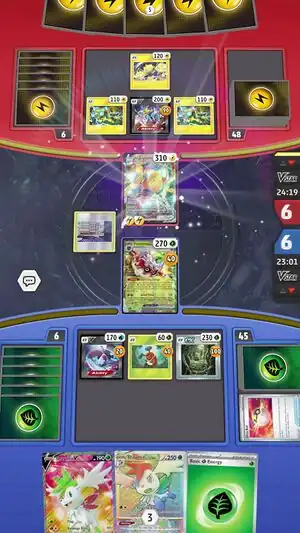
Pokémon TCG Live has a noticeably more fantastical bend compared to its predecessor, with battles taking place in a futuristic setting compared to the prior game depicting a standard tabletop. More things have animations, such as tapping on the playfield or holding an Ancient or Future card. The playfield lights up to indicate who is taking the current turn, and the in-play zone takes on a different appearance depending on the Energy type of the Pokémon who most recently became an Active Pokémon. Attacks again have varying animations depending on the Energy type of the Attacking Pokémon, and a Knocked Out Pokémon has an accompanying red burst sweep through the in-play zone before the card leaves the field.
Players have three dimensional avatars. During a battle, the player can select emotes from a wheel to the side of the playfield. This causes their avatar to slide on screen briefly and perform a representative animation.
Initially, the mobile and desktop versions of Pokémon Trading Card Game Live displayed Benched Pokémon cards with "condensed art" to save screen space. These cards would only display their artwork, a special property indicated by their name, an icon representing their Stage, HP, Energy type, and if they have an Ability. The card's name was not displayed. Stadium cards were also displayed in this way, so the only visible portion of the card was the artwork. This feature was later removed in response to player feedback, and so all cards are now displayed in full.[10]
Modes
Ranked mode
In Ranked mode, players compete against others in the Standard format. Winners get Rank Points, used which allow them to progress through a monthly Ladder and receive rewards, while losing a battle costs players some points. The update from March, 2024 has shorted the rank points to the maximum rank (Arceus League) from 2,660 to 1,620 points,[11] and the update from November, 2024 shortening much more the rank points to the maximum rank (Arceus League) from 1,620 to 550 points.[12]
Casual mode
In Casual mode, nothing is risked for losing matches except for the fact players get more rewards for winning matches than losing them. This mode can be played in the Standard or the Expanded (Beta) format.
Starting March 25, 2025, Trainer Trials has been added to Casual Mode mode offering rotating deckbuilding challenges in a limited number of weeks with alternate formats:
- Week 1-2: Singleton Showdown: Standard format with only one copy of each card being allowed, except for basic Energy cards.
- Week 3-4: Twin Battle: Standard format with each card must appearing exactly twice, except for basic Energy.
- Week 5-6: Gym Leader Challenge format.
- Week 7-8: Silver Series: Cards for the Scarlet & Violet series only, restricted to Common, Uncommon and Rare cards and not using cards with a Rule Box.
- Week 9: CU Cup - Expanded: Expanded format, Common and Uncommon cards only.
Subsequent weeks have featured a mix of new and returning alternate formats.
Friend
Players can set other accounts as Friends and play friendly battles against them in the Standard format.
Decks
The Decks menu lists out all of the decks the player has saved. Decks can be selected as the Active Deck for the Standard or Expanded format as long they are valid for the format and the player has its cards, making them the deck used when the player enters the queue for a battle of that format.
TCG Live has a number of preconstructed decks available for players. A new set of these is granted whenever Standard rotates. Additional decks are granted in much the same way through each expansion's Battle Pass and occasionally as part of limited time events. Preconstructed decks released as real-world products can be obtained in Live by redeeming included code cards or by purchasing them from the in-game Shop. Regardless of the method used to obtain the decks, the cards included in each deck are never removed from a player's account.
Deck Editor
The player can create their own decks, or modify one already stored. This interface for searching for cards is tabbed, such that the player is either viewing Pokémon, Trainers, or Energy. The player can further implement filters for cards, using properties like "Attribute" and "Energy type" to more easily find specific cards. Results can be sorted by schema like "A-Z" for alphabetical ordering by card name, "Expansion" which groups cards by which expansion they were released in and further orders them by collector number, or "Evolution Chain" to group Pokémon that evolve from one another together. Lastly, players can search by text, which checks both names of cards and the text of cards.
After selecting a card, the player can open a menu and scroll to find any one of its rarities and variations, so that they can add a specific printing to their deck. Cards stack in the deck's display, so if multiple copies of the same card with different printings are in a deck only one printing is visible in this menu.
The player can exchange Trade Credits to obtain cards that they do not have already while in the Deck Editor. The cost of this exchange is based on the card's rarity. This is determined per printing, so while a Rare card costs 400 Credits, the same card's Illustration Rare version costs 750 Credits. Exclusive cards from Play! Pokémon Events such as League promos cannot be obtained through this method, and, starting March 25, 2025, overnumbered cards cannot be obtained this way for six months after their release.[13]
Decks can be given names up to 22 characters long. These names are not visible to other players. Preconstructed decks can have longer names, but the player cannot recreate said names.
Deck Customization
Players assign a number of Deck Accessories to their decks, as a purely cosmetic addition. Each deck is assigned one of the three types, using those accessories in any game the deck is being used in.
- Deck Boxes: Seen on pre-game screens.
- Deck Sleeves: Seen as part of the same pre-game screens. Also seen during the game, representing any unknown cards from that deck.
- Coins: Seen as part of the same pre-game screens. Also seen when the player flips a coin for any game effect.
Test Deck
The player can test their decks against an AI opponent, named "AI". This battle is much like a regular battle, except that both players' timers are locked at 39:00 and do not count down at any point. No rewards are given for matches done through this menu. The AI always uses a current or former starter deck, regardless of its legality in the currently selected format. The player's deck must be legal for the current format, but the requirement that the player owns cards in the deck is waived. The Test Deck function is accessed through the menu options of each individual deck.
Card Dex
The July 2025 update introduced the Card Dex, a dedicated gallery for viewing and tracking a player's collection. Cards are grouped by set, with a toggle to switch between Main Set View and Master Set View, the latter of which features parallel foil cards, overnumbered cards, and subsets. Like in the Deck Editor, unowned cards may be acquired through the Card Dex by exchanging Trade Credits for them. Promo cards are currently not shown in the Card Dex, but all cards can continue to be viewed through the Deck Editor by adjusting its filters accordingly.
Changes from TCG Online
- There are more animations in general.
- Attacks that have no effect no longer have an associated animation of the card shaking before returning to the Active Spot.
- Cards with the same name are displayed as a stack in the hand.
- The angle of the camera is such that the cards are facing the camera more directly.
- Cards the opponent play appear right side up, such that the player can read the text.
- Prior to versions 1.2.1 (desktop)[10] and 1.7.0 (mobile platforms)[14], Pokémon cards on the Bench did not display their attacks until they were selected, only showing their artwork, HP, Energy type, and Ability.
- Cards can no longer be traded between players. Instead, players are given more cards and booster packs directly from the game, and can spend Credits in order to craft specific cards.
- The player selects an Active Deck from the deck menus for use in queues, instead of having to pick a deck on the same menu as they enter the queue on.
- Prior to the July 2025 update, packs were modified from their real world counterparts, consisting of 6 or 5 cards instead of 10.
- Prior to the July 2025 update, there was no dedicated menu for looking at the player's collection, with the Deck Editor serving as a substitute.
Tutorial
Professor Fir introduces the player to Pokémon Trading Card Game Live and teaches them how to play.
Battle Pass
- Main article: Battle Pass (TCG Live)
One of the primary new features of TCG Live is the introduction of a Battle Pass. By playing the game and completing once-per-day Quests, players earn experience which is used to unlock tiers in the Pass that give them rewards. Each Battle Pass is themed to go with a single expansion, concluding with the launch of the next expansion and being replaced with a new Battle Pass for that expansion.
The Battle Pass has a large number of Tiers, each rewarding different themed accessories, booster packs, and various currencies. Each player starts at Tier 0, then progresses up the Tiers one at a time until they reach the highest Tier, typically Tier 50. (Certain Passes may have more or fewer Tiers.) The experience points needed to unlock the next Tier increases over the course of the Pass, ranging from 500 XP for the lowest Tiers to 1250 for the highest. XP is earned from playing matches and completing Daily Quests, which typically provide enough XP to unlock one or more Tiers per day. The player can also spend 200 Trainer Points in order to unlock the next Tier instantly, or a multiple of 200 to unlock multiple successive Tiers at the same time.
Tier 0 of the Basic Pass grants a full 60 card deck primarily using some of the new cards from the expansion. Many of the further Tiers reward specific cards meant to upgrade the deck, including Secret Rare variants of the deck's cards. A second free deck is typically available as a reward approximately halfway through each Battle Pass. The remainder of the pass primarily grants Trainer Points, Trade Credits, and booster packs of the current expansion.
Prior to the Surging Sparks Battle Pass, players had the additional option of spending Crystals (now called Trainer Points) to purchase the Premium Pass, a second track of the Battle Pass which was completed at the same time. During this time, many of the rewards currently included in the free Battle Pass were exclusive to the Premium Pass, including Crystals, various cosmetics, and the second Battle Pass deck. The Premium Pass also featured booster packs from prior expansions. For an additional Crystal cost, if a player had yet to purchase a Premium Pass, they could instead purchase the Premium Pass +. It granted the Premium Pass and unlocked the first 15 Tiers of the Battle Pass instantly.
Profile
In the Profile menu, the player can check on certain in game elements of their account and customize their character.
Stats
In the Stats menu, the player can view the total number of matches they have played, as well as the total number of times they have won or lost. They can also look at their current win streak.
Friends
In the Friends menu, the player can look at all of the friends registered to their TCG Live account. Adding friends is done through inputting their screen name, The player can also start battles with their friends.
Avatar Customization
Players have a new avatar system, which uses three-dimensional models rather than two-dimensional artwork. There are two base appearances to choose from, each corresponding to a gender. All items of clothing are gender specific, even items like hats, and are purchased separately. When the game rewards the player with items it always includes both variations of the item. This system allows players to choose options for Face (including the shape of their face, eye color, and skin color), Hair (hair styles and hair color), Glasses (What frame to wear, if any, as well as color options for the frames and lenses), Hats, Tops, Bottoms, and Shoes.
The player can additionally choose Poses, animations that their Avatar uses when starting a match and when winning a match. (The loser does not get to show an animation.) Similarly, players can also choose Catchphrases: strings of text displayed in the same situations.
Shop
The Shop menu allows players to obtain items in the game. It is not the only menu where items can be purchased, but it is a useful framing device to explain aspects of the game's economy.
TCG Live uses the following currencies:
- Trainer Points (formerly Crystals) are used to purchase booster packs, card bundles, and pre-constructed decks (most of which reflect physical products), as well as cosmetic items such as deck boxes, card sleeves and (gameplay) Coins. The Premium Battle Pass could also purchased with this currency, and Trainer Points can be spent to unlock Tiers of the Battle Pass in place of experience.
- Trade Credits (formerly Credits) are exchanged for specific cards, allowing for obtaining specific cards without the randomness of opening booster packs or Collector Crates. Credits can also occasionally be used to buy certain limited-time product bundles. Credits are obtained primarily by the game's duplicate protection; when the player receives a card of which they already have a playset, that excess copy is automatically converted into a number of Credits dependent on the card's rarity. Exclusive cards from Play! Pokémon Events such as League promos cannot be acquired via Credits.
Prior to December 2024, a third currency, Coins, was used to purchase cosmetic items, including avatar clothing. When this currency was removed, all clothing became free, deck cosmetics started costing Crystals, and unspent Coins were converted to Crystals at a 4:1 ratio, up to a maximum of 1,250 Crystals.
Bundles
The Bundles section allows players to purchase various bundles. Most of these reflect a physical product, coming with any of that product's Coins, promotional cards, and card sleeves. If the product is a deck, then the deck and all cards within are also included. Sometimes the deck box for the deck is included, but many deck boxes are not supported in TCG Live and for those products the box is instead one of the game's default type themed boxes. Similarly, competition-legal coin-flip dice are not in the game and are replaced with default type themed coins. If that product has booster packs in it, an equivalent number of booster packs are included with the digital version of the product. While the booster packs may vary in the physical product, the digital version always has all the packs be from one expansion.
Promo Sets are a recurring kind of bundle without a real world product equivalent. Each one contains the three or four Black Star Promo cards from the Single Pack Blisters and Three Pack Blisters for one expansion, along with three booster packs of that expansion. They cost 750 Trainer Points to purchase but each one can only be purchased once. For the Pokémon GO expansion, this is instead called a Promo Pack, following the same principles but taking the promo cards from Pin Collections and Tins. Promo Sets were released for expansions between Chilling Reign and Paldea Evolved.
Expansions
This menu is a hub where the player can select an expansion to land on a page specific to it. There, players can see their progress towards having every card from that expansion, see and purchase product collections with unique cards or items featuring that expansion, or directly buy booster packs of that expansion. Booster pack purchases come with Trade Credits.
- One booster pack and 10 Credits costs 200 Trainer Points
- Three booster packs and 125 Credits cost 560 Trainer Points
- Six booster packs and 350 Credits cost 1120 Trainer Points
Currency
This menu existed prior to the November 2024 update that phased out Coins from the game. It allowed the player to buy 300 Coins for 250 Crystals or 1400 Coins for 1100 Crystals.
Redeem
- Main article: Code Card
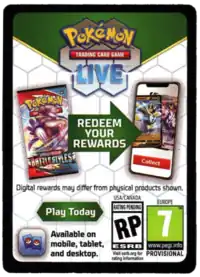
Certain physical Pokémon Trading Card Game products will come with a unique code card that can be used to redeem virtual cards or other virtual products for the TCG Live. Code cards are available in physical Theme Decks, Elite Trainer Boxes, Booster packs, and other products that state that they contain a code card or contain the TCG Live symbol on the packaging, and unlock that product in the game or an item related to that product. Older Code cards created for Pokémon TCG Online can still be used in TCG Live.
Codes can be redeemed in the game in the Redeem section of the Shop menu. This is done either via typing in the code, or by using a camera to read the QR Code from the card. There is also a page on the Pokémon TCG website where codes can also be redeemed through either method, with the rewards appearing in TCG Live afterward.
There is a “soft” redemption limit on the number of codes from a specific physical product that can be redeemed for full rewards, which varies by the item. Once this cap has been reached, further redemptions of that product only grant a small amount of in game currency. Each set has its own redemption limits.
Card Drop Rates
Prior to the July 2025 update, typical booster packs in the TCG Live had 6 cards per pack (5 for expansions before Scarlet & Violet) as opposed to 10 cards from real life, at the usual rarity/drop rates:
- 1 Common card*
- 1 Common or Uncommon card*
- 1 Uncommon card*
- 1 Foil Common to Foil Rare card (for 6-card packs)
- 1 Foil Common to Foil Rare or Rare and above card
- 1 Rare to Ultra Rare card
There was a small chance that the cards with a * would be of a rarity above Rare Holo instead.
From the July 2025 update onward, pack sizes and composition match their real life counterparts, aside from a chance of the first Common slot being replaced with a high rarity card.
Collector Crates are another kind of bundle obtainable from the Ladder and Battle Pass rewards, awarding 9 cards of a specific expansion, typically with the following rarity/drop rates:
- 2 Common Foil cards
- 2 Uncommon Foil cards
- 2 Foil Rare or Rare to Illustration Rare cards
- 2 Ultra Rare cards
- 1 Special Illustration Rare or Hyper Rare card
Transfers from TCGO
Both Live and Pokémon Trading Card Game Online utilize Pokémon.com's Trainer Club account system. As long as players did not migrate their Pokémon TCG Online collection to Pokémon TCG Live's beta, they were free to play either game for as long as TCGO remained available. Players that did decide to migrate their data to TCG Live during the testing period were unable to log in to TCG Online.[15] PTCGO shut down officially on June 7, 2023, though data migration is still possible until further notice.
Items transferred to Live include:
- All cards from the Black & White Series onward
- Four copies of standard cards
- One copy of ACE SPEC cards, Prism Star cards, and pieces of Pokémon V-UNION cards
- 59 copies of Basic Energy cards
- At the launch of Live, cards from the Black & White Series, XY Series, and certain cards from the Classic Collection of the Celebrations expansion (those originally printed before Sun & Moon) could not be used.
- One copy of accessories (deck boxes, coins and card sleeves) that have a real-life counterpart or were from certain special events
Note: When the game was initially announced, cards from Sun & Moon series sets older than Lost Thunder were also listed as being unavailable at launch.
Unopened products are not transferable but the player will be reimbursed for them with Trainer Points:
- 1-9 items: 500 Trainer Points
- 10-24 items: 1100 Trainer Points
- 25-49 items: 2,250 Trainer Points
- 50-124 items: 4,700 Trainer Points
- 125 or more items: 12,400 Trainer Points
Note: When the game was initially announced, the listed reimbursements were half these amounts.
In other languages
| |||||||||||||||||||||
References
- ↑ @PokemonTCG on Twitter
- ↑ Pokémon TCG Live Makes its Canadian Debut in Limited Beta
- ↑ Pokémon TCG Live Available in Canada in Limited Beta
- ↑ @PokemonTCG on Twitter
- ↑ Pokémon TCG Live Available in Canada and Mexico in Limited Beta
- ↑ Pokémon TCG Live Available in Select Countries and Territories in Limited Beta
- ↑ Pokémon TCG Live Available in Select Countries and Territories in Limited Beta
- ↑ Pokémon TCG Live Available in Select Countries and Territories in Limited Beta
- ↑ Challenge Players Across the World with the Launch of Pokémon TCG Live’s Global Beta
- ↑ 10.0 10.1 Letter to the Community, Pokémon TCG Live dedicated site, Pokémon.com, October 11th 2022 (archive)
- ↑ Version 1.12.0 - Patch Notes — Pokémon Forums
- ↑ Letter to the Community - November 5, 2024 — Pokémon Forums
- ↑ Letter to the Community - March 20, 2025 — Pokémon Forums
- ↑ Version 1.7.0 - Patch Notes ― Pokémon Forums
- ↑ Pokémon.com Support
Related articles

|
This article is part of both Project Sidegames and Project TCG, Bulbapedia projects that, together, aim to write comprehensive articles on video games about the TCG. | 
|