Pokémon Frienda
- Not to be confused with Pokémon Friends.
| Pokémon Frienda ポケモンフレンダ | |
|---|---|
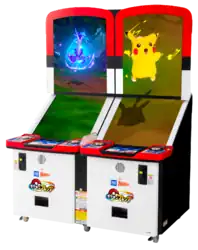 Pokémon Frienda arcade machine | |
Basic info
| |
| Platform: | Arcade |
| Category: | Battle simulation |
| Players: | 1-2 |
| Connectivity: | None |
| Developer: | Takara Tomy A.R.T.S./ Marvelous |
| Publisher: | Takara Tomy A.R.T.S. |
| Part of: | Generation IX miscellaneous |
Ratings
| |
| CERO: | A |
| ESRB: | N/A |
| ACB: | N/A |
| OFLC: | N/A |
| PEGI: | N/A |
| GRAC: | N/A |
| GSRR: | N/A |
Release dates
| |
| Japan: | July 11, 2024 |
| North America: | N/A |
| Australia: | N/A |
| Europe: | N/A |
| South Korea: | N/A |
| Hong Kong: | N/A |
| Taiwan: | N/A |
Websites
| |
| Japanese: | Official site |
| English: | N/A |
Pokémon Frienda (Japanese: ポケモンフレンダ) is an arcade game developed by Takara Tomy A.R.T.S. and Marvelous. It is the fifth peripheral-based title developed by the two companies, following Pokémon Mezastar, Pokémon Ga-Olé, Pokémon Tretta, and Pokémon Battrio. It was officially announced on April 15, 2024,[1] and was launched in Japan on July 11, 2024.
The peripherals used in Pokémon Frienda are called Frienda Picks (Japanese: フレンダピック), which are used to operate Pokémon in battles. Battles are typically conducted with three Pokémon on each side and take place in a variety of environments. Players can capture Pokémon while playing the game, which are dispensed as Frienda Picks from the machine.
Each Pokémon Frienda machine consists of two adjacent stations that incorporate a pair of 50-inch monitors: a vertical monitor and an angled touchscreen below it. The two monitors display the user interface for individual stations, simulating the borders of the machine with on-screen graphics while single-player games are in operation. As previously featured in Pokémon Mezastar, players can partake in cooperative battles, during which the interface is expanded to cover both stations.
The control panel for each station comprises a center section and two raised sections on either side. The center section contains three blue recesses to set Frienda Picks and a Multi-Scanner that can be used to scan QR codes. The raised sections each contain a button that can be used to interact with in-game features and three non-functional recesses that can be used to hold additional Frienda Picks. Each button is surrounded by a circular display that shows various graphics throughout gameplay.
Release history
|
| ||||||
| |||||||
Frienda Picks
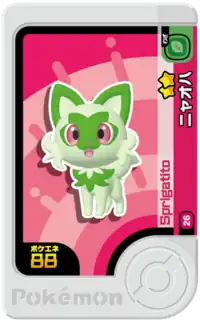
Frienda Picks are rounded rectangular plastic tiles measuring 38.9×62.9×4.2mm.[1] The corner with the larger radius features a Poké Ball symbol and its longest edge is tapered, allowing them to be identified when stored side-on. Each Frienda Pick features a single Pokémon species together with a set of its stats, type(s), and move(s) as derived from the core series of Pokémon games. This data is present in a QR code on the reverse of each Frienda Pick, which is read into the game when it is set in one of the blue recesses.
Stats
Pokémon have a Poké Ene (Japanese: ポケエネ) value on the obverse of Frienda Picks. Much like levels in other Pokémon games, this gives an indication as to their overall strength. A Pokémon's main stats are detailed on the reverse of Frienda Picks. The green HP stat determines how much damage Pokémon can sustain before they can no longer partake in battle. The red Attack and dark red Defense stats respectively determine how powerful Physical moves used by Pokémon are and how susceptible they are to damage from them. The blue Special Attack and dark blue Special Defense stats similarly determine the power of and vulnerability to Special moves. The numerical value of the Speed stat is not displayed but is represented by yellow-colored arrows called the Speed Level, similar to pucks from Pokémon Battrio. Ranging from one to five, Pokémon with a higher Speed Level will have more chance of attacking first on their turn and will be more likely evade incoming attacks.
Types and moves
The types attributed to Pokémon are indicated by symbols above their name on the reverse of Frienda Picks and determine what types of move they will be weak against or resistant to in battle. The types featured in Pokémon Frienda are the same as those found in the core series and share their individual attributes. Most Pokémon can use only one move, as opposed to four in the core series, though some have access to an additional move. Moves and their associated type are detailed on the reverse of Frienda Picks; their damage category is also highlighted in a color that matches the stats below it.
In a change to peripherals from previous titles, the type symbol on the obverse of Frienda Picks relates to its move type rather than its defensive type(s). This is displayed on the tapered edge of Frienda Picks, so was presumably placed as a form of quick reference. Pokémon that have access to powered-up additional moves, such as Z-Moves or by Terastallizing, display the type symbol of that move accompanied by an appropriate symbol.
| Pokémon Frienda types | ||||||||
|---|---|---|---|---|---|---|---|---|


Pokémon Grades
Pokémon in Pokémon Frienda are divided into Grades (Japanese: グレード), as indicated by a star rating. Grades 2 and 3 are considered standard rarities and consist of light gray Frienda Picks with portrait illustrations. They also have colored sections on both sides based on Poké Balls to denote their overall strength: Grade 2 Pokémon feature red sections, referencing standard Poké Balls, and Grade 3 Pokémon feature blue sections, referencing Great Balls.
Grade 4 Pokémon are called Treasure Pokémon (Japanese: トレジャーポケモン), which are metallic blue-colored Frienda Picks with a foil landscape illustration. They also have a yellow/orange section on the reverse, referencing Ultra Balls. Grade 5 Pokémon are called Super Treasure Pokémon (Japanese: スーパートレジャーポケモン), which are lamé-treated, translucent purple Frienda Picks with a foil landscape illustration. They also have a purple-colored section on the reverse, referencing Master Balls.
Higher-Grade Frienda Picks typically feature fully evolved Pokémon, including Legendary and Mythical Pokémon. A proportion of these have additional abilities, such as being able to Terastallize or have access to a Z-Move.

|
| Grade 2 |

|
| Grade 3 |

|
| Grade 4 |

|
| Grade 5 |
Gameplay
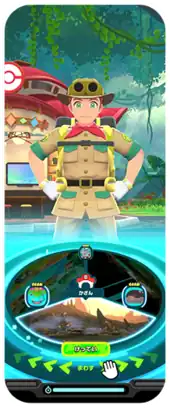
Starting a game
The main theme of Pokémon Frienda is exploration. Upon inserting ¥100, players will be greeted by the Captain (Japanese: キャプテン) at the main hub, who leads the Frienders (Japanese: フレンダーズ). He wears stereotypical adventurer attire and a hat adorned with goggles that mimic his expressions. Players can scan their Trainer Pick (a method of saving progress), purchase a Trainer Pick, or continue a standalone session. If playing a standalone session, the Captain will ask the player to stamp to become a guest of the Frienders by placing their palm on the touchscreen. Players can then select one of the two available game modes: Battle and Catch! (Japanese: バトルでゲット! Get in Battle!) or Catch now! (Japanese: いますぐゲット! Get now!). Battle and Catch! is the main game mode where players can battle and catch Pokémon over three turns; Catch now! mode is a mini-game where players throw Quick Balls at patches of grass to catch random Pokémon.
Battle and Catch! mode
Area selection
Selecting Battle and Catch! mode will present players with a wheel that contains three different areas to explore. Each area will display two high-Grade Pokémon, one of which the player will encounter if they select it. Players can cycle between areas by swiping left or right on the touchscreen. Upon confirming their selection, the Captain will send the player off exploring.
Battle preparation
A short cutscene will show the player discovering two Pokémon—typically of a lower Grade than those displayed on the area selection—followed by one of the higher-Grade Pokémon. Players will then be prompted to set up to three Frienda Picks on the console. Once ready, the player can confirm their selection by pressing the touchscreen or one of the console buttons. If they do not have enough Frienda Picks, players can press a button on the touchscreen to assign rental Pokémon and the game will quickly cycle through random Pokémon for each one they are short. Pressing the touchscreen or one of the console buttons will select the remaining Pokémon for the player to use.
First turn
Prior to the Best Tag series, players were prompted to place their palm on the touchscreen just before their avatar brought their Pokémon into battle. A circle would approach a hand-shaped graphic on the screen, and if a player pressed it as the graphic illuminated, it would earn them a Perfect! (Japanese: かんぺき!). This would apply a Perfect Bonus! (Japanese: かんぺきボーナス!) and increase the attack power of one of the player's Pokémon on the first turn. With the release of the Best Tag series, the Perfect Bonus! was replaced by an Energy Bonus! (Japanese: げんきボーナス!) and automatically applied an attack bonus to one of the player's Pokémon on the first turn.
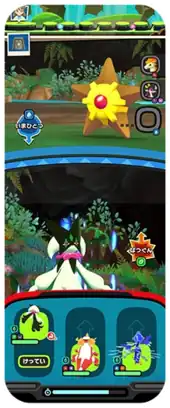
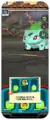
At the start of the first turn, one of the opposing Pokémon will come forward to attack. The players' team will be shown on the touchscreen, correlating with any Frienda Picks set on the console. Players can then prime one of their Pokémon by swiping it up on the touchscreen. Icons will appear either side of the graphic that divides the battlefield, allowing players to gauge how their selected Pokémon will fare against the opposing Pokémon. If a Pokémon's move type has an advantage over a Pokémon's defensive type, a "Supereffective!" (Japanese: ばつぐん!) icon is displayed; if the move has a disadvantage, a "Not Very Effective" (Japanese: いまひとつ) icon is displayed; if the move has no advantage or disadvantage, a "Normal" (Japanese: ふつう) icon is displayed. Players can employ a strategy based on the type matchup against the presented Pokémon but must also be mindful of the matchups against the other two opponents, as a Pokémon's attack will attempt to damage all three. The color of the dividing graphic also denotes which Pokémon will attack first based on their Speed Level: blue indicates the player's Pokémon will attack first, while red indicates the opposing Pokémon will attack first.
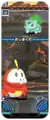
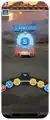
Once ready, pressing the touchscreen will commit the primed Pokémon to battle. First Attack Chance! (Japanese: せんこうチャンス! Flash Chance!) can trigger on occasions when an opponent would attack first, which prompts players to press the console buttons as fast as possible in effort to raise the dividing graphic and turn it blue. If successful, the player will attack first instead. Before their Pokémon executes a move, the player can increase its power with the Attack Roulette (Japanese: こうげきルーレット). This roulette has different base values ranging from 5 to 50 depending on the Grade of Pokémon and can be stopped by pressing the touchscreen or one of the console buttons. The Perfect Bonus! (prior to the Best Tag series) and Energy Bonus! (as of the Best Tag series) can also increase all values on the Attack Roulette by 10.
During the player's Pokémon attack animation, they will be prompted to press the console buttons as fast as possible in effort to increase their attack power further. Segments on the displays encircling these buttons light up and change color as the player presses them, going from blue to green, then to yellow, then to orange, and finally to rainbow once the maximum bonus is attained. Pressing the buttons also builds up stars that are used on Exploration Road (Japanese: たんけんロード) between turns. A maximum of four stars can be earned during this phase.
When a Pokémon uses a move and does not miss, the damage dealt to each opposing Pokémon is the difference between the opponent's Defense/Special Defense and the attacker's Attack/Special Attack (plus/minus any attack bonuses or type advantages/disadvantages). Each Pokémon opposing the player's team has a Catch Gauge, which is filled whenever it takes damage. Completely filling this gauge will make it unable to battle, and thus easier to catch—a state called Catch Chance! (Japanese: ゲットチャンス! Get Chance!) in-game. Players will receive a number of stars equal to the Grade of each Pokémon that enters the Catch Chance! state.
Each of the player's Pokémon similarly has an HP gauge. If a gauge is completely drained, the Pokémon will be removed from the battle. Unlike some previous titles, the player cannot replace any of these Pokémon; however, if they have a Partner Pokémon or a Support Pokémon, one of them will take the mantle and become useable.
Catch Time
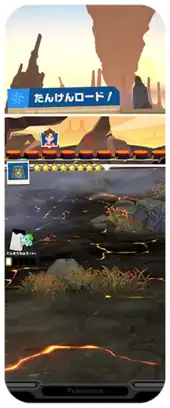
The first turn concludes either when both attacking Pokémon have used their move or if one of the attacking Pokémon becomes unable to battle. If any opposing Pokémon entered Catch Chance! during that turn, a phase named Catch Time (Japanese: ゲットタイム Get Time) follows, where a player can insert ¥100 to capture a Pokémon. If they do, a Ball Roulette (Japanese: ボールルーレット) containing Poké Balls, Great Balls, Ultra Balls, and a Master Ball appears and rotates until the player either swipes upwards on the touchscreen or presses one of the console buttons. The chances of a successful capture depend on the Grade of each opposing Pokémon, how full their individual Catch Gauges were, and the type of ball thrown. As currency is required before Poké Balls are thrown, at least one Pokémon is guaranteed to be captured. The captured Pokémon is then dispensed from the machine as a physical Frienda Pick. If more than one Pokémon is captured, the player can select which Pokémon to dispense. Players will receive a number of stars equal to the Grade of the Pokémon ultimately dispensed—the Pokémon may also come with a star pouch, which will add three more stars to the total.
Exploration Road
At the end of a turn, the player will move along Exploration Road one space for each star they accumulated during that turn. Exploration Road has milestones in the form of doors inlaid with rainbow-colored gemstones, which denote its door level. All players start at door level 1 and can progress as high as door level 4. Reaching a higher door level will increase the chance of encountering a high-Grade Pokémon beyond it. Exploration Road may also have a grass patch on a space, which will reveal a Pokémon if the player reaches it. The Pokémon will apply a random attack, defense, or speed increase to the player's team.
Level 1 Mysterious Door ふしぎなとびら |
→ 13 spaces |
Level 2 Splendid Door ふしぎなとびら |
→ 11 spaces |
Level 3 Silver Door ぎんいろのとびら |
→ 8 spaces |
Level 4 Golden Door おうごんのとびら |
Subsequent turns
If the player still has usable Pokémon after the first turn, the next turn will commence. The second and third turns of Battle and Catch! mode are conducted in the same manner as the first. If the player opted to go through Catch Time, any opposing Pokémon that entered Catch Chance! or were captured on the previous turn will be replaced with new Pokémon, otherwise they will remain unable to battle for the current turn. If still able to battle, the player's Pokémon that attacked on the previous turn will enter a Tired State (Japanese: つかれている), which reduces its Speed stat and, if selected, prevents use of the Attack Roulette. It is therefore advised to use different Pokémon over two turns. Pokémon recover from the Tired State after one turn of non-use.
The Last! Catch Time (Japanese: ラスト!ゲットタイム Last! Get Time) phase will follow the third turn, regardless if any Pokémon entered Catch Chance!, giving the player a final opportunity to catch Pokémon in the opposing lineup. The player will then move along Exploration Road for the last time and approach whatever door they managed to reach. Before entering, the player will be prompted to place both hands on the touchscreen to open the door.
Exploring the door
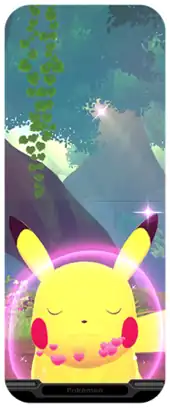
If the player encounters a Pokémon between Grades 2 and 4 beyond the door, they will be given the option to try and befriend it. If the player opts to continue, they will be prompted to rub the touchscreen for a short time in effort to build affection, much like Pokémon-Amie introduced in Pokémon X and Y. Affection is represented by hearts, which can be increased from zero to five. Attaining a higher level of affection will make the Pokémon easier to catch. Once the timer has elapsed, the player will be given the option to insert ¥100 to try and capture the Pokémon. If they do, the player will be prompted to swipe upwards on the touchscreen to throw a Friend Ball at it. If successful, the Pokémon will be dispensed as a Frienda Pick.
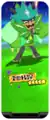
If the player encounters a Grade 5 Super Treasure Pokémon beyond the door, they will engage in a Climax Battle (Japanese: クライマックスバトル). Before the battle begins, players will be given the option to switch one of their Frienda Picks with a new one, which could give a type advantage over the new opponent or simply provide a fresh Pokémon with full HP, as the HP of their party Pokémon will not be replenished. The battle will commence once the player has made their choice. Climax Battles may also randomly start while the player is moving along Exploration Road and can also randomly appear when selecting an area to explore at the start of the game mode.
Climax Battles last two turns and are conducted in the same way as normal Battle and Catch! mode battles. As there is no Exploration Road at this stage, players will not earn any stars during their Pokémon's attack animations or by filling the Catch Gauge of the Super Treasure Pokémon. Climax Battles can also give players the chance to reduce incoming damage from the opponent just as its attack is about to land. If this randomly triggers, players will be prompted to "paint the mark!" (Japanese: マークをぬろう!) and attempt to fill in an appropriate type symbol by using the touchscreen. The Climax Battle will conclude after the second turn and follow up with Last! Catch Time, which will give the player the option to insert ¥100 to try and capture the Super Treasure Pokémon. If they do, they will select a ball on the Ball Roulette as per normal battles; if successful, the Super Treasure Pokémon will be dispensed as a Frienda Pick.
Bonus! Catch Time
The final phase of Battle and Catch! mode is Bonus! Catch Time (Japanese: ボーナス!ゲットタイム Bonus! Get Time), which is similar to Catch now! mode. The player will be presented with a number of grass patches and will have the option to spend ¥100 in order to throw a Quick Ball and dispense a random Frienda Pick. The player is free to exit at any time; however, if they were unsuccessful at capturing a Pokémon beyond the door, the Captain will give the player a free consolation Quick Ball to use (as currency had already been spent).
The number of grass patches present is based on how many Pokémon were dispensed in the session. Possibly based on customer feedback for Pokémon Mezastar, a player can spend no more than ¥600 per session (not including the purchase of a Trainer Pick). With the ¥100 fee to play the game, a player could therefore face a maximum of five grass patches if they did not capture any Pokémon, or a minimum of one if they caught a Pokémon at the end of each turn plus the Pokémon beyond the door. Players will be notified of how many Frienda Picks they have dispensed each time a Pokémon is caught. Grass patches differ in appearance depending on which area the player is exploring. Each patch set will consist of varying sizes and complexities; some may shake and additional graphics may flash above them to give clues as to the Grade of Pokémon they conceal.
The player's avatar will then return to the hub and review their results on a Pokédex-like device. If the player has a Trainer Pick and a Partner Pokémon that is not fully evolved, they will earn stars by playing the game, plus bonus stars equal to the Grade of each Pokémon captured in the session. The player will also be updated on the status of any Frienders Missions in progress. The Captain and the player's avatar will then wave goodbye as the session ends.
Support Pokémon
Support Pokémon (Japanese: サポートポケモン) can come to a player's aid and help turn the tide of battle. To instate a Support Pokémon, players can scan a Support Pokémon Ticket (Japanese: サポートポケモンチケット) on the console Multi-Scanner before they set any Frienda Picks. Support Pokémon Tickets can be obtained digitally through Frienda Circle or physically either in promotional material or via store campaigns. Players can only scan one Support Pokémon Ticket per session; however, those with Trainer Picks will start the battle with a random Pokémon from their current Partner Pokémon roster, allowing them to effectively have two Support Pokémon.
When the player has attacked with one of their Pokémon, Pursuit Chance! (Japanese: ついげきチャンス!) may trigger for a Support Pokémon follow-up attack. If this happens, the Pursuit Roulette (Japanese: ついげきルーレット) will appear, which contains two Support Pokémon spaces and two fail spaces. If the player has a Partner Pokémon, it will occupy the bottom Support Pokémon space. If the player successfully selects a Support Pokémon space, that Pokémon will be summoned to attack. Players can press the console buttons during the animation just as they can when their main Pokémon attacks; however, no stars can be accumulated during this phase.
If any of the player's main Pokémon become unable to battle during the session, a Support Pokémon will take its place and become useable. If a main Pokémon became unable to battle before it had a chance to use its move, a Support Pokémon may use a Substitution Attack! (Japanese: こうたいアタック!) and use its move before taking the place of the main Pokémon. If the player has more than one Support Pokémon in either situation, they can select which one to use. If the player does not have any Support Pokémon that can take the place of any Pokémon unable to battle, the game may provide a randomly assigned Help Pokémon (Japanese: おたすけポケモン) for the player to use.
Terastal Chance!
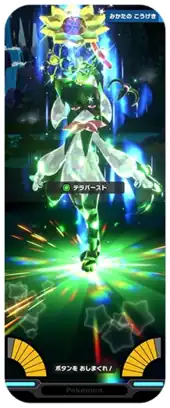
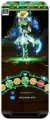
Terastal Chance! (Japanese: テラスタルチャンス!) will activate when players use a Pokémon that can Terastallize in battle. Players will first be asked if they own a Pokémon Tera Orb, sold separately; if they do, they will be asked to remove the relevant Frienda Pick from its recess and position the Tera Orb in its place. Either way, players will then be presented with a large Terastal mark and prompted to build Terastal energy by swiping horizontally on the touchscreen. After three spins, a roulette containing six spaces will appear around the mark. If the player has a Tera Orb, all of these spaces will bear a Terastal mark, otherwise they will comprise four fail spaces and two Terastal mark spaces. Continuing to spin the large Terastal mark can change any fail spaces into Terastal mark spaces or power up existing Terastal mark spaces. After a short time, the roulette will then spin around the spaces and players can stop it by pressing either the touchscreen or one of the console buttons. If players select a standard Terastal mark, "Success!" (Japanese: せいこう!) will display; if they select a powered up Terastal mark, "Great Success!" (Japanese: だいせいこう!) will display. Selecting any Terastal mark will allow the Pokémon to Terastallize.
When a Terastallized Pokémon attacks, the Attack Roulette will apply a Terastal Bonus! (Japanese: テラスタルボーナス!), which upgrades the smallest value to a Tera Burst Mark (Japanese: テラバーストマーク). If players achieved "Success!" on the roulette, the value on the Tera Burst Mark will increase by 30. If they achieved "Great Success!", the Tera Burst Mark value will increase by 35, and the other two values on the roulette will increase by 10. Additionally, if players used a Tera Orb, the Attack Roulette will apply a Tera Orb Bonus! (Japanese: テラスタルオーブボーナス! Terastal Orb Bonus!), further boosting the Tera Burst Mark value by 10. Terastallized Pokémon will use the Terastal move detailed on their Frienda Pick—its type reflects the Tera Type it will adopt upon Terastallizing. A Pokémon will remain Terastallized for as long as it is able to battle and only one Pokémon may Terastallize per session.
Z-Move Chance!
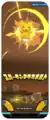
Z-Move Chance! (Japanese: Zワザチャンス!) will trigger when a Pokémon that has access to a Z-Move attacks. If the player decides to use a Z-Move, they can increase its Z-Power (Japanese: Zパワー) by following the prompts on the touchscreen as their avatar performs the appropriate pose. Players can press the console buttons during the animation of a Pokémon's Z-Move to generate stars as they can with a normal move. If a Pokémon uses a Z-Move, the game will forego the Attack Roulette and any possible Pursuit Roulette for that turn. Z-Moves can only be used once per session.
Mega Evolution Chance!
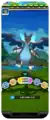
Introduced during the fifth set, Mega Evolution Chance! (Japanese: メガシンカチャンス!) will trigger when a Pokémon capable of Mega Evolution attacks. If the player decides to Mega Evolve their Pokémon, they will be presented with a rhythm game-esque "highway" of Mega Evolution marks and will be challenged to touch the Mega Evolution mark at the bottom of the screen as they intersect. Doing so accurately will increase the Pokémon's Mega Evolution Power (Japanese: メガシンカパワー). A total of five Mega Evolution marks will move down, and if the player is accurate enough with at least two marks, the Pokémon will Mega Evolve.
When a Mega Evolved Pokémon attacks, the Attack Roulette will apply a Mega Evolution Bonus! (Japanese: メガシンカボーナス!) and upgrade the largest value to a double-size rainbow-colored space with a value equal to the Mega Evolution Power attained. A Pokémon will remain in its Mega Evolved form for as long as it is able to battle and only one Pokémon may Mega Evolve per session.[2]
Tag Attack Chance!
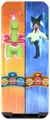
Introduced at the start of the Best Tag series, Tag Attack Chance! (Japanese: タッグわざチャンス!) will trigger when a Pokémon that has a tag partner attempts to attack. During this phase, the player will be presented with a graphic that contains moving icons of the Pokémon and its tag partner. If the player presses both console buttons while the icons are in the blue area, they will be presented with an Attack Roulette for each Pokémon. The bonuses attained from the roulettes are then added together and applied before the two Pokémon attack in unison.
Treasure Tag Battle

A Treasure Tag Battle (Japanese: トレジャータッグバトル) is a cooperative battle against a Super Treasure Pokémon that can take place at any time while both stations on a machine are in use. Players in the middle of a battle can continue on their station or stop and take part in the Treasure Tag Battle. If only one player opts to take part, they will challenge the Super Treasure Pokémon alone without the cooperative features. If both players take part, the on-screen partition disappears and the battle is displayed fullscreen.
Both players can then set three new Pokémon as they would at the start of a normal battle and have three turns to fill the Super Treasure Pokémon's Catch Gauge as much as possible. Before their Pokémon are brought onto the field, both players will have a chance to earn a Perfect Bonus! by touching the hand graphic just as it illuminates on the touchscreen. An Attack Roulette is displayed for each player once they select a Pokémon to attack—the highest value of the two will be the bonus damage applied. When the attack animations play for their Pokémon, players can press their respective console buttons to increase their attack power further. Like Climax Battles, the game may give players the opportunity to reduce incoming damage by painting in the appropriate type symbol when the Super Treasure Pokémon attacks.
If the Super Treasure Pokémon's Catch Gauge is more than half full at the start of a turn, the game may display the message Everyone Attack! (Japanese: みんなでこうげき!) and prompt the players to swipe the type symbols that appear on the touchscreen up towards the Catch Gauge in effort to fill it. If Everyone Attack! was carried out on any turn except the last turn and players were unsuccessful, the next turn will play as normal.
Last! Catch Time follows the battle and both players have the option to insert ¥100 to throw a Poké Ball at the Super Treasure Pokémon. If both opt to do so, a Ball Roulette will be displayed for each player. Similarly to the Attack Roulette, the highest grade Poké Ball chosen will be the one thrown. Unlike normal battles, no capture is guaranteed, and if the Super Treasure Pokémon breaks free, each player receives a consolation Quick Ball to use in Bonus! Catch Time. If the Super Treasure Pokémon is successfully caught, both players receive a copy of the Frienda Pick.
Trainer Picks
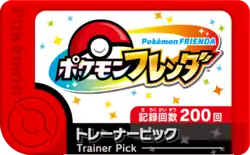
A Trainer Pick (Japanese: トレーナーピック) allows players to record their activity in Pokémon Frienda and fully utilize the game's features. Trainer Picks are the same size and shape as regular Frienda Picks but are colored red. If a player does not have a Trainer Pick, the game will give them the option to purchase one from the title screen for ¥200. Trainer Picks with different designs can also be found in Pokémon Frienda products. Standard Trainer Picks have a limit of 200 saves; Trial Trainer Picks have a limit of 10 saves. Once the maximum allocation of data saves has been reached, players can transfer their data to a new Trainer Pick.
When a player first registers a Trainer Pick, they can select one of six profile images (comprising three male and three female options), one of four color styles for it, their age in years, and their birth month. The larger QR code on the reverse of Trainer Picks can be used to register the player on Frienda Circle (Japanese: フレンダサークル), an online service where they can review their profile, see which Pokémon they have encountered and caught, receive exclusive Support Pokémon Tickets, and customize their avatar with Dress-up Items (Japanese: きせかえアイテム). A dedicated Frienda Circle app could also be downloaded onto iOS and Android devices, which allowed people to review the details of up to five Trainer Picks per profile.
Trainer Picks also allow players to have a Partner Pokémon (Japanese: パートナーポケモン) that can be used as a Support Pokémon from the start of a battle. Each set offers at least one new Pokémon to choose from, which is the earliest in a three-stage evolutionary line. Players can evolve their Partner Pokémon by earning stars during gameplay (different to those used for Exploration Road). If a player has no Partner Pokémon in their roster, they can select one to use right away, otherwise they will have to hatch their selection from an Egg by earning stars. A player can continue to add Pokémon to their Partner Pokémon roster each time their current one reaches its final Evolution stage. If all possible Partner Pokémon are fully evolved, stars will no longer be awarded. Having a Trainer Pick also adds an extra Master Ball to the Ball Roulette during the Catch Time and Last! Catch Time phases.
Catch now! mode
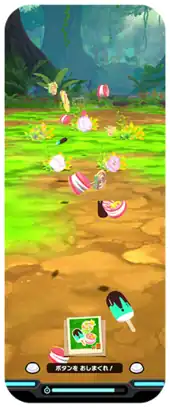
Selecting Catch now! mode will send the player to an area with five grass patches of varying sizes, much like the Bonus! Catch Time phase of gameplay in Battle and Catch! mode. Players will then have a short amount of time to throw sweets at the grass patches and attract Pokémon. Patches that have additional graphics above them after throwing sweets denote they may hide higher-Grade Pokémon. Players can then opt to deposit ¥100 and catch a Pokémon. If they do, a cursor will quickly move between patches, which will stop when the player swipes upwards on the touchscreen to throw a Quick Ball. The captured Pokémon will then be revealed and dispensed as a Frienda Pick. Players can continue to throw Quick Balls at the remaining patches, costing ¥100 each time. If a player opts not to insert any currency or catches all five available Pokémon, Catch now! mode will end. If the player has a Trainer Pick and a Partner Pokémon that is not fully evolved, they will earn stars equal to the Grade of each Pokémon captured. The Captain and the player's avatar will then wave goodbye as the session ends.
Pokémon Frienda TV
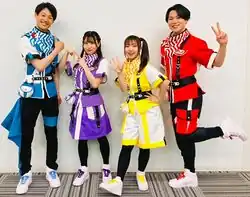
Each of the developer's previous titles has had at least one presenter to promote the game in various media and provide a presence at official events. Pokémon Frienda has a team of four presenters called Frienda Navigators (Japanese: フレンダナビゲーター) that wear explorer-inspired attire designed by Creative Works Velonyca.[3] The initial team comprised:
- Hiroto (Japanese: ヒロト), portrayed by Hiroto Kitazawa.[4] He wears a light blue outfit and specializes in knowledge related to Frienda Picks.
- Nagisa (Japanese: ナギサ), portrayed by Nagisa Hinata.[5] She wears a purple outfit and focuses on collecting Grade 5 Frienda Picks.
- Mai (Japanese: マイ), portrayed by Mai Endo.[6] She wears a yellow outfit and excels at searching for and collecting the rarest Pokémon possible.
- Jin (Japanese: じん), portrayed by Jin Takeuchi.[7] He wears a red outfit and serves as the comedic relief.
The team appears in episodes uploaded to an official YouTube channel called Pokémon Frienda TV, which provides weekly updates and demonstrations of the game. It took over from its initial incarnation, Mezastar TV, on May 31, 2024 following the upload of the final Mezastar TV episode. New episodes are uploaded every Friday, with additional content, such as Pokémon Frienda advertisements and other videos, occasionally posted on other days.
A rival team (Japanese: フレン団 Frien-dan) was introduced on September 1, 2024 at the CoroCoro Spirit Festival in Tokyo Toy Show 2024.[8] This team consists of two members:
- Big Summer (Japanese: ビッグ・サマー), portrayed by Atsuya Natsuyagi[9]
- Shiora (Japanese: シオーラ), portrayed by Sakura Nishio[10]
The pair began to appear more frequently in Pokémon Frienda TV episodes, sometimes competing against the Frienda Navigators, but also joining them and starring in their own episodes. Their team name is a play on the group of explorers players join in-game, the Frienders, featuring the suffix villainous teams typically have in other Pokémon titles.
On June 20, 2025, it was announced that Hiroto was graduating and that his activities as a Frienda Navigator would cease,[11] although he had not appeared in a Pokémon Frienda TV episode since April 4, 2025. A new character named Captain Jun (Japanese: キャプテンジュン) made an appearance in the June 27, 2025 episode. He is portrayed by Pokémon Mezastar TV alumnus Jun Ishihara[12] and wears an outfit similar to the in-game character Captain, sporting a blue neckerchief and reflective goggles.
Gallery
-
 Logo
Logo -
 Selecting a base avatar
 -
 Mode selection
 -
 Committing Pokémon to battle
 -
 A battle about to begin
 -
 Attaining a Perfect!
 -
 Priming Pokémon
 -
 First Attack Chance!
 -
 The Attack Roulette
 -
-
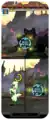 Pokémon entering the Catch Chance! state
 -
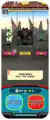 Catch Time
 -
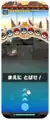 The Ball Roulette
 -
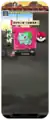 Successfully catching a Pokémon
 -
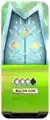 Reaching the door
 -
 Opening the door
 -
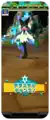 Terastal Chance!
 -
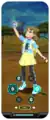 The Terastal Roulette
 -
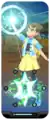 Building up Terastal energy
 -
 The Terastal Attack Roulette
 -
 Z-Move Chance!
 -
 Building Z-Power
 -
 A Pikachu using Gigavolt Havoc
 -
 A Climax Battle about to begin
 -
 Being offered a trade in Trade Chance!
 -
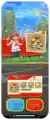 Being challenged to a Trainer Battle
 -
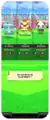 The start of a Trainer Battle
 -
 Successfully completing a Trainer Battle
 -
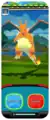 Mega Evolution Chance!
 -
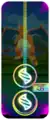 Building Mega Evolution Power
 -
 A Charizard Mega Evolving into a Mega Charizard X
 -
 The Mega Evolution Bonus! on the Attack Roulette
 -
 Tag Attack Chance!
 -
 Trying to begin a Tag Attack
 -
 Two Attack Roulettes during a Tag Attack
 -
 A Meganium and a Meowscarada using their moves together
Related articles
References
- ↑ 1.0 1.1 タッチパネル搭載の新アミューズメントマシン登場! 『ポケモンフレンダ』2024年7月より順次稼動予定 | PR TIMES (archived)
- ↑ メガシンカチャンス | Official Pokémon Frienda website how-to-play details (archived)
- ↑ 北澤 大斗 | Creative Works Velonyca official site (archived)
- ↑ 北澤 大斗 | MAIMU Pro official site (archived)
- ↑ 日向渚プロフィール | KeKKe Corporation Official Web Site (archived)
- ↑ 遠藤 麻衣 | Timely Office official site (archived)
- ↑ 竹内 仁 | LEOPARD STEEL Entertainment Production official site (archived)
- ↑ ポケモンフレンダ【公式】 on Twitter (archived)
- ↑ 夏八木 敦也 | MYSTAR LLC Site (archived)
- ↑ 西尾 咲良 | Timely Office official site (archived)
- ↑ フレンダナビゲーター・ヒロトの卒業に関するお知らせ | Official Pokémon Frienda website (archived)
- ↑ 石原純プロフィール | KeKKe Corporation Official Web Site (archived)

|
This article is part of Project Arcade, a Bulbapedia project that covers all aspects of Pokémon arcade games. |