e-Reader
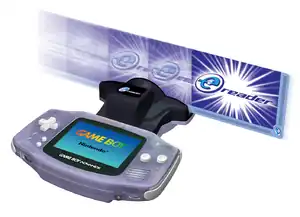
The e-Reader (Japanese: カードeリーダー Card e Reader) is a peripheral for the Game Boy Advance that is used to scan special cards in order to unlock new features in existing games, add new features to games that have e-Reader functionality, or to play minigames on the e-Reader itself. It was developed jointly by Creatures, Inc., HAL Laboratory, Inc., and Olympus.
The original Japanese Card e Reader (カードeリーダー) was released exclusively in Japan on December 1, 2001.[1] The Card e Reader + (カードeリーダー+), which added the Game Link Cable port, was released in Japan on June 23, 2003.[2] The e-Reader, which has the same functionality as the Card e Reader +, was released in North America on September 16, 2002[3] and in Australia on October 31, 2003.[4] The e-Reader was not released in Europe.[5] Using a Game Link Cable, the e-Reader can connect to a Nintendo GameCube or a second Game Boy Advance system to send data to a game on that system.
Though it was popular in Japan, with e-Cards released until the end of the Game Boy Advance's lifespan, the e-Reader proved to be unpopular in North America, leading to its discontinuation in 2004. e-Reader functionality, included in the Japanese versions of Pokémon FireRed, LeafGreen, and Emerald, was removed from the English and other translations, as the compatible cards were never planned to be released. Due to this early discontinuation, the e-Reader was only released in North America and Australia, though e-Cards were released in Europe as well.
Technical specifications
- "Dot Code Technology" (Optical scanning technology)
- 8 Megabit flash memory
- 64 Megabyte mask ROM
- The long strip on each e-Card holds 2.2 kilobytes of data.
- The short strip holds 1.4 kilobytes of data.
- Passthrough game link port
Release
To promote the e-Reader prior to its English release, kiosks with built-in Game Boy Advance consoles and e-Reader devices used three placeholder e-Cards to demonstrate its functionality: a "Manhole" card along with Pichu (Expedition 58) and Hoppip (Expedition 112). These three cards, which are slightly thicker than usual Pokémon cards and have a glossy finish, were all hole-punched so they could be attached to the device via a cable to prevent loss or theft whilst allowing enough flexibility for the cards to still be swiped. The same cards were handed out at E3 2002 (which also included a Kirby e-Card); however, the Pokémon cards at E3 are regular thickness cards without a glossy finish and have a Japanese back instead of a regular English back.
In Japan, the Card e Reader + was bundled with Doubutsu no Mori e+ — an enhanced version of Animal Crossing for GameCube that includes many of the features added in the Western release, as well as e-Reader support. The Card e Reader + was also sold separately. The Card e Reader +, Doubutsu no Mori e+, Pokémon Battle e: Series 1 e-Cards, and Doubutsu no Mori e+: Series 1 e-Cards all released on June 23, 2003 in Japan.[2]
In Australia, the e-Reader was released on October 31, 2003, the same day as the Pokémon Battle e: Series 1 e-Cards, alongside the Mario Bros.-e, Tennis-e, and Excitebike-e e-Card sets.[4]
Pokémon e-Cards
- The Pokémon Battle e card series
- The Sample Set demonstration series
- The Expedition Base Set TCG expansion
- The Aquapolis TCG expansion
- The Skyridge TCG expansion
- The EX Ruby and Sapphire TCG expansion (Pokédex entries only)
- The EX Sandstorm TCG expansion (Pokédex entries only)
- The EX Dragon TCG expansion (Pokédex entries only)
- The EX Team Magma vs Team Aqua TCG expansion (Pokédex entries only, select cards only)
- Select Wizards Black Star Promos and Nintendo promotional TCG cards.
- The P Promotional cards (Japan)
- The McDonald's Pokémon-e Minimum Pack (Japan)
- The Theater Limited VS Pack (Japan, select cards only)
- Special cards containing extra features for the Smeargle Paint minigame in Pokémon Channel
- Special cards allowing a player to increase the likelihood of special events in Pokémon Pinball: Ruby & Sapphire
- Two cards distributed with Pokémon Scoop's Winter 2004 magazine containing the Berry Program Update, fixing the Berry glitch in Pokémon Ruby and Sapphire.
Gallery
-
 The original Japanese Card e Reader
 -
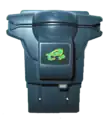 The Japanese Card e Reader +
 -
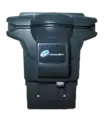 English language e-Reader, based on the Japanese Card e Reader +
Trivia
- The minigame Machop At Work was included with the purchase of an e-Reader in the United States.
- According to Nintendo Power v.169, it would take roughly 62,500 e-Reader cards to equal the data on one GameCube disc.
- However, this is a gross understatement when checked mathematically. Assuming the cards used have two long strips of 2.2KB each (for 4.4KB per card) it would take 331,819 e-Reader cards.
- The device was originally going to be called the "Pokémon Card-e-Reader", and the only mentioned functionality for it was reading Pokémon TCG cards.[7]
- e-Reader cards can be reliably scanned through a thin plastic sleeve, such as a penny sleeve or a perfect fit sleeve, so long as the sleeve is not significantly scratched or damaged.
References
- ↑ カードeリーダー Nintendo.co.jp
- ↑ 2.0 2.1 『カードeリーダー+』の発売に関して Nintendo.co.jp
- ↑ E-Reader release date and details! Nintendo World Report
- ↑ 4.0 4.1 DASH INTO STORES NOW!! Nintendo Australia
- ↑ Nintendo will not release E-Reader in Europe Eurogamer
- ↑ Vidgame.net: Nintendo E-Reader
- ↑ 2001 e3 -- POKéMON CARD-E-READER Fact Sheet
Communications media
| ||
|---|---|---|
| Gen I | Game Link Cable • Transfer Pak • 3DS Wireless (VC) | |
| Gen II | Game Link Cable • Infrared • Transfer Pak • Mobile Game Boy Adapter • 3DS Wireless (VC) | |
| Gen III | Game Link Cable • Wireless Adapter • Dual-slot mode • | |
| Gen IV | DS Wireless • Wi-Fi • Dual-slot mode • Infrared | |
| Gen V | DS Wireless • Wi-Fi • Infrared | |
| Gen VI | 3DS Wireless • Nintendo Network • Infrared • StreetPass • SpotPass | |
| Gen VII | 3DS Wireless • Switch Wireless • Nintendo Network • Infrared • Nintendo Switch Online • Bluetooth | |
| Gen VIII | Switch Wireless • Nintendo Switch Online | |
| Gen IX | Switch Wireless • Switch 2 Wireless • Nintendo Switch Online | |