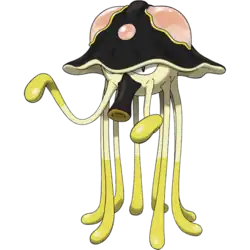
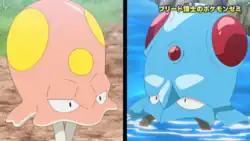
The subject of this article has no official name. The name currently in use is a fan designator; see below for more information.
Dugtrio and its ecologically similar counterpart, Wugtrio
Certain Pokémon are described as closely resembling[1] or being ecologically similar[2] (Japanese: 生態は似ている[3]ecologically similar) to previously discovered species, but are otherwise completely different Pokémon. This concept was first introduced in Generation IX alongside the reveal of Wiglett before the release of Pokémon Scarlet and Violet.[4]
They are sometimes referred to by fans as convergent Pokémon or convergent species, relating the concept to convergent evolution in biology, or regional fakes, due to their similarity to regional forms, which are different forms of the same Pokémon. So far, six of these Pokémon have been introduced. Jacq is known for his research on these Pokémon in collaboration with the World Pokémon Ecological Society.[4]
Ecologically similar Pokémon tend to have similar, though not always identical, base stats.
These Pokémon were first identified by the World Pokémon Ecological Society after the discovery of Wiglett during a survey.[4] Wiglett was initially mistaken as a possible Paldean form of Diglett before it was determined that it was a different species entirely and the similarities were merely coincidental.
Though it looks like Diglett, Wiglett is an entirely different species. The resemblance seems to be a coincidental result of environmental adaptation.
Jacq's memo from the World Pokémon Ecological Society conference:
This Pokémon that lives on the beach or in the sea of the Paldea region would be Wiglett. Although they appeared to be the Paldean Form of Diglett, we've learned that they live and eat differently as if they are entirely different Pokémon. According to the research, it is said that it is a coincidence that they have similar bodies, as they both burrow in the ground and the sand.
It’s said that Wiglett’s resemblance to Diglett might be a mere coincidence—a result of its adaptation to its environment.
Though It May Closely Resemble Diglett, It’s a Completely Different Pokémon: It may look like Diglett, but it’s actually a completely different species of Pokémon. Wiglett pokes a part of its body out of the sand to feed in the ocean. It’s still unclear what the rest of its body hidden in the sand is like or how long it might be.
It may resemble Sinistea at a glance, but Poltchageist is actually an entirely different species of Pokémon.
Though Ecologically Similar to Sinistea, It’s a Completely Different Pokémon: Poltchageist has a swirl pattern similar to the one that’s known to be Sinistea’s weak point. However, one thing that sets these species apart is that Poltchageist’s swirl is not its weak point. After a target is sprinkled with some of Poltchageist’s powdery body or eats food dusted with it, Poltchageist drains their life-force and absorbs it as energy.
These Pokémon are similar to the Paradox Pokémon in that they bear a striking resemblance to certain Pokémon but are nonetheless completely different species.
These Pokémon are all part of a two-stage evolutionary line.
The Poltchageist and Sinistea families are the only ecologically similar Pokémon that share a type, the only ones to share Egg Groups with each other, and the only ones to have multiple forms.
Additionally, they are the only ones which are named after the inverse of their counterparts, with Poltchageist's evolved form Sinistcha being named after Polteageist's unevolved form Sinistea, and vice versa.
In the code of Pokémon Scarlet and Violet, Toedscool and Toedscruel are referred to as "OKAKINGU" (hill king, from Koiking, Magikarp's Japanese name) and "OKAGYARADOSU" (hill Gyarados), respectively, suggesting that they may have replaced a scrapped evolutionary line based on Magikarp and Gyarados.
The newer Pokémon of each ecologically similar pairing always have the type advantage against their original counterpart. For example, the Water type of Wiglett's line is strong against the Ground type of Diglett's.
In Poltchageist's case, however, both its line and its counterpart's are super effective against each other, since Ghost-type moves are super effective against Ghost-type Pokémon.
The Pokédex entries for the Galarianlegendary birds imply that their similarities to the Kantonian legendary birds could be a coincidence, and that they might actually be completely different Pokémon that were given the same names based on their physical appearance. Despite this, they are still categorized as the same species.
Origin
While Poltchageist and Sinistea are described as "ecologically similar",[2] it may be more accurate to describe the pairs of similar Pokémon in this group as "morphologically similar", as while they have similar physical characteristics, many of them occupy very different ecological niches. The concept resembles convergent evolution and parallel evolution in evolutionary biology, both of which can lead to separate organisms independently developing similar or identical characteristics and body plans.
In other languages
Though It May Closely Resemble Diglett, It’s a Completely Different Pokémon