Form
- If you were looking for the various Pokémon body shapes called forms in Generation IV and V, see List of Pokémon by shape.
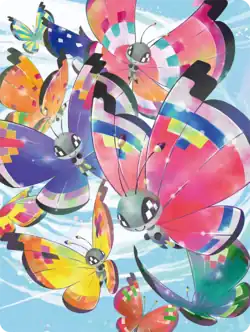
Many Pokémon have multiple forms (Japanese: 姿 form) or variations that differ in appearance between individuals of the same species. These appearances are different from Evolution, as a Pokémon's different forms are considered the same species. Two forms of the same species can differ vastly, including a difference in their type, height and weight, Ability, base stats, or even gender.
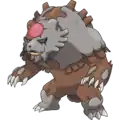
Certain Pokémon are able to undergo a form change (Japanese フォルムチェンジ Forme change), in which they change from one form to another when specific requirements or conditions are met.[1] Unlike Evolution[2] and Shiny Pokémon[3], a Pokémon who undergoes a form change is able to return to their original form. Not all Pokémon with known forms are able to change between them, such as most regional forms. Additionally, some Pokémon undergo a variation in appearance that is uncontrolled by either form change or Evolution, such as Bloodmoon Ursaluna.[4]
Terminology
A difference in appearance of a Pokémon that is unattributed to Evolution is known as a form (Japanese: 姿 form). Some of these alternate appearances are instead named using the French word Forme (Japanese: フォルム Forme). Most form names are formatted as proper nouns and end with either the word "Form" or "Forme".
The term "form change" is the process in which a species can alternate between one or more existing forms. This process has also been translated as "Forme change"[5], to "change forms",[6][7] and "Forme Change".[8]
Types of forms and variations

Form differences and other transformations
- Main article: List of Pokémon with form differences
Many of the major form variations are officially recognized by the Pokédex.
The difference between two forms a species can take on vastly depends on the mechanism in which a Pokémon takes on the alternate appearance. Most of these differences typically fall under one of two patterns. Form change allows certain Pokémon to change between their different forms, such as with Castform or Oricorio, while other Pokémon have forms that are permanent and noninterchangeable, such as Unown. Form changes can be activated either by Ability, an item, current health, level, either by using a move, the environment, or a combination of the listed. Not all form differences result in gameplay changes, such as with Flabébé and Xerneas, whose form differences are purely cosmetic.
Some Pokémon have alternate forms, states, stances, or other properties that are unrecognized by the Pokédex, but may still be described as different forms in Pokédex descriptions or game dialogue. These types of variations are often not described as forms mechanically and are usually seen as part of a Pokémon's animations for attacks or cinematics during gameplay. For example, Cyclizar is known to take on three different forms: Ride, Battle, and Basic form, with its posture changing based on activity.
Shiny Pokémon
- Main article: Shiny Pokémon
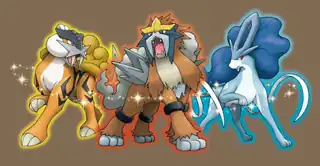
Making their appearance in Pokémon Gold and Silver, Shiny Pokémon provide a unique coloration from how a species or form may otherwise appear. With a rarity of approximately 1/4000 (1/8000 prior to Generation V), Shiny Pokémon can usually be obtained through the same methods as any standard color Pokémon. A Shiny Pokémon's differences are purely cosmetic and do not affect gameplay, and are typically sought out by collectors for their rarity. Most Shiny Pokémon appear with a shining glitter or confetti-like effect when first encountered, giving them their name. Shiny Pokémon are recognized as forms in the Pokédex starting in Pokémon Black and White.
All species and forms have a unique Shiny coloration (among exceptions), but certain games may provide a Shiny lock on certain species, making their Shiny appearance unobtainable through standard methods.
-
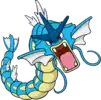 Gyarados
 -
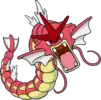 Shiny Gyarados
Gender differences
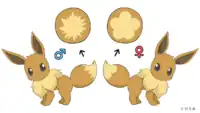
- Main article: List of Pokémon with gender differences
Though the majority of Pokémon have no visual distinction between their genders, there are some that do. Gender differences were introduced in Generation IV, with multiple Pokémon from earlier generations having been updated to have these differences in addition to new Pokémon. Most gender differences have no in-game effect beyond the Pokémon's appearance; however, there are a number of exceptions, with Meowstic, Indeedee, and Oinkologne also differing in Abilities and the moves they can learn, while Indeedee, Basculegion, and Oinkologne differ in base stats.
Fusion
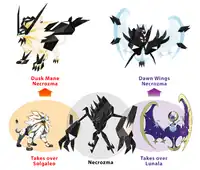
- Main article: Pokémon fusion
Originally introduced with Pokémon Black 2 and White 2, three groups of Pokémon are known to have the ability to fuse with another, those being Kyurem, Necrozma, and Calyrex. Pokémon fusion[9] requires the base species, their host (the Pokémon who it is combining with), and an item to tie the two together. Fusion between Pokémon will allow the base Pokémon to gain the properties of its host, including type, Ability, and the usage of some moves.
Kyurem is the only one with a named method of fusion, Absofusion (Japanese: 吸収合体 Absorb Union), but all three species have been described as "fusing" with another. Necrozma's fusion with Solgaleo and Lunala is mechanically required for it to Ultra Burst into Ultra Necrozma.
-
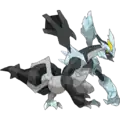 Black Kyurem
 -
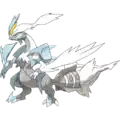 White Kyurem
 -
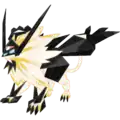 Dusk Mane Necrozma
 -
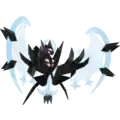 Dawn Wings Necrozma
 -
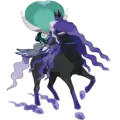 Shadow Rider Calyrex
 -
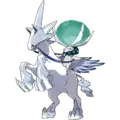 Ice Rider Calyrex
Mega Evolution
- Main article: Mega Evolution
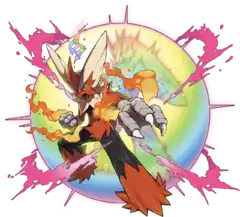
Pokémon X and Y introduced Mega Evolution, allowing certain Pokémon to achieve a more powerful form in battle. Mega Evolution may only be achieved if the Pokémon's Trainer possesses a Key Stone and the Pokémon holds the Mega Stone corresponding to its species, and a Trainer can only Mega Evolve their Pokémon once per battle. In addition to altering the Pokémon's appearance, Mega Evolution changes its base stats and may also change its type and Ability. In the core series, Mega Evolution appears in all Generation VI and Generation VII games, as well as Pokémon Legends: Z-A.
As an exception to the above, Rayquaza does not hold a Mega Stone, but instead, requires the move Dragon Ascent. Rayquaza holding a Z-Crystal will be prevented from Mega Evolving. There are currently 51 different Mega-Evolved forms, of which there are 49 species able to Mega Evolve.
Primal Reversion
- Main article: Primal Reversion
Starting with Pokémon Omega Ruby and Alpha Sapphire, Kyogre and Groudon have the ability to revert to a primal state through usage of Natural Energy. Similar to Mega Evolution, Primal Reversion causes a Pokémon's base stat total to increase by 100. They are given new Abilities, and Groudon earns a new type. Unlike Mega Evolution, Primal Reversion does not require a Key Stone, and the Pokémon is able to transform at the start of battle by simply holding either a Red or Blue Orb. Multiple Pokémon can undergo Primal Reversion in battle.
-
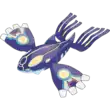 Primal Kyogre
 -
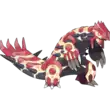 Primal Groudon
Regional forms
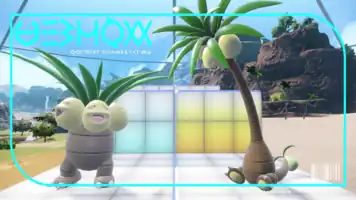
- Main article: Regional form
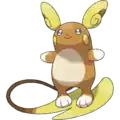
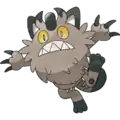
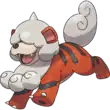
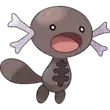
Introduced in Pokémon Sun and Moon, regional forms, formerly known as regional variants, are Pokémon that have adapted specifically to the environment of the region they reside in and thus differ in appearance from their previously discovered counterparts. They may also differ in other attributes, such as type, moves, Ability, or base stats. There are four known classifications of regional forms: the Alolan forms found in Alola, the Galarian forms found in Galar, the Hisuian forms found in Hisui, and the Paldean forms found in Paldea.
Dynamax forms
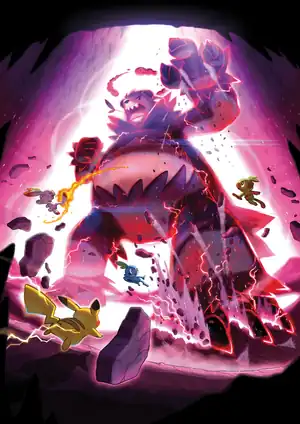
- Main article: Dynamax
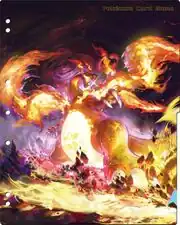
Introduced in Pokémon Sword and Shield, the Dynamax phenomenon is a particular transformation that causes a Pokémon to grow to extreme sizes for three turns. These Dynamax forms[10] will increase a Pokémon's HP and change all their moves to Max Moves. Additionally, they ignore certain properties of other moves, such as those affecting weight, due to their tremendous size. In the core series, this phenomenon is stated to be found only within specific locations in the Galar region. Dynamax is not recognized by the Pokédex in the core series, despite being described as a form.
In Pokémon GO, Pokémon who are able to Dynamax are considered a separate form than those of the same species and appearance, whereas in other titles, any Pokémon are able Dynamax.
Gigantamax forms
- Main article: Gigantamax
In Pokémon Sword and Shield, Gigantamax was introduced. It is a special type of Dynamax that causes the Pokémon's appearance to change beyond a simple increase in size. Only certain species of Pokémon can Gigantamax, and even among Pokémon with Gigantamax forms, only those possessing a trait known as the Gigantamax Factor may Gigantamax. Gigantamaxing has many of the same effects as regular Dynamaxing; however, when a Pokémon Gigantamaxes, its attacking moves of a certain type are replaced with that Pokémon's exclusive G-Max Move, rather than regular Max Moves.
With the exception of Melmetal, a species with a Gigantamax form may eat Max Soup in order to gain the ability to Gigantamax or revert into being able to Dynamax instead. There are 32 known Gigantamax forms, and 32 different species that are able to Gigantamax.
Terastallized states

- Main article: Terastal phenomenon
The Terastal phenomenon was introduced in Pokémon Scarlet and Violet. While Terastallized, a Pokémon takes on a crystallized appearance, allowing them to change into a special type known as a Tera Type. This appearance is accompanied by a giant gem known as a Tera Jewel that rests on the Pokémon's head signifying the newly received type. While in a Terastallized state, the Pokémon's moves gain multiple usage properties, such as an increase in STAB. The Stellar type is a type exclusive to Terastallized Pokémon, encompassing the power of all types.
Two species have unique Terastallized states, Ogerpon and Terapagos. This prevents them from changing their Tera Type by using Tera Shards. Terapagos' Terastallized state, its Stellar Form, is recognized by the Pokédex, unlike other forms of Terastallization.
-
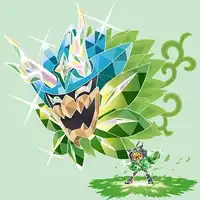 Terastallized Ogerpon (Teal Mask)
 -
 Terastallized Ogerpon (Wellspring Mask)
 -
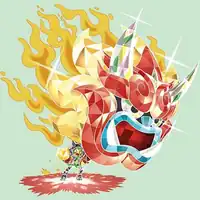 Terastallized Ogerpon (Hearthflame Mask)
 -
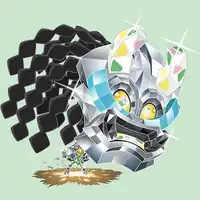 Terastallized Ogerpon (Cornerstone Mask)
 -
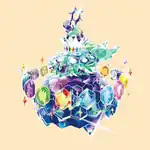 Terastallized Terapagos (Stellar Form)
Unique individuals
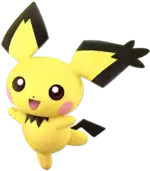
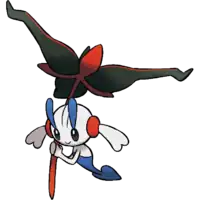
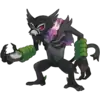
Some Pokémon have a unique appearance unattributed to any sort of Evolution or form change (with exception of Ash-Greninja, who's base form is visually identical to that of ordinary Greninja). These appearances are registered as forms in the Pokédex, however they are represented by only a single member of their species, making them stand-out from not only their own species, but other form types. Because of their unique appearances, these forms are unable to pass down through breeding. Many of these unique individuals go beyond aesthetic differences, having unique moves, height and weight, Abilities, base stats, or Z-Moves. Cosplay Pikachu and Greninja with Battle Bond are the only ones among this list who have a form change within their individual forms, while Pikachu in a cap are the only collection of individuals who cannot change form between the related forms.
Eternal Flower Floette was never officially released, but remains in data for the 3DS Generation VI and Generation VII titles. The Spiky-Eared Pichu cannot be transferred or traded, and the Cosplay Pikachu is unable to be transferred. Additionally, Greninja with Battle Bond are incapable of transforming into Ash-Greninja in Pokémon Scarlet and Violet.



Other variations
- Main article: Variant Pokémon
Some Pokémon have other variations that may not be recognized by the Pokédex as distinct forms, such as Shadow Pokémon, Pokémon fusions, giant Pokémon, cloned Pokémon, mirage Pokémon, and toy Pokémon, as well as several other unique variations affecting individuals or groups of Pokémon.
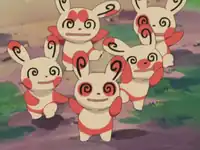
Spinda is a Pokémon known for each member of the species possessing a unique pattern of spots. It is an example of the variation a Pokémon can even within its own species. In Generation VII exclusively, Spinda's Pokédex may display male and female variants in the model viewer and portraits, similar to Pokémon with gender differences.
In other languages
Form
| ||||||||||||||||||||||||||||||||||||||||||||||||||
Forme
| ||||||||||||||||||||||||||||||||||||||||||||||||||
Form change/Forme change
| ||||||||||||||||||||||||||
References
- ↑ Jacq: "There’s also a phenomenon called a form change, where a Pokémon’s appearance changes under certain conditions." (Pokémon Scarlet and Violet).
- ↑ Lillie: "It’s not actually evolving but undergoing a so-called “form change.” (Pokémon Sun and Moon)
- ↑ Jacq: "Form changes are different from Evolution in that the Pokémon can return to its original form. And unlike Shiny Pokémon, which can’t change their special coloration, the same individual Pokémon can go back and forth between its forms." (Pokémon Scarlet and Violet)
- ↑ "The Pokémon is unique in that its altered appearance cannot be attributed to Evolution or form change." - Pokémon Scarlet and Violet official website.
- ↑ "Changing your hairstyle is like a Forme change for people!" - Pokémon X and Y
- ↑ "The nectar that lets Oricorio change forms is a bit different from one meadow to the next." - Pokémon Sun and Moon
- ↑ "Some Pokémon can also change forms, which can change how they look and their stats." - Pokémon Sun and Moon
- ↑ "This Zygarde has the Power Construct Ability, which allows Zygarde to Forme Change!" - Reassembly Unit, (Pokémon Sun and Moon)
- ↑ "I happen to know quite a bit about Pokémon fusion myself..." - Colress (Pokémon Ultra Sun and Ultra Moon)
- ↑ Mustard: "and when they drink the soup, their Dynamax form will change into a Gigantamax form!" (Pokémon Sword and Shield)

