N-Desalkylflurazepam
 | |
 | |
| Clinical data | |
|---|---|
| Routes of administration | By mouth |
| Legal status | |
| Legal status |
|
| Pharmacokinetic data | |
| Bioavailability | Peak plasma concentration achieved within 90-120 minutes |
| Metabolism | Liver |
| Elimination half-life | 47-150 hours[1] (~71hr avg)[2] 150-200 hours (under continuous administration)[3] |
| Excretion | Kidney |
| Identifiers | |
IUPAC name
| |
| CAS Number | |
| PubChem CID | |
| ChemSpider | |
| UNII | |
| ChEMBL | |
| CompTox Dashboard (EPA) | |
| ECHA InfoCard | 100.018.863 |
| Chemical and physical data | |
| Formula | C15H10ClFN2O |
| Molar mass | 288.71 g·mol−1 |
| 3D model (JSmol) | |
| Melting point | 205 to 206 °C (401 to 403 °F) [4] |
SMILES
| |
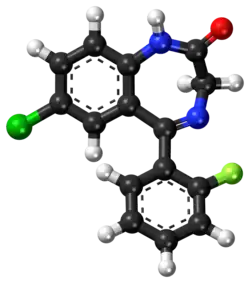
N-Desalkylflurazepam (also known as norflurazepam) is a benzodiazepine analog and an active metabolite of several other benzodiazepine drugs including flurazepam,[5] flutoprazepam,[6] fludiazepam,[7] midazolam,[8] flutazolam,[9] quazepam,[10] and ethyl loflazepate.[11][12] It is long-acting, prone to accumulation[10][3], and binds unselectively to the various benzodiazepine receptor subtypes.[10] It has been sold as a designer drug from 2016 onward.[13]
Pharmacology
Pharmacokinetics
N-Desalkylflurazepam has an elimination half-life of 47-150 hours[1] (up to 200 hours in some healthy volunteers),[3] with an average of ~71 hours.[2] Peak blood concentrations of N-Desalkylflurazepam is reached at 10.2 h following a single 15mg dose of Flurazepam, typically around ~10-20.4ng/mL.[2][3]
It's plasma levels are unreliable amongst patients, and are largely influenced by liver disease, liver enzyme inducers and inhibitors, as well as old age (in men).[3]
References
- 1 2 Flurazepam Monograph. Accessed 31 August 2025.
- 1 2 3 Nikfarjam Z, Doustkhahb E, Zamanic F, Brownd RW (August 2022). "Pharmaceutical applications of 1, 4-benzodiazepines.". Benzodiazepine-Based Drug Discovery. pp. 125–182. doi:10.1016/B978-0-12-824516-3.00009-4. ISBN 978-0-12-824516-3.
Table 5.19. Pharmacokinetic parameters of desalkylflurazepam as the major flurazepam metabolite after single 15 mg oral dose. Desalkylflurazepam shows the highest plasma peak concentration (20.4 ng/mL) that occurs at 10.2 h after dosing with an average t1/2 = 71.4 hr. This metabolite remains in the blood much longer than other species, which is still detectable after 9 days of administration.
- 1 2 3 4 5 Greenblatt DJ, Abernethy DR, Divoll M, Harmatz JS, Shader RI (April 1983). "Pharmacokinetic properties of benzodiazepine hypnotics". Journal of Clinical Psychopharmacology. 3 (2): 129–132. PMID 6132931.
- ↑ Clarke GM, Barry LJ, Swinbourne FJ, Williamson B (1980). "The conversion of 2-(2-chloroacetamido)benzophenones into 2,3-dihydro-2-oxo-1,4-benzodiazepines. Part III. Further consideration of the hexamine system". Journal of Chemical Research, Synopses (12): 400. ISSN 0308-2342.
- ↑ Riva R, de Anna M, Albani F, Baruzzi A (March 1981). "Rapid quantitation of flurazepam and its major metabolite, N-desalkylflurazepam, in human plasma by gas-liquid chromatography with electron-capture detection". Journal of Chromatography. 222 (3): 491–495. doi:10.1016/S0378-4347(00)84153-5. PMID 7228960.
- ↑ Barzaghi N, Leone L, Monteleone M, Tomasini G, Perucca E (1989). "Pharmacokinetics of flutoprazepam, a novel benzodiazepine drug, in normal subjects". European Journal of Drug Metabolism and Pharmacokinetics. 14 (4): 293–298. doi:10.1007/bf03190114. PMID 2633923. S2CID 20710732.
- ↑ Descotes J, ed. (December 1996). Human Toxicology (1st ed.). Elsevier Science. p. 43.
- ↑ Vogt S, Kempf J, Buttler J, Auwärter V, Weinmann W (2013). "Desalkylflurazepam found in patients' samples after high-dose midazolam treatment". Drug Testing and Analysis. 5 (9–10): 745–747. doi:10.1002/dta.1484. PMID 23713025.
- ↑ Miyaguchi H, Kuwayama K, Tsujikawa K, Kanamori T, Iwata YT, Inoue H, et al. (February 2006). "A method for screening for various sedative-hypnotics in serum by liquid chromatography/single quadrupole mass spectrometry". Forensic Science International. 157 (1): 57–70. doi:10.1016/j.forsciint.2005.03.011. PMID 15869852.
- 1 2 3 Nikaido AM, Ellinwood EH (1987). "Comparison of the effects of quazepam and triazolam on cognitive-neuromotor performance". Psychopharmacology. 92 (4): 459–464. doi:10.1007/bf00176478. PMID 2888152. S2CID 13162524.
- ↑ Ba BB, Iliadis A, Cano JP (1989). "Pharmacokinetic modeling of ethyl loflazepate (Victan) and its main active metabolites". Annals of Biomedical Engineering. 17 (6): 633–646. doi:10.1007/bf02367467. PMID 2574017. S2CID 31310535.
- ↑ Davi H, Guyonnet J, Necciari J, Cautreels W (July 1985). "Determination of circulating ethyl loflazepate metabolites in the baboon by radio-high-performance liquid chromatography with injection of crude plasma samples: comparison with solvent extraction and thin-layer chromatography". Journal of Chromatography. 342 (1): 159–165. doi:10.1016/S0378-4347(00)84498-9. PMID 2864352.
- ↑ Manchester KR, Maskell PD, Waters L (March 2018). "Experimental versus theoretical log D7.4 , pKa and plasma protein binding values for benzodiazepines appearing as new psychoactive substances". Drug Testing and Analysis. 10 (8): 1258–1269. doi:10.1002/dta.2387. PMID 29582576.