Mexazolam
 | |
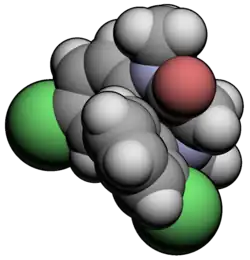 | |
| Clinical data | |
|---|---|
| Trade names | Melex, Sedoxil |
| Other names | 13-chloro- 2-(2-chlorophenyl)- 5-methyl- 3-oxa- 6,9-diazatricyclo[8.4.0.02,6] tetradeca- 1(10),11,13-trien- 8-one |
| AHFS/Drugs.com | International Drug Names |
| Routes of administration | Oral |
| ATC code | |
| Legal status | |
| Legal status |
|
| Pharmacokinetic data | |
| Metabolism | Liver (CYP3A4) |
| Excretion | Kidney |
| Identifiers | |
IUPAC name
| |
| CAS Number | |
| PubChem CID | |
| ChemSpider | |
| UNII | |
| KEGG | |
| CompTox Dashboard (EPA) | |
| Chemical and physical data | |
| Formula | C18H16Cl2N2O2 |
| Molar mass | 363.24 g·mol−1 |
| 3D model (JSmol) | |
SMILES
| |
InChI
| |
| (verify) | |

Mexazolam[1] (marketed under the trade names Melex and Sedoxil)[2] is a drug which is a benzodiazepine derivative.[3] Mexazolam has been trialed for anxiety and was found to be effective in alleviating anxiety at one week follow-up. Mexazolam is metabolised via the CYP3A4 pathway. HMG-CoA reductase inhibitors including simvastatin, simvastatin acid, lovastatin, fluvastatin, atorvastatin and cerivastatin inhibit the metabolism of mexazolam,[4] but not the HMG-CoA reductase inhibitor pravastatin.[5][6] Its principal active metabolites are chlorodesmethyldiazepam (also known as chloronordiazepam or delorazepam, trade name Dadumir) and chloroxazepam (also known as lorazepam, trade name Ativan).[7] Researchers have found a dose of 1.67 mg mexazolam equals 5 mg diazepam. [8] Clinical studies suggest that 3 mg of mexazolam has a comparable effect to 1.5 mg of alprazolam.[9]
Pharmacokinetics
Mexazolam is a long-acting benzodiazepine that undergoes extensive hepatic metabolism. In humans, the parent drug is primarily oxidized by cytochrome P450 3A isoforms, yielding two active benzodiazepine metabolites: chloronordiazepam and chloroxazepam. Mexazolam follows biphasic elimination profile: the initial distribution phase has a half-life of approximately 1.4 hours, reflecting rapid tissue uptake and first-pass metabolism, following by a terminal phase with a half-life of about 76 hours. The long duration of the terminal phase driven by high plasma protein binding (over 90 percent) and gradual release from peripheral compartments.[10] The active metabolites further extend duration of action of the drug.[10][11] The elimination half-lives of the active metabolites is 130–200 h, which supports once-daily dosing but also calls for caution regarding accumulation and residual sedative effects during prolonged therapy.[10]
Mechanism of action
Mexazolam's primary target is GABAA receptor, benzodiazepine site, via the active metabolite chloronordiazepam.[11] Mexazolam potentiates GABA currents at α2/α3 (anxiolytic) subunit‑containing receptors. The drug has minimal effect on α1 (sedative) amplitude;[12][11] as such, mexazolam has lower sedative load compared to classical benzodiazepines[11] such as chlordiazepoxide.[13]
See also
References
- ↑ DE Patent 1954065
- ↑ "Benzodiazepine Names". non-benzodiazepines.org.uk. Archived from the original on 2008-12-08. Retrieved 2009-04-05.
- ↑ Kurono Y, Kamiya K, Kuwayama T, Jinno Y, Yashiro T, Ikeda K (September 1987). "Kinetics and mechanism of the acid-base equilibrium of mexazolam and comparison with those of other commercial benzodiazepinooxazole drugs". Chemical & Pharmaceutical Bulletin. 35 (9): 3831–3837. doi:10.1248/cpb.35.3831. PMID 2893667.
- ↑ Mc Donnell CG, Harte S, O'Driscoll J, O'Loughlin C, Van Pelt FN, Shorten GD (September 2003). "The effects of concurrent atorvastatin therapy on the pharmacokinetics of intravenous midazolam". Anaesthesia. 58 (9): 899–904. doi:10.1046/j.1365-2044.2003.03339.x. PMID 12911366. S2CID 25382546.
- ↑ Ishigami M, Takasaki W, Ikeda T, Komai T, Ito K, Sugiyama Y (August 2002). "Sex difference in inhibition of in vitro mexazolam metabolism by various 3-hydroxy-3-methylglutaryl-coenzyme a reductase inhibitors in rat liver microsomes". Drug Metabolism and Disposition. 30 (8): 904–910. doi:10.1124/dmd.30.8.904. PMID 12124308. S2CID 2620104.
- ↑ Ishigami M, Honda T, Takasaki W, Ikeda T, Komai T, Ito K, et al. (March 2001). "A comparison of the effects of 3-hydroxy-3-methylglutaryl-coenzyme a (HMG-CoA) reductase inhibitors on the CYP3A4-dependent oxidation of mexazolam in vitro". Drug Metabolism and Disposition. 29 (3): 282–288. PMID 11181496.
- ↑ Fernandes H, Moreira R (June 2014). "Mexazolam: clinical efficacy and tolerability in the treatment of anxiety". Neurology and Therapy. 3 (1): 1–14. doi:10.1007/s40120-014-0016-7. PMC 4381915. PMID 26000220.
- ↑ Inada T, Inagaki A (August 2015). "Psychotropic dose equivalence in Japan". Psychiatry and Clinical Neurosciences. 69 (8): 440–447. doi:10.1111/pcn.12275. PMID 25601291.
- ↑ Adriano VS, Maria LF. "Mexazolam and Alprazolam in the Treatment of Generalised Anxiety Disorder: A Double-Blind, Randomised Clinical Trial". Clin Drug Invest. 4 (21).
- 1 2 3 Fernandes H, Moreira R (June 2014). "Mexazolam: clinical efficacy and tolerability in the treatment of anxiety". Neurology and Therapy. 3 (1): 1–14. doi:10.1007/s40120-014-0016-7. PMC 4381915. PMID 26000220.
- 1 2 3 4 Fernandes H, Batalha V, Braksator E, Hebeisen S, Bonifácio MJ, Vieira-Coelho MA, et al. (October 2022). "Voltage-clamp evidence of GABAA receptor subunit-specific effects: pharmacodynamic fingerprint of chlornordiazepam, the major active metabolite of mexazolam, as compared to alprazolam, bromazepam, and zolpidem". Pharmacological Reports. 74 (5): 956–968. doi:10.1007/s43440-022-00411-x. PMID 36097257.
- ↑ Soares Da Costa I, Moreira R, Fernandes H (2022). "Tranquilizer/Anxiolytics: Mexazolam". NeuroPsychopharmacotherapy. pp. 2151–2159. doi:10.1007/978-3-030-62059-2_162. ISBN 978-3-030-62058-5.
- ↑ McGrath C, Burrows GD, Norman TR (2000). "The benzodiazepines: A brief review of pharmacology and therapeutics". Anxiolytics. pp. 1–11. doi:10.1007/978-3-0348-8470-9_1. ISBN 978-3-0348-9581-1.