Pokémon in Latin America
- This article is about the Pokémon franchise in Hispanic America. For the franchise in Brazil, which speaks Portuguese, see Pokémon in Brazil.
| Pokémon in Latin America | ||||
|---|---|---|---|---|
| ||||
| Language | Latin American Spanish | |||
| Continent | The Americas | |||
| Original animated series airdates | ||||
| EP001 | April 26, 1999 June 14, 1999 September 6, 1999 | |||
| AG001 | January 21, 2004 | |||
| DP001 | February 9, 2008 | |||
| BW001 | March 17, 2012 | |||
| XY001 | March 2, 2015 | |||
| SM001 | June 5, 2017 | |||
| JN001 | October 5, 2020 | |||
| HZ001 | March 7, 2024 | |||

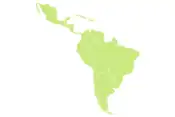
The Pokémon franchise first reached Latin America in an article that was published and appeared on the cover of the October issue of the Club Nintendo magazine in 1998[1] and with the release of Pokémon Red and Blue Versions in English in the same month.[2] The Pokémon animated series followed after with the first broadcast of Pokémon, ¡Yo te elijo! in Latin American Spanish on Chilean channel Chilevisión on April 26, 1999, followed by its premiere in Mexican channel Canal 5 (Mexican TV channel) in June 14, and followed by its panregional cable debut on Cartoon Network Latinoamérica in September 6, reaching the rest of Latin America as well as the Caribbean.
¡Atrápalos ya! is the current, and historically, Pokémon's most recognized Latin American Spanish slogan. This slogan was used during most TV spots and merchandise during the early years of the franchise, and is the most used slogan in the animated series, being only replaced by ¡Tienes que atraparlos! during Pokémon Chronicles. The slogan is often referenced throughout the Pokémon canon, much like the English slogan "Gotta catch 'em all!" is. From 2017 until the introduction of Latin American Spanish to the TCG, game trailers and official merchandise used the ¡Hazte con todos! slogan that was originally used in Spain. Some book guides and magazines published in Mexico used the slogan ¡Es para todos!.
Starting with Pokémon Legends: Z-A, core series games have separate translations for Latin American Spanish.
Pokémon video games
All of the core series Pokémon games have been released in Latin American countries. Historically, most games were available in English only, imported from the United States by various distributors in the region; however, Pokémon Red and Blue were also available in Spanish, using the translation from Spain. The Spanish versions of Red and Blue were not available until 1999, months after the original release in English in October 1998, and were re-released on the Virtual Console alongside the English and French versions. No other Pokémon games were available in Spanish in Latin America until the release of Pokémon HeartGold and SoulSilver, which also used the Spanish translation from Spain. Pokémon Legends: Z-A is the first core series game with a separate Latin American Spanish translation.
Despite the content of the games being almost identical to that of the releases from Spain, the Latin American Spanish versions of the games have their own country code in the serial numbers, LTN (instead of USA for English North America, or ESP for Spain, etc.). As Pokémon X and Y feature multilingual support, the need for separate English and Spanish Game Cards from Generation VI onwards appears to have been eliminated, as players may choose their preferred language at the beginning of the game.
Most of the spin-off titles (such as Pokémon Snap and Pokémon Stadium) have been released in Latin America as well, but like the majority of the core series Pokémon games, they are only available as English-language imports (however, Pokémon Stadium 1 and 2 are fully compatible with the Spanish versions of Red and Blue).
On November 16, 2020, Twitter user @BylethEisnerN started a signs petition on change.org explaining in detail and exposing the need for Pokémon games to be localized into Latin American Spanish after so many years of only receiving games in English and European Spanish (via the multilanguage option introduced in Pokémon X and Y), labeling it as the biggest problem of the franchise in the Latin American region.[3] Despite this user's constant efforts for a whole year, his lack of visibility resulted in a low number of signatures until December 6, 2021, when all the content posted on change.org/PokemonLATAM was turned into a in-depth collab video with the anime, manga, video games, and TV news portal ANMTV Latinoamérica.[4] The video quickly gained popularity thanks to the producers getting the participation of Gabriel Ramos and Gabriel Gama for the narration, the original voice actors of Ash Ketchum and Brock in Latin America, giving a great boost to the signs petition and causing a huge impact in both local and international media. In addition, on February 2, 2022, ANMTV released a video summary of this campaign completely in Japanese, in order to reach audiences closer to the Pokémon developers themselves.[5]
From this point on, there were noticeable changes and signs that the campaign had reached The Pokémon Company International. On February 17, 2022, the Pokémon Trading Card Game Live trailer mentioned for the first time in a Pokémon game that it will support Latin American Spanish.[6] Though it was almost the exact same trailer that had already been shown last September, "LATAM Spanish" was added in the available languages shown at the end of the video. However, in the Canada-exclusive beta released five days later (February 22), although all dialog and menu texts were indeed localized to Latin American Spanish, the entire content of the cards remained in European Spanish, causing inconsistencies that remained until the day of the official global release on June 8 of the following year. On February 26, 2022, Pokémon UNITE released its first trailer localized in Latin American Spanish,[7] though the game itself still lacks such localization. On April 22, 2022, via Pokémon Support, when asked about Latin American Spanish, for the first time they gave a direct answer by replying that they are "looking into when and how (...) best expand localization (...), like Latin America", as well as thanking the fans "for their support and patience", which confirmed that they were aware of the campaign.[8] On February 27, 2023, for the first time, a Pokémon Presents was broadcasted on the official Pokémon Latam channel, featuring subtitles localized to Latin American Spanish with terms such as "Superbola" and "Ultrabola" in the Pokémon GO segment, but without announcing any localization for that game.[9] On May 10, 2023, Pokémon Latam's official social media accounts posted for the first time videogame-related content not using terms from Spain, with the move "Carantoña" shown as "Juego Rudo".[10] Pokémon Scarlet and Violet, despite not featuring a Latin American Spanish translation, renamed the European Spanish option from "Spanish" to "Spanish (Spain)" and altered its language of origin tag from "ESP" ("SPA" in English) to "ES-ES" ("SP-EU" in English), a change that was also applied in Pokémon HOME in an update on May 24, 2023.[11] In September 2023, the Oddish-centered website[12] not only explicitly says that the Oddish Pokédex entry is in European Spanish, but also calls it "el Pokédex" (with masculine article), the form used in the Latin American Spanish dub of the animated series, as opposed to "la Pokédex" (with feminine article), the form used in Spain.[13]
On March 15, 2024, a datamine by the Twitter user @abcboy101 revealed support for Latin American Spanish in upcoming version 0.305.0 of Pokémon GO.[14] The progressive rollout began on March 18 in Mexico[15] and, one month later, on April 19, 2024, for the rest of the world, complete with localization of legacy terms from the animated series, Pokémon's only official source of Latin American Spanish up to that point.[16] The same day, the sign petition opened almost three years ago was finally closed as a success with a total of 28359 signs.[17] Meanwhile, ANMTV also decided to end the successful media campaign but not without waiting for an official reveal, which finally happened on May 5, 2024,[18] not only officially announcing the arrival of Latin American Spanish to Pokémon GO during the final day of the CCXP Mexico conference, but also pairing it with an exclusive in-game event for Latin America.[19] Since then, the Latin American Spanish localization has continued to grow along with the game, being constantly polished and enriching the terminology of the animated series with some new translations and fixes of certain errors present in the Latin American Spanish dub.
In a Pokémon Presents presentation on February 27, 2025, it was finally announced that future core series games would be released in Latin American Spanish starting with Pokémon Legends: Z-A. A Latin American Spanish translation of the newly-announced game Pokémon Champions was also confirmed.
Regarding rating systems in Latin America, on November 27, 2020, the RTC of Mexico introduced the SMECCV, a new rating system to replace the ESRB in the region. The law took effect by May 27, 2021, and New Pokémon Snap became both the first Pokémon game, and first new video game in general[20] to be rated by Mexican authorities. All Pokémon games have been rated "A", appropriate for all ages, equivalent to the "E" ESRB rating.
Commercials
In the late 1990s, Nintendo aired many commercials in Latin America for video games such as Mario and Pokémon. These commercials are not unique to Latin America, they are simply Spanish-dubbed versions of the commercials aired in the United States. However, due to the rise of video game piracy, Nintendo has decided not to invest much money in promoting their franchises in Latin America. This may be a reason why few recent games receive Spanish releases in Latin America. Despite this, Spanish commercials for Pokémon games still appear on cable networks such as Cartoon Network and Nickelodeon.[21]
Events
Local events rarely occurred in Latin American countries, particularly in a single country exclusively. The events were usually announced on the Pokémon.com website but in Generation V, the events were announced on the web sites of the stores hosting the events. Starting with Generation VI, events are announced by the stores and/or Nintendo Latin America's Facebook page.
The distribution of local Pokémon events had only been in the countries of Mexico and Chile in 2010 during Generation IV. However, two local distributions occurred in Generation V, of Keldeo and Meloetta, in more Latin American countries.
Nowadays, since the use of Wi-Fi connection has become more common, Latin American players can download all worldwide events for the games, making special Pokémon considerably easier to obtain than before.
During 2016, most North American distribution events were also extended to Latin American stores, with code cards in Spanish, but Pokémon.com didn't announce them since they had no News page for Latin America.
All 2018 Legendary Pokémon year events were announced on the official site for Latin America.
Pokémon animation
The Latin American dub of Pokémon airs or has aired in the following countries: Argentina, Bolivia, Chile, Colombia, Costa Rica, Dominican Republic, Ecuador, El Salvador, Guatemala, Honduras, Nicaragua, Mexico, Panama, Paraguay, Peru, Uruguay and Venezuela.[22][23] The series aired on Cartoon Network Latinoamérica since its debut in the rest of the Latin American countries until 2021. In addition to Cartoon Network, which serves many different countries, the animated series is also aired on one or more local channels in most regions of Latin America. In the United States, the Latin American dub of the original series airs on TeleXitos.
Starting on January 1, 2010, the first season began to air on Tooncast, a sister network of Cartoon Network and Boomerang Latin America[24]. Tooncast aired the series up to the first Sun and Moon season, until being removed from the schedule on June 1, 2021, just a few months before Cartoon Network also stopped airing the series.
In Mexico, as previously mentioned, the series was acquired by Televisa's Canal 5 and premiered in June 14, 1999. Canal 5 aired up to Johto League Champions before removing the series in late 2002. The series returned to Canal 5 in 2006, rerunning the first two Johto seasons and then premiering Master Quest. Advanced then premiered in January 2008, however, the next two Hoenn seasons were skipped, going straight to Battle Frontier in 2009. Diamond and Pearl debuted on August 23, 2010, however, it only lasted a few months on the schedule and no further series aired on the channel.
On June 12, 2017, Mexican network Azteca 7 premiered Pokémon the Series: XY as well as the first season. Only the first XY season aired on Azteca 7, while the original series aired up to Master Quest until being removed from the schedule in June 2019.[25].
From July 18, 2020 to May 8, 2022, the series was broadcasted in Mexico by Imagen Televisión. Only the first season as well as the first XY season were aired.
The series returned to Azteca 7 on November 25, 2024, airing the original series, but by early 2025 they switched to air the XY seasons.
| Country | Channels aired | |
|---|---|---|
| Cable Network | Locals | |
| Argentina | Cartoon Network Latinoamérica Tooncast |
Magic Kids, Azul Television |
| Bolivia | ATB | |
| Chile | Chilevisión, Mega, Etc...TV | |
| Colombia | Caracol TV, Canal Capital, CityTV | |
| Costa Rica | Repretel | |
| Dominican Republic | Telecentro Canal 13 | |
| Ecuador | Gamavisión, Ecuavisa, Teleamazonas | |
| El Salvador | Canal 2 | |
| Guatemala | ||
| Honduras | Televicentro | |
| Mexico | Canal 5, Azteca 7 | |
| Nicaragua | ||
| Panama | TVN, TVMax | |
| Paraguay | ||
| Peru | Frecuencia Latina, Panamericana Televisión | |
| Uruguay | Montecarlo Televisión (Canal 4) | |
| Venezuela | Televen | |
Cartoon Network

Cartoon Network is one of the most popular children's television channels in Latin America due to the channel airing original productions from the original US channel such as the Cartoon Cartoons as well as international acquisitions like Dragon Ball, Naruto, Inuyasha and other animated series, including Pokémon. Since Pokémon debuted on September 6, 1999, it became one of the most popular shows on Cartoon Network.
Cartoon Network aired every episode and season of the animated series that has been dubbed into Spanish up to the first Journeys season, including Pokémon Chronicles and all the movies except for 4, 5 that were shown on Jetix, and 6 and 7 that were released on DVD. The special episode Pokémon Mystery Dungeon: Team Go-Getters Out of the Gate! debuted on February 8, 2008, and The Mastermind of Mirage Pokémon debuted on July 13, 2008.
The series aired for the final time on CNLA on September 30, 2021.
With the premiere of each season, the channel performed special promotions such as marathons of older episodes and, in years past, contests and other events. In December 2002, to commemorate the premiere of Pokémon: Master Quest on January 1, 2003, the channel held a contest called "Los Elegidos Pokémon". To participate, viewers would vote for their favorite episodes on Cartoon Network's website, the most popular of which would be aired in a marathon on December 31, 2002.[26]
Original series
On Cartoon Network, Season 1 premiered September 6, 1999. Season 2 premiered in 2000, Season 3 in 2001 and Season 4 in 2002.
Pokémon the Series: Ruby and Sapphire
Season 6 premiered on January 21, 2004, but only the first episode. It continued in March 2004 until the finale on December 6, 2004. Season 7 debuted on January 22, 2005 and broadcasted until the finale on September 19, 2005. Season 8 premiered on August 8, 2006 and ran until the finale in October 2006. Season 9 premiered on March 3, 2007 at 2:30pm and ran until the finale on February 2, 2008.
Pokémon the Series: Diamond and Pearl
The 10th season premiered on February 9, 2008 but only ran for 3 episodes, the show continued in June 2008 and its finale was on September 24, 2008. Season 11 premiered on January 5, 2009 at 7pm and its finale was on May 27, 2009. The 12th season premiered on January 10, 2010 at 7pm, it was then shown on Sundays but, was on Wednesdays at 6pm from June 2010 and the finale was on January 19, 2011. The 13th season premiered on April 2, 2011 & was shown from then at 12:30pm on Saturdays and Sundays but only for 26 episodes from July 2011. But it returned on October 8, 2011 on Saturdays and the finale was shown November 26, 2011. Finally, Zoroark Master of Illusions premiered on March 10, 2012
Pokémon the Series: Black & White
Pokémon: Black & White premiered on March 17, 2012 at 2pm. On May 5, 2012, the schedule was changed to broadcast at 7am, causing much criticism by fans. On January 4, 2013, the schedule was changed again to Friday at 12:00pm until the finale on February 8, 2013. The movie Black—Victini and Reshiram aired on November 29, 2012 at 12:00pm in Mexico and 2:00pm in the rest of Latin America. Pokémon Black & White: Rival Destinies premiered on April 19, 2013 and its finale was on November 15, 2013, while the movie White—Victini and Zekrom aired on June 11, 2013. Kyurem and the Sword of Justice premiered on November 1, 2013. Pokémon Black & White: Adventures in Unova premiered on February 3, 2014 at 2pm in Mexico and 12pm in the rest of Latin America. It ran until the finale on April 4, 2014. On May 30th, Genesect and the Legend Awakened premiered simultaneously; except in Chile, where it was pushed one hour before the rest of the transmissions to avoid airing at the same time as a live soccer match against Egypt.
Pokémon the Series: XY
On March 2, 2015, Pokémon the Series: XY premiered at 2:00pm in Colombia, 2:30pm in Venezuela 3pm in the Dominican Republic and 4:00pm in other countries, with new episodes being aired five days a week. Unlike previously, there was no advertising or any official announcement at all that the series was going to premiere, other than the synopsis for XY001 being found on the Cartoon Network website's schedule a few days before, which was announced between the fan community by word of mouth. The season finale aired on May 6, 2015. XY022 did not air on March 31, 2015 as it was originally intended to be due to a Cartoon Network special airing in its place and the episode schedule not being re-accommodated afterwards. Said episode did air on June 16, 2015 during reruns though and as of 2016 XY022 can be viewed on Netflix. In June the schedule changed at 4:00 a.m. for the series (it varied depending on the country).
The movie Diancie and the Cocoon of Destruction premiered on August 2, 2015 at 7pm Colombia, 7:30pm Venezuela, 8pm Dominican Republic and 9pm in other countries.
The Season 18 premiered on August 3, 2015 at 4pm (2pm Colombia, 2:30 Venezuela etc.) returning to its old schedule. This is the first time in a while that a season debuted in the same year as that of the US, this may be because Cartoon Network declared that they would bring the premieres closer to the date of the USA. The season finished on May 31, 2016.
The movie Hoopa and the Clash of Ages was released on August 11, 2016 at 7pm Colombia, 7:30pm Venezuela, 8pm Dominican Republic and 9pm in other countries.
Pokémon the Series: XYZ started on August 15, 2016 at 4pm, however, a preview with the first two episodes was aired on August 12 and August 13.
The movie Volcanion and the Mechanical Marvel premiered on August 10, 2017.
Pokémon the Series: Sun & Moon
Pokémon the Series: Sun & Moon started airing on Cartoon Network on June 5, 2017. Unlike previous seasons, the Latin American Spanish dub premiered on Disney XD through the second audio program (SAP) channel on March 17, 2017.
I Choose You! had a theatrical premiere on November 5 and 6, 2017. This movie was later shown on Cartoon Network on December 8, 2017.
Pokémon the Series: Sun & Moon - Ultra Adventures premiered on June 4, 2018.
The Power of Us premiered on July 13, 2019.
Pokémon the Series: Sun & Moon – Ultra Legends premiered on June 3, 2019.
Pokémon Journeys: The Series
Pokémon Journeys: The Series premiered on September 21, 2020. This was the last season that premiered on Cartoon Network, with future content being premiered on Netflix.
Digital distribution





Select movies can also be bought through Claro.
Dubbing
The Latin American dub of the Pokémon animated series is based on the English dubs by 4Kids Entertainment and The Pokémon Company International, retaining all of their character names, Pokémon names, and any cuts or alterations present in the English dub. Televix Entertainment[27][28] was responsible for distributing the series in the Latin American market up to Season 12,[29][30] then TPCI decided to distribute the series themselves.
The dub itself is recorded and produced in Mexico. The series has been dubbed by five different companies. Originally, dubbing production was conducted by the company Audiomaster 3000 of Televisa, which dubbed the series from the first season until the first episodes of Pokémon: Advanced Challenge. Audiomaster 3000 went out of business in 2005, leaving the seventh season incomplete.
Thus, the series was rushed to Candiani Dubbing Studios (due to them acquiring Audiomaster 3000's assets), which dubbed the series until mid-2009, with many mistakes of pronunciation and a change in the voices of several characters. Several moves that had a fixed translation until that point were changed, and the number of naming inconsistencies in moves increased. Cities and towns from the Kanto region which had used their Spanish names up until that point were changed to their English names during those seasons (the only exception being Pallet Town).
In the first season, initially the Spanish translation for some terms was used, like moves and cities (except Fuchsia City), due to the launch of Red and Blue in Spanish.
On September 26, 2009, AF The Dubbing House confirmed on their Twitter that they would start dubbing Pokémon Diamond & Pearl: Galactic Battles, indicating that they were the new dubbing company for the series. This company changed the voices of several characters and terminology used, with several moves and city names being taken directly from the Spanish localization, specially during the first episodes, though several of these changes were reverted after some episodes. The company was able to return Gabo Ramos to the role of Ash Ketchum, since said actor was living in Argentina at that moment.
Seasons 13 to 18 were dubbed by SDI Media de México. Their involvement was confirmed in October 2010[31] via Eduardo Garza's Twitter, which reported that he would be the dubbing director and asked for help from fans to help standardize the terminology and return to each character's original voice. Ash's voice was changed, however, due to logistic reasons. The thirteenth season had more mistakes than the previous season, due to the terminology used, with some attack names alternating between the Spanish localization and a previous Latin American dub localization, even within the same episode. Starting the fourteenth season, most of the naming inconsistencies from previous seasons diminished notably. Seasons 19 to 22 were dubbed by Jarpa Studio Mexico in collaboration with DuArt Film & Video. DuArt departed the series after season 22, and SDI Media returned for Pokémon Journeys: The Series onwards. Iyuno later took control of the dub through acquiring SDI Media.
Pokémon movies
As the series, most of the films have were dubbed in Mexico. The films Mewtwo Strikes Back, The Power of One and Spell of the Unown: Entei were dubbed by Audiomaster 3000 under license and distribution of Warner Bros., while Celebi: The Voice of the Forest and Pokémon Heroes: Latios & Latias (dubbed in Mexico by MADE Productions), as well as Jirachi Wish Maker and Destiny Deoxys (dubbed in Argentina by Media Pro Com) were licensed by Miramax and their dubs were produced by Disney Character Voices International.
Televix was responsible for licensing and distributing Lucario and the Mystery of Mew, Pokémon Ranger and the Temple of the Sea, The Rise of Darkrai, Giratina and the Sky Warrior, and Arceus and the Jewel of Life.[30] Movies 8 to 10 were dubbed by Candiani Dubbing Studios while movies 11 and 12 were dubbed by AF The Dubbing House.
The movies Zoroark: Master of Illusions, Black - Victini and Zekrom / White - Victini and Reshiram, Kyurem VS. The Sword of Justice, Genesect and the Legend Awakened, Diancie and the Coocon of Destruction and Hoopa and the Clash of Ages were dubbed at SDI Media México and distributed by TPCI. Movies 19 to 22 were dubbed at Jarpa Studio México in collaboration with DuArt Media Services, while movie 23 was dubbed by Iyuno-SDI.
Cast and crew
Many different voice actors have worked on the dubbing of Pokémon in Latin America.
Main cast

Gerardo Vázquez was the dubbing director for the series from the first season until the sixth season. He was also the director for Diamond and Pearl.
He provides the voices for Team Rocket's Meowth, the Narrator, Koga, Victor, Slowking from The Power of One, Chatot in AG184, and Gibeon. He has worked on several other anime series, dubbing characters such as Raye Penber in Death Note, the Narrator in One Piece, Roberto Hongo in Captain Tsubasa, and other non-anime roles such as Dr. Hibbert, Seymour Skinner, Barney Gumble, Sideshow Mel and Jimbo Jones in The Simpsons (starting from the sixteenth season besides before he played the role of Hibbert since season ten, but was absent in the fifteenth).

Gabriel Ramos (born September 18, 1986) was chosen by the Nintendo authority in charge of the dubbing in Mexico at that time and so, he provided the voice of Ash Ketchum from EP001 until DP090. He then quit voice acting due to commitments to the Latin American MTV, where he works as a VJ. From DP091-DP104, he was replaced by Irwin Daayán. Ramos made a little returned to dub Ash starting from DP105 thanks to his fans. Although Ramos moved to Argentina, he was able to record Ash's voice at a recording studio called Sonar Studio and send the recordings over the internet to the dubbing company in Mexico. However, he was later replaced by Miguel Ángel Leal from DP158 on because the new client did not want Ramos to keep voicing Ash while living in Argentina, since he wouldn't have any voice direction there. While Ramos returned to Mexico in 2015, he instead became the voice of Remo because the distributor didn't want to change Ash's voice. He would later return in Pokémon Master Journeys: The Series to voice Alternate World Ash. Other series Ramos has dubbed for include Ippo Makunouchi in Fighting Spirit, MegaMan.EXE in MegaMan NT Warrior, Remi in the redub of Nobody's Boy: Remi and Gerald (second voice) in Hey Arnold!.

Irwin Daayán (born November 9, 1978) was responsible for the voice of Ash in the absence of Gabriel Ramos from DP091 until DP104. Daayán also provides the voices for Samurai, Ken, Drew (starting from Pokémon: Advanced Challenge), Conway, Tucker, and Tate. Daayán is a well-known voice actor, voicing numerous roles in other series including the main roles of Yugi Mutou/Yami Yugi in Yu-Gi-Oh!: Duel Monsters, Mugen in Samurai Champloo, Goku in Monkey Typhoon and Pegasus Seiya in Saint Seiya: Hades - Chapter Sanctuary and Hades - Chapter Inferno.

Misty is dubbed by experienced voice actress Xóchitl Ugarte (born April 21, 1979), who also voices Andi, Kenny, and Angie. She also is famous for dubbing Sabrina Spellman (originally played by Melissa Joan Hart) in Sabrina, the Teenage Witch and Diva in Blood+. She is the sister of Gaby Ugarte and Victor Ugarte.

Gaby Ugarte (born December 22, 1983) provided the voices for Dawn (from DP001-DP104, DP158-DP191, Pokémon Journeys: The Series), Melody, Jasmine and Giselle. She also dubs in other series, such as Kuki Sanban/Numbuh Three in Codename: Kids Next Door, Zatch Bell and Zeno Bell in Zatch Bell!, Saya Otonashi in Blood+ and Gwen Tennyson in Ben 10 and Ben 10: Alien Force. Ugarte left the show when dubbing production was moved to AF The Dubbing House, right at the beginning of the Galactic Battles season, coming back in the next season, although she was replaced in the fifteenth season because she currently lives in France, but she returned to dub her character in Pokémon Journeys: The Series, dubbing her remotely from France.
Leyla Rangel voiced Dawn after Gaby Ugarte left in the 12th season. Besides giving her voice to Mars during the previous season, Leyla's prominent dubbing roles include Kagome Higurashi in InuYasha, Kimberly Ann Possible in Kim Possible, Estella Malone in JONAS, Hermione Granger in the Harry Potter film series (from The Goblet of Fire onwards), Ami in Hi Hi Puffy Ami Yumi, and several of Raven-Symoné's TV and movie roles like That's So Raven and The Cheetah Girls, she returned to voice Dawn in the fifteenth season since Gaby Ugarte was in France.
Gabriel Gama provided the voice of Brock from the character's introduction until DP020 (except for DP010), and stopped because he had problems with Candiani but came back in the 13th season. During the break between Gabriel Gama's return to the cast, Alan Prieto voiced Brock in DP010 and from DP021 until DP157.
Brock was voiced by Arturo Mercado Jr. in Celebi: The Voice of the Forest and Pokémon Heroes: Latios & Latias.

May was voiced by Ana Lobo from AG001 until AG044, She also voices Roy. Lobo also is famous for voicing Kagome Higurashi from Inuyasha.

Starting from AG045, May has been voiced by Mariana Ortiz. Ortiz has also provided the voices for Nurse Joy, Erika, Lisa, and Marble. Her other voice acting work includes characters such as Fuu from Samurai Champloo, Kaoru Matsubara/Buttercup from Powerpuff Girls Z and Meg Griffin from Family Guy (starting from season four).
May's younger brother, Max, is voiced by Diego Ángeles.
Alfredo Leal was the voice for Tracey Sketchit from EP084-EP116 and JN147. Alfredo is the brother of Ash's current voice actor, Miguel Ángel Leal.

José Antonio Macías (born September 19, 1967) is the voice of James (except for AG105-AG110), as well as Detective Pikachu in the movie of the same name.
Gerardo García dubbed the voice of James for AG105-AG110. He is also the voice of Harley, Paul (DP002-DP100, DP163-present) and has voiced Tracey Sketchit since EP225, He was also the director for Battle Dimension.

Until her passing in April 2021, Jessie had been voiced for the entire series by Diana Pérez. Pérez was well known for her role of Monkey D. Luffy in One Piece in 4Kids version, and she had also been the director for the series since Pokémon the Series: XY. Beginning with Pokémon Master Journeys, Jessie is voiced by Rebeca Gómez.
Bruno Coronel is the voice of Cilan, Buck, and Kenny (during season 12). He is also known for being the voice of Mikey Kudo in Digimon Fusion. Susana Moreno voices Iris and Princess Salvia. She is also known for being the voice of Apple Bloom in My Little Pony: Friendship is Magic.
Jose Ángel Torres voices Clemont, Verania Ortiz (daughter of Luis Daniel Ramírez, Stephan's voice actor, and Mariana Ortiz, May's second voice actress) voices Serena and Jocelyn Robles voices Bonnie.
Pamela Cruz voices Lana, Kristoffer Romo voices Kiawe, Jennifer Medel voices Lillie. Karla Vega voiced Sophocles from SM001 to JN037, as well as Plumeria. Alicia Barragán voices Olivia, and takes on the role of Sophocles starting JN096. Araceli Romero voices Mallow and Rolando de la Fuente voices the Rotom Pokédex.
Diego Becerril voices Goh in Pokémon Journeys: The Series, he previously voiced Charlie Charma in Pokémon the Series: Sun & Moon and, much like Goh's Japanese and English's voice actors, he is currently the voice of the Rotom Phone in Pokémon Horizons: The Series.
Erika Ugalde voices Liko, she previously voiced Wicke, Chrysa, Pikala and Mia.
Lupita Leal voices Dot, she previously voiced Janina, Crystal, Bianca and additional voices.
Supporting cast
Gary Oak has had five different voice actors in the Latin American dub. He was voiced by Gerardo del Valle up until the end of Pokémon: Master Quest and his return in Pokémon Master Journeys. For Pokémon the Series: Ruby and Sapphire, he was voiced by Ricardo Bautista. He was voiced by Benjamín Rivera in DP045 and by Noé Velásquez in DP085. In Pokémon Chronicles, he was voiced by Victor Ugarte, the brother of Xóchitl and Gaby.
Professor Oak is voiced by Hugo Navarrete.
Aside from Mariana Ortiz, Nurse Joy has also been voiced by Christine Byrd, Georgina Sánchez, Mildred Barrera and Liliana Barba.
Officer Jenny has been voiced by Ana María Grey, Mayra Arellano, Isabel Romo, Erika Edwards, and Cristina Hernández.
Argentinian cast
Unlike previous and subsequent movies, Jirachi: Wish Maker and Destiny Deoxys were dubbed in Argentina with a completely different voice cast.
Ash was dubbed by Pablo Gandolfo.
May's Argentinian voice actress was Agustina Priscila.
Redub
In 2015, some voice actors announced that some old episodes (which included The Water Flowers of Cerulean City!, Hook, Line and Stinker and Going, Going, Yawn) were going to be redubbed by SDI Media Mexico. The redubbed version of The Water Flowers of Cerulean City! made its debut on Netflix on September 1, 2015, along with the other 103 episodes of the first two seasons, which remained intact. The redub had a mixed reception from fans, ones liked that the same script was used and that Misty and Brock kept their voice actors while others disliked that Gabriel Ramos didn't voice Ash despite being available, with Miguel Angel Leal being used instead.
Music

All of the theme songs used in the Latin American dub are translated versions of the songs from the English dub.
Three Pokémon soundtracks have been released in Latin America. The first, Pokémon: ¡Para Ser Un Maestro!, is a Spanish translation of Pokémon 2.B.A. Master. This soundtrack included a bonus video of the Pokérap that could be played on a computer. It was released by Tycoon Music in Mexico in association with 4Kids Productions (catalogue number 16-KO-001).
A translated version of Totally Pokémon was released as well, entitled Pokémon: The Johto Journeys. This album did not contain any of the karaoke songs from the English release, but it did include an extra song, "Pokémon Johto 2".
The soundtrack to Pokémon the First Movie was also released in Latin America. This Latin American version contained all the same songs as the English North American release, but with an added bonus track, Pokémon Theme, which is performed in Spanish by Álvaro Véliz.
Pokémon manga

Pokémon Adventures and Magical Pokémon Journey were both translated into Spanish in Mexico by Toukan Manga magazine. However, neither series was completed, and all translated volumes are now out of print.
In 2015, Panini Comics Mexico announced that they would be publishing Pokémon Adventures in the country. They began publishing the Black & White arc in April 2016 and finished publishing it on the same year. Panini Comics began publishing Red, Green & Blue arc in March 2017, and released subsequent volumes bi-monthly. As of March 2025, the Mexican edition is on Volume 54.
In April 2021, Panini Comics Argentina announced that they will start publishing Pokémon Adventures in Argentina to celebrate the franchise's 25th anniversary, with the Red, Green & Blue chapter, Yellow arc, Gold, Silver & Crystal arc and the Black & White chapter planned to release. Volume 1 of the series was published in June 2021, with the next volume releasing in July 2021, and subsequent volumes releasing every 3 months. As of March 2025, the Argentine edition is on Volume 17, with Volumes 43 and 44 also being available.
Pokémon Trading Card Game
Both English- and Spanish-language cards for the Pokémon Trading Card Game are sold in Latin America. Spanish-language cards are recognized as tournament legal for Play! Pokémon.
On January 9, 2025, it was announced that Journey Together would be the first expansion to be released in Latin American Spanish, releasing on March 28, 2025.
Pokémon merchandise
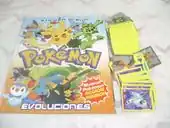

During the height of Pokémon's popularity in the late 1990s and early 2000s, a great number of collectables and other merchandise based on the Pokémon franchise was available in Latin American countries, including sticker albums, postcards, plush toys, and figurines.
Books from the Pokémon Chapter Books such as I Choose You!, Island of the Giant Pokémon, and Attack of the Prehistoric Pokémon have been serialized and translated into Spanish by Norma Editorial in several countries of Latin America.
Pokémon Tazos, collectable discs which resemble Pogs, were available in bags of Frito-Lay chips. These Tazos, which have featured other franchises besides Pokémon, grew in popularity to a level greater than or equal to the early popularity of the Pokémon Trading Card Game in North America.
The Corporación Gráfica Navarrete S.A., based in Peru, is a company known for publishing a wide variety of Pokémon sticker albums. Stickers for these albums are sold separately and are distributed randomly in packs. Each sticker is numbered and is intended to be glued to its assigned spot in the album.

The album will often have artwork and descriptions that compliment the artwork on the stickers. These sticker albums have been published in several Latin American countries such as Peru and Mexico since the late 1990s. The most recent sticker albums are "Pokédex", which was published in 2007 and was available in Bolivia, Brazil, Mexico, Peru and Puerto Rico; and "Pokémon Evoluciones", was published in 2008 and was only available in Peru.[32]
Burger King has also brought a few of its Pokémon promotions to Latin America, including the recent TCG promotions.
In Argentina, Mirinda soda released a limited-edition Pokémon soft drink. It was the same as regular orange-flavored Mirinda, but featured Pokémon characters on the packaging.
Community
Most of the Spanish-speaking Pokémon fandom is located in Latin America, as it is a region of countries who speak the same language with the same (or similar) accents. Usually, the fans are followers of the animated series and video games because they are governed by the translations of video games (being only available in English for most of the games before X and Y) and dubbing (Spanish in the animated series dub). The Latin American fandom is very active in everything that has happened since the release of the first Pokémon video games, even throughout the voice cast changes made in the dubbing of the animated series.
Currently, two of the biggest and oldest Spanish-language Pokémon sites are Centro Pokémon and Pokéxperto, founded in 2005 and 2006 respectively, which probably are two of the most trusted Pokémon sites in Latin America and Spain. They post about the most recent news from the Pokémon video games, animated series, and TCG, and also have very large community forums.
One of the oldest Spanish-language Pokémon sites is Pikaflash. With over 14 years of existence, Pikaflash was one of the most popular forums in Latin America because of the huge variety of discussion topics, even to the point of being mentioned twice during Team Rocket's motto in the dub. During its early years, Pikaflash focused only on Pokémon, but over time has expanded to include other topics such as other animated series dubbed in Latin America, such as Dragon Ball and InuYasha. To this day, Pikaflash has closed its forums and the website is no longer updated.
Another important fansite is Pokémon Project. Pokémon Project offers Pokémon-related news as well as game and animated series information. It was one of the most visited fansites because of the content it offered and its interaction with the community of fans who followed the web site. One of the major events made by the community of Pokémon Project was a protest and request for Gabriel Ramos to come back to the Latin American dub.
Events
So far, Mexico and Chile are the only Latin American countries to have any Pokémon: Symphonic Evolutions concerts scheduled. There were three performances in 2015—in Guadalajara on October 21, in Mexico City on October 22, and in Monterrey on October 25; while there were five performances in 2016—one in Santiago on August 12, and two in Mexico City on October 31 and November 1. In 2017, two more performances took place in Mexico City on February 26.
Latin America has also hosted numerous Pokémon GO in-person events such as Pokémon GO City Safari in Mexico City, Mexico in 2023; São Paulo, Brazil in 2024; and Santiago, Chile in 2025.
Trivia
- Cartoon Network Latinoamérica never banned an episode of the animated series except for episodes which have been banned in Japan and the United States. However, it skipped some episodes due to network oversights, though all of them but XY022 were ultimately aired.
- Cartoon Network's "Biografia Toon" segment, which consists of biographies and histories of cartoon characters, did a two-part segment on Ash's Pikachu. According to the segment, Pikachu was the result of an experiment conducted by Professor Oak and allegedly destroyed the lab when he was created in a momentary loss of control.
- When speaking at an anime event at a school in Buenos Aires, Argentina, voice actor Gabriel Ramos revealed that Pokémon Diamond & Pearl: Galactic Battles would have a total of 54 episodes.[33] However, season 12 ended with Gotta Get a Gible!, which brought the total number of Galactic Battles episodes to 52.
- Before the premiere of Steeling Peace of Mind! on February 14, 2010, Lucario and the Mystery of Mew was re-aired on February 10 and February 11, 2010. This is likely due to the similarity of Riley and Sir Aaron.
- When Cheers on Castaways Isle! was rerun on 3 March 2010 on Cartoon Network, the opening theme was Pokémon Theme instead of Battle Cry - (Stand Up!)'. This is also true for the reruns of Hold the Phione!* and Another One Gabites the Dust!*. Starting from Stealing the Conversation!, Battle Cry - (Stand Up!) was restored as the opening theme. For these three episodes, the episode titles were also not announced in Spanish.
- Before 2019, in "Choose Your Country!" from Pokémon.com, the only countries in Latin America that had external websites were Argentina and Chile. Peru used to have a website as well.
- Season 13 was the first one to be distributed in Latin America and Spain by the same distributor, SDI Media Poland.
- This caused the lyrics of We Will Carry On! and Black and White to be similar with minor or no changes and sung by different performers. Since the first season these have always been different for each dubbing.
References
- ↑ Portadas de Club Nintendo - 1998 (in Spanish)
- ↑ Pokémon Azul/Pokémon Rojo (in Spanish)
- ↑ https://x.com/BylethEisnerN/status/1328401414310277122
- ↑ https://www.youtube.com/watch?v=Zx6pTEMSb5k
- ↑ https://www.youtube.com/watch?v=hR9aIekUlt4
- ↑ https://www.youtube.com/watch?v=ieR3K1koPwI
- ↑ https://www.youtube.com/watch?v=agFOyghEUMI
- ↑ https://www.anmtvla.com/2022/04/the-pokemon-company-rompe-el-silencio.html
- ↑ https://www.youtube.com/watch?v=YrMt7i41kqY
- ↑ https://www.youtube.com/shorts/7LKVLLOlwsw
- ↑ https://x.com/BylethEisnerN/status/1659223932258361345
- ↑ https://oddish.pokemon.com/es-mx/
- ↑ https://x.com/BylethEisnerN/status/1699810944682008878
- ↑ https://x.com/abcboy101/status/1768624284551852379
- ↑ https://x.com/WikiDexOficial/status/1769788278998229392
- ↑ https://x.com/WikiDexOficial/status/1781451945632276626
- ↑ https://x.com/BylethEisnerN/status/1781469534089617647
- ↑ https://www.anmtvla.com/2024/03/como-nacio-la-campana-para-localizar.html
- ↑ https://pokemongolive.com/post/pokemon-go-espanol-latam?hl=es_MX
- ↑ A menos de dos meses de la nueva clasificación de videojuegos en México, 'New Pokémon Snap' luce el nuevo diseño del etiquetado. (Less than two months after the new video game classification in Mexico, ‘New Pokémon Snap’ shows off the new labeling design.) Xataka Gaming. (April 2, 2021). Retrieved August 13, 2025.
- ↑ Commercials of Pokémon Yellow, Pokémon Stadium, Pokémon Gold and Silver, Pokémon Mystery Dungeon: Red Rescue Team and Blue Rescue Team, Pokémon Platinum (first and second) and Pokémon HeartGold and SoulSilver (first, second and third commercial) in Spanish
- ↑ Pokémon Hits The World - Animation World Network (October 3, 1998)
- ↑ Pokémon sold to Latin America broadcasters - Animation World Network (February 14, 1999)
- ↑ Enero en Tooncast: El estreno de Pokémon (in Spanish)
- ↑ Pokemon XY se emitira en Mexico (in Spanish)
- ↑ Los Elegidos Pokémon - Cartoon Network archive (in Spanish)
- ↑ Televix: Series & Animation (as of 2000)
- ↑ Record-TV y Televisa adquieren segunda temporada de “Pokémon” - Produ (May 18, 1999)
- ↑ Televix listing for Pokemon Seasons 10-12
- ↑ 30.0 30.1 Televix Feed from 2011 (contains Pokemon season & movie mentions)
- ↑ "El doblaje de pokemon se realizará en SDI Media Group, con la traducción de Julio Cesar Alcántara (Bakugan, kerwhizz)" - Eduardo Garza via Twitter (October 21, 2010)
- ↑ Albumes y coleccionables - Corporación Gráfica Navarrete (in Spanish)
- ↑ Fancon: Kodomo Monsters - Pokémon Project (in Spanish)
External links
- The official Latin America Pokémon website (partial website)
- Pokémon on Cartoon Network Latinoamérica's website (in Spanish)
- Web history: 2000, 2001, 2002, 2003 - 2005, 2015-2016
Related articles
| The Pokémon franchise around the world | |
|---|---|
| Africa: | South Africa |
| The Americas: | Brazil • Canada • • United States |
| Asia: | Hong Kong • Indonesia • Japan • mainland China • Malaysia • Philippines Singapore • South Asia • South Korea • Thailand • Taiwan • Vietnam |
| Europe: | Albania • Belgium • Bulgaria • Croatia • Czech Republic • Denmark • Finland • France • Germany • Greece Hungary • Iceland • Ireland • Italy • Latvia • Lithuania • Netherlands • North Macedonia • Norway • Poland Portugal • Romania • Russia • Serbia • Slovakia • Spain • Sweden • Ukraine • United Kingdom |
| Middle East: | Arab world • Israel • Turkey |
| Oceania: | Australia • New Zealand |

|
This article is part of Project Globe, a Bulbapedia project that aims to write comprehensive articles on the Pokémon franchise around the world. |