Language of origin
- Language redirects here. For languages that Pokémon speak, see Pokémon language.
|
It has been suggested that this article be moved to Language. Please discuss whether or not to move it on its talk page. |

|
The subject of this article has no official name. The name currently in use is a fan designator; see below for more information. |
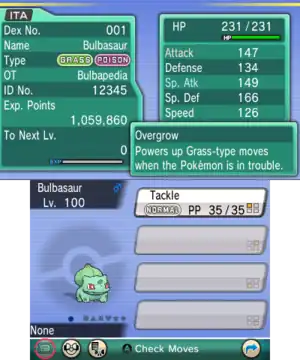
The language of origin, referred to as simply language (Japanese: 言語 language) in Pokémon HOME, is a value in the Pokémon data structure that indicates the language of the game a Pokémon originates from. This value was introduced in Generation III. From Generation VI onward, Pokémon with a different language of origin to the current game have their language shown on the summary screen.
Assignment
From Generation III onward, Pokémon caught in the wild or obtained as a gift have the language of the game they were obtained in set as their language of origin. Pokémon obtained from in-game trades usually have the language of the game they were obtained in set as their language of origin, but some in-game trade Pokémon have a different language of origin, such as the Meister's Magikarp. Shedinja retains the Nincada's language of origin upon Evolution.
In Generation III, Eggs have their language of origin set upon hatching (not when first obtained). From Generation IV to VII, Eggs have their language of origin set to the language of the game in which they were obtained, not the game they were hatched in. Starting in Generation VIII, Eggs again have their language of origin set to the language of the game in which they were hatched, not the game they were obtained in.
Pokémon from Mystery Gifts usually match the language of the game they are distributed to, but some distributions have a fixed language of origin regardless of the receiving game's language. This is particularly common for distributions of Pokémon that were used in official tournaments, which often match the language of the player who used them.
The Generation I and II games do not track Pokémon's languages of origin, so Pokémon transferred from these Virtual Console games record the language of the game they were transferred from as their language of origin.
Pokémon transferred from Pokémon GO via GO Park use the language of the Pokémon: Let's Go, Pikachu! and Let's Go, Eevee! game they were transferred to as their language of origin. Pokémon transferred from Pokémon GO via GO Transporter use the language that was originally set in the mobile version of Pokémon HOME the first time that the player used it (regardless of the current setting) as their language of origin.
In-game trade Pokémon with different languages of origin
Some in-game trade Pokémon have a different language of origin to the game the trade is conducted in.
- In Pokémon Diamond, Pearl, Platinum, Brilliant Diamond, and Shining Pearl, the Magikarp traded by Meister at Route 226 is German in origin in all languages except German, in which it is Japanese in origin.
- In the English version of Pokémon Diamond and Pearl, all Pokémon from in-game trades except for Meister's Magikarp are erroneously Japanese in origin (this was corrected in all other languages and in Pokémon Platinum, Brilliant Diamond, and Shining Pearl).
- In Pokémon HeartGold and SoulSilver, the Pikachu traded by Lt. Surge is French in origin in the English version, and English in origin in all other languages.
- In the Japanese version of Pokémon Black and White, all Pokémon from in-game trades erroneously have a language of origin value of 0 (this was corrected in all other languages and in Pokémon Black 2 and White 2). Any Pokémon with a language of origin value of 0 has it changed to 1 (Japanese) when transferred through Poké Transporter.
Display
From Generation VI onward, a Pokémon's language of origin is displayed on its summary screen if it differs from the save file's language. In Pokémon HOME, the language of origin is always displayed even if it matches Pokémon HOME's language.
The language is displayed as an abbreviation of the language name. The exact abbreviation used depends on the current game's language; for example, in English, Japanese is displayed as "JPN", but in Spanish it is displayed as "JAP".
| Language | Abbreviations |
|---|---|
| Japanese | JPN, J, JAP, JAP., GPN, G |
| English | ENG, E, ANG, ANGL., ING |
| French | FRA, FRE |
| Italian | ITA, ITA. |
| German | GER, ALL, ALL., TED, DEU, DEUT, ALE |
| Spanish Spanish (Spain) |
SPA, ESP, ESP. SP-EU, ES-EU, SPA-E, ES-ES |
| Korean | KOR, COR, CORÉ. |
| Chinese (Simplified) | CHS, CIN-S, CHV |
| Chinese (Traditional) | CHT, CIN-T |
In Pokémon Sun, Moon, Ultra Sun, and Ultra Moon, due to a bug, the German-language icons displayed on the summary screen for simplified Chinese and traditional Chinese are swapped, being incorrectly displayed as "CHT" and "CHV", respectively.
Function
Fonts
Generation III
In Western languages, a Pokémon's language of origin determines which font to use to display its name and Original Trainer. This allows the names and Original Trainers of Pokémon from Japanese games to display correctly, including displaying Latin letters as fullwidth characters.
In Japanese, the language of origin is entirely ignored—names are always rendered using the Japanese character set. This causes all names to be truncated to five characters (even though they can be up to 10 characters in Western languages). In some cases, this causes characters to render as mojibake; for example, if the in-game trade Seel from Spanish Pokémon FireRed and LeafGreen (whose nickname is normally SEELÍN) is traded to a Japanese game, its nickname will be displayed as SEELコ.
Generation IV to Pokémon Ultra Sun and Ultra Moon
From Generation IV onward, a multi-byte character encoding is used, allowing all languages to use the same character encoding.
The same font is used for all Pokémon names regardless of the Pokémon's language of origin.
Pokémon: Let's Go, Pikachu! and Let's Go, Eevee! onward
In these games, five fonts are used for Pokémon names depending on its language of origin: one for Japanese, one for Western languages, one for Korean, one for Simplified Chinese, and one for Traditional Chinese.
Unnicknamed Pokémon
Generation III
The names of unnicknamed Pokémon remain in their language of origin when traded. Eggs display "Egg" in the language of the current game as their name, rather than "Egg" in their language of origin as in later generations.
Generation IV to Pokémon Ultra Sun and Ultra Moon
The names of unnicknamed Pokémon and Eggs remain in their language of origin when traded. When a Pokémon is hatched or an unnicknamed Pokémon is evolved, its name is updated to its new species name in the save file's language (regardless of its language of origin). Unnicknamed event Pokémon are assigned their species name in the language of the game they were received (even if locked to a specific language of origin). When an unnicknamed Pokémon is transferred from a Generation V game to Pokémon Bank via Poké Transporter, or from Pokémon Bank to Pokémon HOME, its name is reset to its species name in its language of origin.
Pokémon: Let's Go, Pikachu! and Let's Go, Eevee! onward
The names of unnicknamed Pokémon and Eggs remain in their language of origin when traded. When an unnicknamed Pokémon is evolved, its name is updated to its new species name in its language of origin.
In all games from Pokémon: Let's Go, Pikachu! and Let's Go, Eevee! to Pokémon Scarlet and Violet, there is a bug affecting the nicknames of unnicknamed event Pokémon with a fixed language of origin. These event Pokémon are assigned their species name in the language of the game in which they were received, rather than in their language of origin. Since their Korean and Chinese names can contain characters not present in the font used for Japanese or English text, their nicknames will display as question marks when redeemed in these languages. This bug was fixed in version 1.3.0 of Pokémon Scarlet and Violet, where these event Pokémon are instead assigned their species name in their language of origin.
Other functionality
From Generation IV onward, outsider Pokémon with a different language of origin to the save file gain 1.7× experience (outsider Pokémon normally gain 1.5× experience).
From Generation IV onward, if two Pokémon are bred that have different languages of origin to each other, Eggs they produce are more likely to be Shiny. This is known as the Masuda method.
From Generation IV onward, if a Pokémon with a different language of origin to the save file is obtained, the player gains access to its Pokédex entry in its language of origin. In Pokémon Diamond and Pearl, this only applies to 14 specific Pokémon; from Pokémon Platinum onward, this applies to all Pokémon. Korean first became available as a foreign Pokédex entry in Generation V (as the Korean Generation IV games are not compatible with other language games). Traditional and Simplified Chinese first became available as foreign Pokédex entries with their introduction in Generation VII.
In Pokémon Sword, Shield, Scarlet, and Violet, the player can give a nickname to an unnicknamed outsider Pokémon, as long as the Pokémon's language of origin is the same as the current Trainer's game language and, starting in Pokémon Scarlet and Violet, it was not met in a fateful encounter.
In Pokémon HOME, deposited Pokémon can be filtered by language of origin. When searching for Pokémon on the GTS, it is possible to limit the search results to Pokémon with a specific langauge of origin.
Possible values
Starting in Pokémon Scarlet and Violet, the Spanish icon is displayed as "SP-EU" in English, instead of "SPA" as in previous games. This change was later made in Pokémon HOME in version 2.1.0 (mobile) and version 3.0.0 (Switch). Latin American Spanish will debut as a separate language option in Pokémon Legends: Z-A.
| # | Icon | Language | |||||||
|---|---|---|---|---|---|---|---|---|---|
| XYORAS | SMUSUM | PE | SwShHOME | BDSP | LA | SV | |||
| 1 |  |
 |
 |
 |
 |
 |
 |
Japanese | |
| 2 |  |
 |
 |
 |
 |
 |
 |
English | |
| 3 |  |
 |
 |
 |
 |
 |
 |
French | |
| 4 |  |
 |
 |
 |
 |
 |
 |
Italian | |
| 5 |  |
 |
 |
 |
 |
 |
 |
German | |
| 6 | unused | ||||||||
| 7 |  |
 |
 |
 |
 |
 |
 |
 |
Spanish (Spain) |
| 8 |  |
 |
 |
 |
 |
 |
 |
Korean | |
| 9 |  |
 |
 |
 |
 |
 |
Chinese (Simplified) | ||
| 10 |  |
 |
 |
 |
 |
 |
Chinese (Traditional) | ||
In other languages
| ||||||||||||||||||||||||||
Specific languages
 English English
|
 Kana Kana
|
Rōmaji
|
 French French
|
 German German
|
 Italian Italian
|
 Spanish Spanish
|
 Hangul Hangul
|
Romanized
|
 Hànzì Hànzì
|
Romanized
|
|---|---|---|---|---|---|---|---|---|---|---|
| Japanese | 日本語 | Nihongo | Japonais | Japanisch | Giapponese | Japonés | 일본어 | Ilboneo | 日文 日語 / 日语 |
Rìwén / Yahtmán Rìyǔ / Yahtyúh |
| English | 英語 | Eigo | Anglais | Englisch | Inglese | Inglés | 영어 | Yeong-eo | 英文 英語 / 英语 |
Yīngwén / Yīngmán Yīngyǔ / Yīngyúh |
| French | フランス語 | Furansu-go | Français | Französisch | Francese | Francés | 프랑스어 | Peurangseueo | 法文 法語 / 法语 |
Fǎwén / Faatmàhn Fǎyǔ / Faatyúh |
| German | ドイツ語 | Doitsu-go | Allemand | Deutsch | Tedesco | Alemán | 독일어 | Dogireo | 德文 德語 / 德语 |
Déwén / Dākmàhn Déyǔ / Dākyúh |
| Italian | イタリア語 | Itaria-go | Italien | Italienisch | Italiano | Italiano | 이탈리아어 | Itallia-eo | 義大利文 意大利文 / 意大利文 義大利語 意大利语 |
Yìdàlìwén / Yihdaaihleihmàhn Yìdàlìwén / Yidaaihleihmàhn Yìdàlìyǔ Yìdàlìyǔ |
| Korean | 韓国語 | Kankokugo | Coréen | Koreanisch | Coreano | Coreano | 한국어 | Han-gugeo | 韓文 / 韩文 韓語 / 韩语 |
Hánwén / Hòhnmán Hányǔ / Hòhnyúh |
| Spanish | スペイン語 | Supein-go | Espagnol | Spanisch | Spagnolo | Español | 스페인어 | Seupeineo | 西班牙文 西班牙語 / 西班牙语 |
Xībānyáwén / Sāibāanngàhmàhn Xībānyáyǔ / Sāibāanngàhyúh |
| Spanish (Spain) | 欧州スペイン語 | Ōshū Supein-go | Espagnol (Espagne) | Spanisch (Spanien) | Spagnolo (Spagna) | Español (España) | 유럽 스페인어 | Yureop Seupeineo | 歐洲西班牙文 欧洲西班牙语 |
Ōuzhōu Xībānyáwén / Āujāu Sāibāanngàhmàhn Ōuzhōu Xībānyáyǔ |
| Chinese (Simplified) | 中国語(簡体字) | Chūgokugo (Kantaiji) | Chinois simplifié | Chinesisch (vereinfacht) | Cinese (semplificato) | Chino simplificado | 중국어/간체자 | Junggugeo/Gancheja | 簡體中文 / 简体中文 | Jiǎntǐ zhōngwén / Gáantái jūngmàhn |
| Chinese (Traditional) | 中国語(繁体字) | Chūgokugo (Hantaiji) | Chinois traditionnel | Chinesisch (traditionell) | Cinese (tradizionale) | Chino tradicional | 중국어/번체자 | Junggugeo/Beoncheja | 繁體中文 / 繁体中文 | Fántǐ zhōngwén / Fàahntái jūngmàhn |
See also

|
This game mechanic article is part of Project Games, a Bulbapedia project that aims to write comprehensive articles on the Pokémon games. |