Intestinal capillariasis
| Intestinal capillariasis | |
|---|---|
| Other names: Infection due to Capillaria philippinensis[1] | |
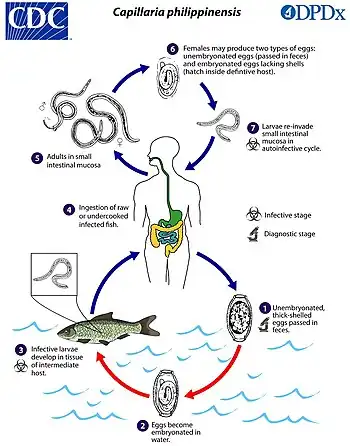 | |
| Capillaria philippinensis life cycle[2] | |
 | |
| Specialty | Infectious disease |
| Symptoms | Chronic diarrhea, abdominal pain[3] |
| Complications | Protein-losing enteropathy[4][2] |
| Causes | Capillaria philippinensis[5] |
| Diagnostic method | Stool examinations[2][6] |
| Differential diagnosis | Strongyloidiasis, giardiasis, tropical sprue[7] |
| Treatment | Albendazole, mebendazole[8] |
Intestinal capillariasis (or Capillaria philippinensis infection[9])is a disease in the group of helminthiasis diseases caused by the nematode Capillaria philippinensis.Humans acquire the infection by consuming raw/undercooked freshwater fish containing the parasite[2]
Medications like albendazole or mebendazole are used to treat the infection[10] Intestinal capillariasis is prevalent in the Philippines and Thailand, but cases have been reported in other parts of Asia[4]
Symptoms and signs
Symptoms in infested humans include watery diarrhea, abdominal pain, edema, weight loss, borborygmus , and depressed levels of potassium and albumin in the blood. In humans, the parasites damage the cells of the intestinal wall. This damage interferes with the absorption of nutrients and the maintenance of a proper electrolyte balance.[3][2][5]
Complications
As to the possible complications an affected individual may experience we find:[4][2]
- Protein-losing enteropathy
- Hypoalbuminemia
- Anemia
Cause
Capillaria philippinensis is a tiny nematode(roundworm) parasite range from 2.3 to 3.2 mm in length. They possess ventrolateral caudal expansions at the tail end and a long, smooth spicular sheath enclosing the spicule[2]
Diagnosis
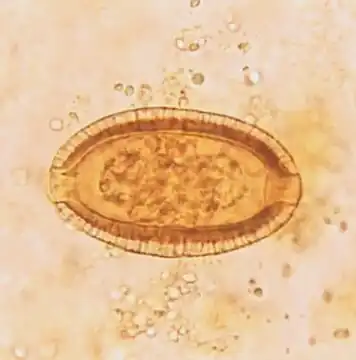
As to intestinal capillariasis it is diagnosed by identifying the parasite Capillaria philippinensis this is done via the following:[2][6]
- Clinical symptom
- Stool examination
- Biopsy
-
-
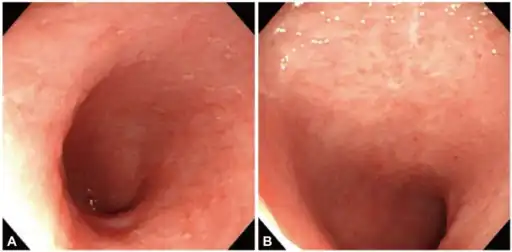 Intestinal capillariasis diagnosed by endoscopic biopsy.
 -
![Small bowel study in intestinal capillariasis showing continuous long segment of fold thickening, fold effacement, and increased luminal fluid.[4]](./_assets_/0c70a452f799bfe840676ee341124611/Intestinal_capillariasis.jpg) Small bowel study in intestinal capillariasis showing continuous long segment of fold thickening, fold effacement, and increased luminal fluid.[4]
Small bowel study in intestinal capillariasis showing continuous long segment of fold thickening, fold effacement, and increased luminal fluid.[4]
Differential diagnosis
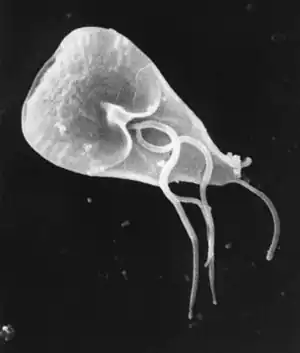
Conditions that may appear similar include:[4][2][7]
- Giardiasis
- Tropical sprue
- Strongyloidiasis
Prevention
Prevention is as simple as avoiding eating small, whole, uncooked fish; however, in C. philippinensis endemic areas, such dietary habits are common[5]
Treatment
As to management we find that anthelmintics such as mebendazole and albendazole eliminate infestation more effectively than thiabendazole.[8]These medications need special care for pregnant women and young children. The World Health Organization allows their use in the 2nd and 3rd trimesters of pregnancy when the benefits outweigh the risks[11]
Prognosis
In terms of the prognosis we find that recovery takes two months;assuming diagnosis and treatment were both prompt to begin with[4]
Epidemiology
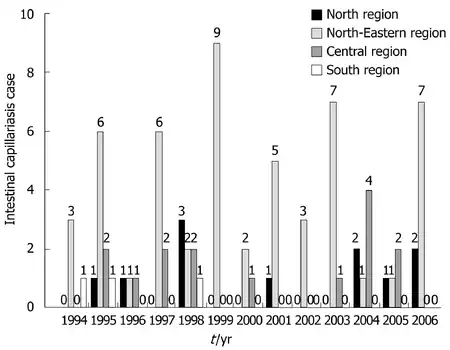
The disease was first identified in Philippines in the 1960s, where it caused a outbreak. The infection is considered endemic in the Philippines and Thailand.It has also been reported in several countries across Asia and the Middle East, including:[2][13][12]
- Thailand
- Iran
- Japan
- Egypt
- Indonesia
- Korea
- India
- Taiwan
History
As to Intestinal capillariasis it was first identified in 1963 in the Philippines, where it caused a outbreak in Northern Luzon. The causative agent, Capillaria philippinensis, was officially described and named in 1968 by Velasquez, Chitwood, and Salazar.[4][14]
This discovery followed a wave of illness that affected over 1,000 people and more than 100 deaths between 1967 and 1969[14][4]
Research
A 2025 article by Sadaow et al, indicates that a new rapid diagnostic test was developed to detect antibodies in simulated whole-blood samples. This test aims to improve early detection of intestinal capillariasis, especially in endemic areas where access to advanced diagnostics is limited[15]
See also
References
- ↑ "ICD-10 Code for Intestinal capillariasis- B81.1- Codify by AAPC". www.aapc.com. Retrieved 13 June 2025.
- ↑ 2.00 2.01 2.02 2.03 2.04 2.05 2.06 2.07 2.08 2.09 "CDC - DPDx - Intestinal Capillariasis". www.cdc.gov. 14 February 2020. Archived from the original on 11 June 2025. Retrieved 10 June 2025.
- ↑ 3.0 3.1 Mathison, Blaine A.; Pritt, Bobbi S. (2022). "Parasites of the Gastrointestinal Tract". Encyclopedia of Infection and Immunity. Elsevier. pp. 136–203. doi:10.1016/b978-0-12-818731-9.00107-5. ISBN 978-0-323-90303-5.
- ↑ 4.0 4.1 4.2 4.3 4.4 4.5 4.6 4.7 Limsrivilai, Julajak; Pongprasobchai, Supot; Apisarnthanarak, Piyaporn; Manatsathit, Sathaporn (December 2014). "Intestinal capillariasis in the 21stcentury: clinical presentations and role of endoscopy and imaging". BMC Gastroenterology. 14 (1): 207. doi:10.1186/s12876-014-0207-9. ISSN 1471-230X. PMC 4271459. PMID 25492259.
- ↑ 5.0 5.1 5.2 "capillariasis". cdc. 4 September 2024. Archived from the original on 19 June 2025. Retrieved 19 June 2025.
- ↑ 6.0 6.1 "Capillariasis | EBSCO Research Starters". www.ebsco.com. Retrieved 21 June 2025.
- ↑ 7.0 7.1 Palmer, Philip E. S.; Reeder, Maurice M. (8 November 2000). The Imaging of Tropical Diseases: With Epidemiological, Pathological and Clinical Correlation. Springer Science & Business Media. p. 98. ISBN 978-3-540-62471-4.
- ↑ 8.0 8.1 Hwang, K.P., T.E. Wang, T.C. Liou, S.C. Lin, C.R. Kao, T.Y. Wang and K.K. Pang (2004) "Clinical features of human intestinal capillariasis in Taiwan Archived 2009-02-06 at the Wayback Machine." World Journal of Gastroenterology 10(16):2391-2393.
- ↑ "Capillaria philippinensis infection (Concept Id: C0006899) - MedGen - NCBI". www.ncbi.nlm.nih.gov. Archived from the original on 14 April 2025. Retrieved 6 April 2025.
- ↑ Lindquist, H. D. Alan; Cross, John H. (1 January 2017). "195 - Helminths". Infectious Diseases (Fourth ed.). Elsevier. pp. 1763–1779.e1. ISBN 978-0-7020-6285-8.
- ↑ "Clinical Care of Capillariasis". Parasites - Capillariasis. 16 February 2024. Archived from the original on 14 June 2025. Retrieved 16 June 2025.
- ↑ 12.0 12.1 Saichua, Prasert; Nithikathkul, Choosak; Kaewpitoon, Natthawut (28 January 2008). "Human intestinal capillariasis in Thailand". World Journal of Gastroenterology. 14 (4): 506–510. doi:10.3748/wjg.14.506. ISSN 1007-9327. PMC 2681139. PMID 18203280.
- ↑ Wertheim, Heiman F. L.; Horby, Peter; Woodall, John P. (4 January 2012). Atlas of Human Infectious Diseases. John Wiley & Sons. p. 133. ISBN 978-1-4443-5467-6. Retrieved 20 June 2025.
- ↑ 14.0 14.1 Belizario, Vicente Y.; G Totañes, Francis Isidore; de Leon, Winifreda U.; Migriño, Julius R.; Macasaet, Lino Y. (April 2010). "Intestinal capillariasis, western Mindanao, the Philippines". Emerging Infectious Diseases. 16 (4): 736–738. doi:10.3201/eid1604.080483. ISSN 1080-6059. PMC 3321930. PMID 20350410.
- ↑ Sadaow, Lakkhana; Boonroumkaew, Patcharaporn; Rodpai, Rutchanee; Sanpool, Oranuch; Intapan, Pewpan M.; Maleewong, Wanchai (3 September 2025). "Development of an Immunochromatographic Test to Detect Antibodies in Simulated Whole-Blood Samples for the Diagnosis of Intestinal Capillariasis". The American Journal of Tropical Medicine and Hygiene. 113 (3): 640–644. doi:10.4269/ajtmh.25-0212. Retrieved 19 October 2025.
External links
| Classification |
|---|