Pappataci fever
| Pappataci fever | |
|---|---|
| Other names: Sandfly fever[1] | |
  | |
| |
 | |
| Specialty | Infectious disease |
Pappataci fever (also known as Phlebotomus fever , sandfly fever and three-day fever) is a vector-borne febrile arboviral infection caused by three serotypes of Phlebovirus. It occurs in subtropical regions of the Eastern Hemisphere. The name, pappataci fever, comes from the Italian word for sandfly; it is the union of the words pappa (food) and taci (silent), distinguishing these insects from blood-feeding mosquitoes, which produce a typical noise while flying.[2]
Signs and symptoms
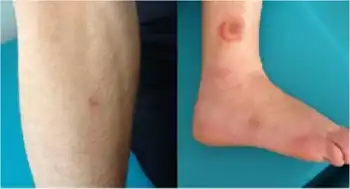
A few days after the infective bite, a feeling of lassitude, abdominal distress and chills develop followed by fever , joint aches, flushing of the face and a fast heart rate. After two days the fever begins to subside and the temperature returns to normal. Fatigue, a slow heart rate and low blood pressure may persist from a few days to several weeks but complete recovery is the rule.[2]
Cause
Three serotypes of Phlebovirus are known as the causative agents: Naples virus, Sicilian virus and Toscana virus.
-
![Neighbour-joining tree of Old World sandfly-borne phleboviruses(Naples, Sicilian and Salehabad species)[3]](./_assets_/ba48700f93e6ccab7a94adacb8f4c793/1-s2.0-S0166354213001927-gr1.jpg) Neighbour-joining tree of Old World sandfly-borne phleboviruses(Naples, Sicilian and Salehabad species)[3]
Neighbour-joining tree of Old World sandfly-borne phleboviruses(Naples, Sicilian and Salehabad species)[3] -
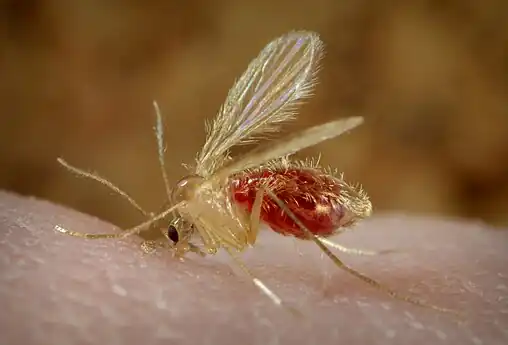 Phlebotomus papatasi taking a bloodmeal
The disease is transmitted by the bites of phlebotomine sandflies of the Genus Phlebotomus, in particular, Phlebotomus papatasi, Phlebotomus perniciosus and Phlebotomus perfiliewi. The sandfly becomes infected when biting an infected human in the period between 48 hours before the onset of fever and 24 hours after the end of the fever, and remains infected for its lifetime.Besides this horizontal virus transmission from man to sandfly, the virus can be transmitted in insects transovarially, from an infected female sandfly to its offspring.
Diagnosis
Although commercial tests are not readily available, diagnosis can be confirmed by serology-based assays or quantitative PCR by laboratories that have developed assays to perform such identification.[2]
Differential diagnosis
As to the DDx we find that evaluation of those with Pappataci fever might include:
- Malaria
- Dengue
Prevention
Prevention of sandfly bites, and control of sandflies and their breeding grounds with insecticides are the principal methods for prevention. Mosquito nets may not be sufficient to prevent sandfly bites.
Treatment
There is no specific treatment for the disease. Pain killers and fluid replacement may be useful.[4]
Epidemiology

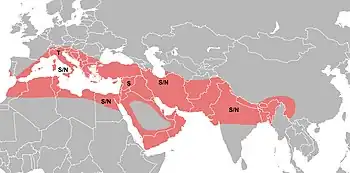
Pappataci fever is prevalent in the subtropical zone of the Eastern Hemisphere between 20°N and 45°N, particularly in Southern Europe, North Africa, the Balkans, Eastern Mediterranean, Iraq, Iran, Pakistan, Afghanistan and India.[5]
Pappataci fever is seldom recognised in endemic populations because it is mixed with other febrile illnesses of childhood, but it is more well-known among immigrants and military personnel from non-endemic regions.
History
In terms of history we find that the viral nature and transmission by Phlebotomus sandflies were clarified during World War II by researchers Albert B. Sabin, Cornelius B. Philip, and John R. Paul, who conducted investigations for the U.S. Army[6]
Research
References
- ↑ "Phlebotomus fever (Concept Id: C0030372) - MedGen - NCBI". www.ncbi.nlm.nih.gov. Retrieved 10 November 2025.
- ↑ 2.0 2.1 2.2 Magill, Alan J.; Strickland, G. Thomas; Maguire, James H.; Ryan, Edward T.; Solomon, Tom (12 November 2012). Hunter's Tropical Medicine and Emerging Infectious Disease E-Book. Elsevier Health Sciences. p. 320. ISBN 978-1-4557-4043-7.
- ↑ Alkan, Cigdem; Bichaud, Laurence; de Lamballerie, Xavier; Alten, Bulent; Gould, Ernest A.; Charrel, Rémi N. (1 October 2013). "Sandfly-borne phleboviruses of Eurasia and Africa: Epidemiology, genetic diversity, geographic range, control measures". Antiviral Research. 100 (1): 54–74. doi:10.1016/j.antiviral.2013.07.005. ISSN 0166-3542. Archived from the original on 2 August 2023. Retrieved 9 November 2025.
- ↑ Tavana AM. Sandfly fever in the world. Ann Trop Med Public Health 2015;8:83–7
- ↑ Gratz N.G. (2004). The vector-borne human diseases in Europe. Their distribution and burden on public health (PDF). Copenhagen, Denmark. pp. 25–6. Archived (PDF) from the original on 2010-05-03. Retrieved 2021-12-02.
{{cite book}}: CS1 maint: location missing publisher (link) Archived 2010-05-03 at the Wayback Machine - ↑ Sabin, Albert B. (1 July 1944). "PHLEBOTOMUS (PAPPATACI OR SANDFLY) FEVER: A DISEASE OF MILITARY IMPORTANCE SUMMARY OF EXISTING KNOWLEDGE AND PRELIMINARY REPORT OF ORIGINAL INVESTIGATIONS". Journal of the American Medical Association. 125 (9): 603. doi:10.1001/jama.1944.02850270001001. Retrieved 13 November 2025.
External links
| Classification |
|---|