Pokémon Pinball: Ruby & Sapphire
|
It has been suggested that this article be moved to Pokémon Pinball Ruby & Sapphire. Please discuss whether or not to move it on its talk page. |
| Pokémon Pinball: Ruby & Sapphire ポケモンピンボール ルビー&サファイア | |
|---|---|
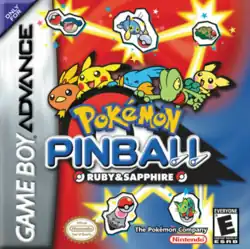 Cover of Pokémon Pinball: Ruby & Sapphire | |
Basic info
| |
| Platform: | Game Boy Advance, Wii U (Virtual Console) |
| Category: | Pinball |
| Players: | 1 |
| Connectivity: | None |
| Developer: | Jupiter Corporation |
| Publisher: | Nintendo |
| Part of: | Generation III spin-off |
Ratings
| |
| CERO: | A |
| ESRB: | E |
| ACB: | N/A |
| OFLC: | G8+ |
| PEGI: | 3+ |
| GRAC: | N/A |
| GSRR: | N/A |
Release dates
| |
| Japan: | August 1, 2003 (GBA)[1] December 10, 2014 (Wii U VC)[2] |
| North America: | August 25, 2003[3] January 1, 2015 (Wii U VC)[4] |
| Australia: | September 26, 2003[5] December 12, 2014 (Wii U VC)[6] |
| Europe: | November 14, 2003[7] December 11, 2014 (Wii U VC)[8] |
| South Korea: | N/A |
| Hong Kong: | N/A |
| Taiwan: | N/A |
Websites
| |
| Japanese: | Pokémon.co.jp Nintendo.co.jp Nintendo.co.jp (Virtal Console) |
| English: | Pokémon.com (US) Pokémon.com (UK) Nintendo.com |
|
Japanese boxart
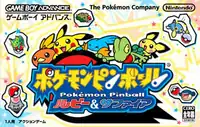 Japanese boxart of Pokémon Pinball: Ruby & Sapphire | |
Pokémon Pinball: Ruby & Sapphire (Japanese: ポケモンピンボール ルビー&サファイア Pokémon Pinball: Ruby & Sapphire), sometimes shortened to Pokémon Pinball, is a spin-off pinball video game for the Game Boy Advance. It expands upon the game mechanics used in Pokémon Pinball and features the Pokémon in the Hoenn Pokédex.
It was originally released in Japan on August 1, 2003, in North America on August 25, 2003, in Australia on September 26, 2003, and in Europe on November 14, 2003. It was later released on Wii U Virtual Console in Japan on December 10, 2014, in Europe on December 11, 2014, in Australia on December 12, 2014, and in North America on January 1, 2015, making it the first Pokémon game to be released for the Wii U Virtual Console. The Virtual Console release became unavailable after the Wii U Nintendo eShop was discontinued on March 27, 2023.
The game is played with a Poké Ball in the traditional pinball format. There are two tables, the Ruby Field and Sapphire Field, each varying in gameplay and Pokémon available for capture.
If this game is played on the Game Boy Player accessory, the player can use the rumble feature in the GameCube's controller.
Name
"Pokémon Pinball: Ruby & Sapphire" is the main name used for this game on Pokémon.com,[9] Nintendo.com,[10] the Nintendo Power magazine,[11][12][13] and has been used at least once on Nintendo of America's Youtube Channel.[14] This is formatted as "Pokémon™ Pinball: Ruby & Sapphire" on the list of games of the Wii U Virtual Console. Alternatively, "Pokémon Pinball: Ruby and Sapphire" has also been used at least once on Pokémon.com[9] and Nintendo.com.[10]
In the American game manual, this is written without the colon as "Pokémon Pinball Ruby & Sapphire".[15] In the European game manual, this is formatted as "Pokémon Pinball™ Ruby&Sapphire".[16]
This game was known as "Pokémon Pinball" when originally announced at E3 2003.[17] This title was mentioned in an article about the E3 2003 on Nintendo Power prior to the game release,[18] is occasionally used in-game,[19] is included in the blurb on the back of the game box,[20] and has been used at least once on Nintendo.com.[21]
-
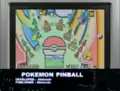 "POKEMON PINBALL" in the game announcement at E3 2003
 -
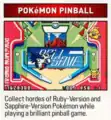 "POKéMON PINBALL" in Nintendo Power #169 prior to the game release
Blurb
More than a regular pinball game, Pokémon Pinball combines fast flipper action with a unique way to catch your favorite Pokémon. Control the flippers to shoot the Poké Ball at targets on one of two PlayFields. Play on either the Ruby or Sapphire field to rack up as many points as possible. Catch over 200 Pokémon - featuring characters from Pokémon Ruby and Pokémon Sapphire!
- Play pinball with your favorite Pokémon!
- Shoot the Poké Ball to find & catch Pokémon!
- Use the Game Boy Advance Game Link cable to share your Pokédex and Hi-Score with a friend! You'll need a Game Boy Advance Game Link and two Game Paks to link up with a friend (sold separately).
- Play on both the Ruby & Sapphire Fields.
- Try to catch over 200 Pokémon!
Obtaining Pokémon
Beyond getting a high score, the main aim of the game is to complete the Pokédex. All of the Pokémon in the regional Hoenn Pokédex are available in the game except for Deoxys. Chikorita, Cyndaquil, Totodile, and Aerodactyl are also available which brings the total amount of Pokémon up to 205.
There are three methods of obtaining Pokémon, all of which must be used to complete the Pokédex:
- Catch 'Em Mode: This mode begins with a shadowed image which is uncovered by hitting the Pokémon bumpers three times. The Pokémon will then appear and must be hit three times before the two minutes run out to be caught. The Pokémon are all area exclusive, and some appear only on the Sapphire or Ruby Field.
- Egg Mode: As soon as the Egg on the field hatches, the newborn Pokémon will start moving around the field. It must be hit twice within the time limit for a successful capture. A total of 32 different Pokémon can be caught using Egg Mode. Some, but not all, hatched Pokémon with three forms can also be caught in their middle form in Catch 'Em Mode. To find a Pichu egg, you must have caught or evolved five Pokémon in a single game.
- Evo Mode: Most middle and top-form Pokémon can only be obtained by evolving Pokémon caught through the above two methods. Once the Pokémon to evolve has been selected, three items must be collected in turn and the ball must then enter the Center Hole within two minutes. These items represent how the Pokémon evolves in the games.
- There are a few Pokémon that have a unique way of being caught. To catch Groudon, Kyogre, and Rayquaza, their bonuses need to be completed twice in one game. To catch Jirachi, one must get into the start slot while in the Ruins area and match it on the Jirachi bonus. Jirachi moves around the field and must be hit three times in only thirty seconds.
Catching 15 Pokémon earns the player an extra ball.
Super-Rare Pokémon
To get Latias and Latios to spawn, five Pokémon must have been captured or evolved and 100 Pokémon must be registered as caught in the player's Pokédex. Once you register the 100th Pokémon, the field must be reloaded for the game to register this, whether it be by starting a new game, entering and exiting a bonus field or saving and continuing. There is 1% chance that one of these Pokémon will spawn; 2% if the player has beaten the Rayquaza bonus stage or scanned the Encounter Rate UP e-Reader card.
If the player has scanned the GET Special Guests e-Reader card, Chikorita, Cyndaquil, Totodile, and Aerodactyl will become the first spawned Pokémon in any area, though they are not able to evolve. They can also become spawnable as a super-rare Pokémon with a 1% chance of appearing in either field if the player has them in the Pokédex. This can be done by sharing data with a game that has them unlocked already using a Game Link Cable.
The order in which these Super-Rare Pokémon spawn is predetermined and it will select the first eligible Pokémon that has not been caught. Latias (Sapphire Field) or Latios (Ruby Field) will spawn first, followed by Cyndaquil, Totodile, Chikorita, and finally, Aerodactyl. If all the Pokémon are registered as caught, then a random Pokémon will be selected.[22]
Poké Ball
Fittingly with the other Pokémon-inspired tweaks to the basic pinball formula, the ball is a Poké Ball. Each table has three lights near the top of the upper half that, when lit simultaneously, will upgrade the Poké Ball temporarily to the next better basic Poké Ball; the upgrades are the Great Ball, the Ultra Ball, and the Master Ball. Each upgrade multiplies the points gained on the table by a different multiplier: 2×, 3×, and 4×, respectively.
Bonus tables
Catching a Pokémon in Catch 'Em Mode will cause one Poké Ball icon to light up below the display on the lower portion of the field. Evolving a Pokémon in Evolution Mode will cause two of these lights to light up instead (or one if there is no room for two). Three of these lights can be lit at a time; when all three are lit, the player can shoot the ball into the center hole to access one of several bonus stages that are progressed through in a linear fashion, going in order as they are completed. If a stage is failed, the bonus stage will repeat in the subsequent bonus stage activation, until completed. Each table has a separate progression of three bonus tables, with only the final stage on each table (the Rayquaza stage) being the same for both tables.
Kecleon bonus stage
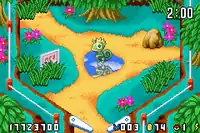
This is the first bonus stage on the Ruby Field.
Kecleon will turn invisible with its Color Change ability and can hide in tall grass. A Devon Scope can be knocked out of the tree to make it visible for a short time. Kecleon must be knocked over and then hit with the ball ten times in two minutes to win the bonus stage. 30,000,000 points are added after completion and multiplied by the type of Poké Ball.
Groudon bonus stage
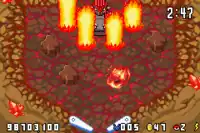
This is the second bonus stage on the Ruby Field.
Groudon will throw rocks down from the ceiling to add obstacles to the field and create an eruption to surround itself in four pillars of fire. The rocks take three hits to break while the fire pillars take four hits to break. During this time, Groudon will also throw fire balls at the Poké Ball to stall it further. The eruption does break any rocks still on the field. Groudon must be hit 15 times in three minutes to complete the bonus stage. Completing this bonus stage will earn 50,000,000 points and multiplied by the type of Poké Ball. After beating the round twice, Groudon will be captured.
Dusclops bonus stage
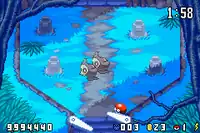
This is the first bonus stage on the Sapphire Field.
Similar to the Gengar Bonus Stage in Pokémon Pinball, this stage is set in the graveyard. Two wild Duskull appear at the same time. Twenty of them must be hit in order to make Dusclops appear. Then Dusclops must be hit five times to complete the bonus stage. Dusclops can only be hit in the back or while moving and can devour the ball if directed towards the front. 30,000,000 points are added after completion and multiplied by the type of Poké Ball.
Kyogre bonus stage

This is the second bonus stage on the Sapphire Field.
Kyogre will first use Sheer Cold to freeze the ball in place. It will then create whirlpools to trap the ball further. Finally, it will dive into the water to evade being hit completely. However, air bubbles will appear where it is about to rise out of the water. Kyogre must be hit 15 times in three minutes to win. After beating the round twice, Kyogre will be captured. Completing this bonus stage will earn 50,000,000 points and multiplied by the type of Poké Ball.
Rayquaza bonus stage
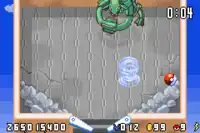
This is the third bonus stage on both the Ruby and Sapphire Fields.
It can only be challenged after capturing Groudon or Kyogre and will then join the circuit of bonus fields. Rayquaza will bounce along from left to right, allowing the ball to roll under it if it is up. It will sometimes use Thunder to paralyze the ball if it is not moving fast enough, though it does stay still while it is unleashing the attack. Rayquaza will also sometimes use ExtremeSpeed to create two tornadoes that cause the ball to fly up into the air for several seconds if contact is made. Rayquaza must be hit 15 times in three minutes to win. After beating the round twice, Rayquaza will be captured. 99,999,999 points are awarded after completion and multiplied by the type of Poké Ball.
Once the Rayquaza stage is completed, the rotation will cycle back to the first bonus stage for the table being played, the music will change on both fields and there will be increased chance to encounter new Pokémon.
Fields
There are two playing fields in the game: the Ruby Field and the Sapphire Field. They are similar in design, but have very distinct differences. These differences include:
- The Sapphire Field has a Zigzagoon that can stop the slot roll, while the Ruby Field has a Makuhita that can send the ball through the coin loop.
- The requirements for getting to the Spheal Bonus Stage are different.
- All bonus stages are unique to one particular field except Rayquaza's and Spheal's.
- There are several areas per field that are only accessible from that field, plus some field-exclusive Pokémon. These include the Lake, Beach and Desert Areas on the Sapphire Field, while Chimney Mountain, Lilycove and Safari Zone Areas on the Ruby Field.
- The Ruby Field has a ball upgrade available on the field, while the Sapphire Field does not.
- Latios is the Ball Saver for the Ruby Field and Latias is the Ball Saver for the Sapphire Field.
Field mechanics
On each field, various Pokémon appear, taking the place of more traditional pinball obstacles like switches and bumpers.
Ruby Field
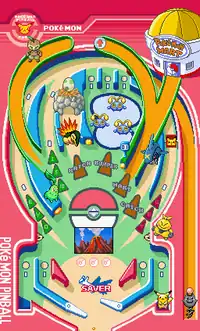
- Chinchou or Lotad: Three appear at the center of the top screen. They serve as bumpers for the Poké Ball and also break silhouette tiles in Catch 'Em Mode. This can be switched to Chinchou rotating counterclockwise, clockwise, moving up and down, one Chinchou, or Lotad replacing the Chinchou. This is done by pushing the yellow button to the left of them.
- Sharpedo: If the ball is sent to the right side of the table, Sharpedo will eat the ball and release it; if at least two GET lights are lit, Catch 'Em Mode begins when this happens.
- Makuhita: Makuhita appears in the middle right of the field. When the ball is near it, press the button for the right flipper to send the ball to a loop with Nuzleaf. Hitting the Nuzleaf twice will form a loop in which a ball upgrade, or, rarely, an extra ball can be obtained. This works only when Makuhita is in attack stance.
- Cyndaquil: Hitting Cyndaquil will knock it back. After a few hits, Cyndaquil will be knocked into the Egg stand and the flame on its back will start heating the Egg. Hitting Cyndaquil one more time will cause the Egg to hatch and the player will have a chance to catch the newly hatched Pokémon.
- Chikorita: Hitting a button near Chikorita will cause Chikorita to use Razor Leaf in which two Linoone pop out on each side of the field.
- Linoone: Two Linoone hide on each side of the field, a Chikorita must be hit for the Linoone to pop out. The left Linoone will cause a Gulpin to appear and the right Linoone will change Makuhita's stance.
- Gulpin: Make three of these appear to trigger Travel mode. One will appear when the left Linoone is hit.
- Whiscash: Whiscash replaces the bumpers at the top of the field, sending the ball to the Spheal bonus stage if the ball is directed toward its mouth. Hitting Whiscash at the top will make Whiscash angry and cause an Earthquake, shaking the field.
- Latios: Latios is the Ball Saver for the Ruby Field.
Sapphire Field
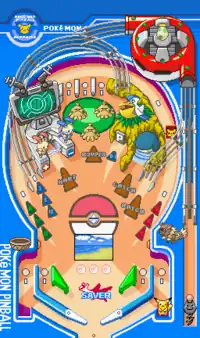
- Shroomish: Three appear at the center of the top screen. They serve as bumpers for the Poké Ball and also break silhouette tiles in Catch 'Em Mode.
- Wailmer: If the ball is sent to the right side of the table, Wailmer will eat the ball and release it; if at least two GET lights are lit, Catch 'Em Mode begins when this happens.
- Plusle and Minun: They block access to the Poké Mart with electric barriers. Hitting the plus and minus buttons on each side will cause the barriers to switch off, allowing access to the shop.
- Zigzagoon: By hitting the right button, Zigzagoon can force the slot to stop.
- Seedot: Making three appear will trigger Travel mode. Hitting the left button makes one appear.
- Pelipper: Pelipper can take the ball to the top of the table or to the Spheal bonus stage.
- Latias: Latias is the Ball Saver for the Sapphire Field.
Both fields
- Spoink: Spoink serves as the launcher for the ball.
- Pikachu: Pikachu can appear under either one of the exit lanes (from which the ball cannot normally be saved); Pikachu's location is toggled with the flipper buttons. If the ball would exit the table via the exit lane that Pikachu is under, if Pikachu is ready, then instead it will rebound the ball onto the field by using ThunderShock. Pikachu is readied by spinning a spinner on the right side of the large loop on each table. There is a gauge with a lightning bolt symbol in it to indicate how ready Pikachu is; it can only rebound the ball if this gauge is full.
- Pichu: If obtained via the slot or the Poké Mart, for the rest of the ball, the Pichu can assist Pikachu if the ball reaches the exit lines.
Areas
The species of Pokémon that are available in Catch 'Em Mode are dependent on the areas, though this is the only effect that areas have on the gameplay. The current area is represented through the image between the Catch Counter and center hole.
There are nine areas, of which seven can be reached on each field. The Forest, Plains, Cave and Ruins are available on both fields with only a slight variation in the available Pokémon between the two. Lilycove, Chimney Mountain, and the Safari Zone are unique to the Ruby Field while the Beach, Desert, and Lake are unique to the Sapphire Field.
The first area is chosen at random at the start of the game. After this, a new area can be reached through Travel Mode. Once the mode begins, the Poké Ball must be sent round a loop and then sent into the Center Hole within one minute. The areas are in a set order, though two are available in one Travel Mode; the next in line is reached through the left loop while the second in line is reached through the right loop. However, an area that could have been traveled to in the previous Travel Mode will be skipped in the following Travel Mode; in other words, if the previous Travel Mode went through the left loop, then in the following Travel Mode the left loop will bring the player to the second area in line and the right loop will bring the player to the third area in line. Depending on the player's starting area, a given area can be paired with either the one before it or after it in the order (for example, on Ruby Field, Forest might be linked with either Cave or Chimney Mountain).[23]
For the Ruby Field, the order is Cave, Forest, Chimney Mountain, Plains, Lilycove, Safari Zone. For the Sapphire Field, the order is Cave, Forest, Lake, Plains, Desert, Beach. The player will always travel to the Ruins on the sixth Travel Mode. From the Ruins, Travel Mode will bring the player to the areas that would have been accessible in the previous Travel Mode. As there are seven locations but Ruins are reached every sixth travel, the game only repeats the order every 18th travel.
Slots
By lighting up all four "HOLE" lights at the top of the four lanes, the player makes the "Slots" bonus available. This makes the center hole open, and by shooting the ball into it, the player activates the slots. A slot reel will spin around and the player can make it stop by pressing 'A' (it can be forced to stop by using Zigzagoon in Sapphire Field). The player is then awarded one of the following bonuses:
- Small: A bonus of 100 - 900 points.
- Big: A bonus of 1,000,000 - 9,000,000 points.
- Get: Starts Catch 'Em Mode.
- Evo: Starts Evolution Mode.
- Saver: For the next 30/60/90 seconds, if the ball is drained, Latios or Latias will return the ball to the Spoink and the ball can be launched.
- Pika: For the rest of this ball Pichu will assist the Pikachu in saving the ball if it goes into the out lanes.
- Upgrade: The ball is upgraded to the next level, increasing the score multiplier.
- Max: The ball is upgraded to the max level (Master ball), increasing the score multiplier.
- Extra: The player receives an extra ball (an extra life).
- Bonus multiplier: The bonus multiplier is increased.
- Timer: Adds 30 seconds to next timed event
- Go to bonus: The player immediately plays the next bonus stage.
Only some of these are available at any given time. The game will first go through these ten combinations. The bonus multiplier here can be only 1 to 3. BIG can only go up to 3 million on first five, then 5 million on the next five.
| #1 | #2 | #3 | #4 | #5 | #6 | #7 | #8 | #9 | #10 |
|---|---|---|---|---|---|---|---|---|---|
 |
|
|
|
 |
|
|
|
|

|
 |
|
|
 |
 |
|
|
|
|

|
 |
|
|
|
|
|
|
|
|
|
|
|
 |
|
|
|
 |
|
 |
|
|
|
|
|
 |
|
|
|
|
|
 |
 |
|
 |
|
|
|
|
|
|
Afterwards, the game loops through the following 15 combinations. Multiplier increase and BIG have their full range here:[24]
| #11 | #12 | #13 | #14 | #15 | #16 | #17 | #18 | #19 | #20 | #21 | #22 | #23 | #24 | #25 |
|---|---|---|---|---|---|---|---|---|---|---|---|---|---|---|
|
|
|
|
|
|
|
|
|
|
|
|
|
|
|
|
 |
|
|
|
|
|
|
|
|
|
|
|
|
|
|
|
|
|
|
|
|
|
|
|
|
|
|
|
|
|
|
|
|
|
|
|
|
|
|
|
|
|
|
|
|
|
|
|
|
|
|
|
|
|
|
|
|
|
|
|
|
|
|
|
|
|
|
|
|
|
|
|
|

|
Note that the player can light up the four "HOLE" lights at any time, however the slots will only become available when the player is not in Catch 'Em, Evolution or Travel modes and the bonus stage is not available.
Pokémon Mart
- Main article: Pokémon Mart (Pinball)
A new feature to this pinball game is the shop. Coins are earned by sending the ball through the Coin loop and can be spent on items:
- 30 Second Ball Saver (10 coins)
- 60 Second Ball Saver (20 coins)
- 90 Second Ball Saver (30 coins)
- Ball Upgrade (40 coins)
- Timer Up (40 coins) - This adds 30 seconds to the next timed event.
- Pika (50 coins) - Pichu joins Pikachu. For the rest of that ball, the Poké Ball is guaranteed to be rescued if it falls to the sides of the fields.
- Bonus Challenge (60 coins) - The ball will be transported to the Spheal Bonus Field.
- Extra Ball (99 coins) - The player receives an extra ball (an extra life). Available once after starting and then again after each time Rayquaza has been caught.
When Evo Mode is possible, the activation of it will replace the shop.
e-Reader Room
|
This section is incomplete. Please feel free to edit this section to add missing information and complete it. Reason: e-Reader Room screenshots, also with the cards |
- This section is about the Card e Room in Pokémon Pinball: Ruby & Sapphire. For the Card e Room in Pokémon Colosseum, see Card e Room.
The cartridge releases feature an e-Reader Room (Japanese: カードeルーム Card e Room), which was disabled for the Virtual Console releases. It can be accessed from the title screen with the following button sequence:
- Press and hold →.
- Press L and then R thrice each.
The cards for the e-Reader Room were only available in Japan, but they can be scanned in all cartridge releases of the game if a Japanese e-Reader+ is used. An American e-Reader will instead return the "·Region Error· Incompatible Version" error message.
| Card ID | Card Name | Card Effect | Promotion |
|---|---|---|---|
| 09‑A001 | Bonus Stage Card | Allows players to play the bonus stage of their choice | Pokémon Scoop (Summer 2003); Pokémon Festa 2003 |
| 09‑A002 | GET Special Guests Card | Unlocks one of the following Pokémon for capture: Chikorita, Cyndaquil, Totodile or Aerodactyl | Demo cards placed in selected stores in Japan throughout September 2003 (not for distribution) |
| 09‑A003 | Ruin Area Card | Allows players to start their games from the Ruins | Distributed to customers who purchase the game at Pokémon Centers |
| 09‑A004 | DX Mode Card | Allows players to start with 9 balls (lives), Master Ball and 99 coins; in addition, Pichu rescuer will always be enabled throughout the game | Distributed to customers who purchase the game at Pokémon Centers |
| 09‑A005 | Encounter Rate UP Card | Forces Pokémon with low encounter rate to show up more often | Distributed to customers who purchase the game at Pokémon Centers |
Reception
Gaming magazine Famitsu gave Pokémon Pinball: Ruby & Sapphire a score of 34 out of 40. IGN rated the game a "Great" 8.8/10.[25] It holds a rating of 80.03% on GameRankings, based on 27 reviews.[26]
Sales
Japanese sales
Pokémon Pinball: Ruby & Sapphire sold approximately 39,400 units on its first week on the Japanese market. By December 28, 2003, the end of its 22nd week, it had sold 291,501 copies.
| Week | Week ending | Ranking | Units sold | Total units sold |
|---|---|---|---|---|
| 1 | August 3, 2003 | 4th | 39,400 | 39,400 |
| 2 | August 10, 2003 | 5th | 38,400 | 77,800 |
| 3 | August 17, 2003 | 4th | 54,400 | 132,200 |
| 4 | August 24, 2003 | 4th | 18,500 | 150,700 |
| 5 | August 31, 2003 | 6th | 19,400 | 170,200 |
| 6 | September 7, 2003 | 10th | 11,500 | 181,800 |
| 9 | September 28, 2003 | 21st | - | - |
| 17 | November 23, 2003 | 37th | - | - |
| 22 | December 28, 2003 | - | - | 291,501 |
Staff
- Main article: Staff of Pokémon Pinball: Ruby & Sapphire
Gallery
Logos
-
 English Pokémon Pinball: Ruby & Sapphire logo
Virtual Console icons
-
 Wii U Virtual Console icon (English)
 -
 Wii U Virtual Console icon (Japanese)
Trivia
- At least one full-size pinball machine based on this game was produced by Personal Pinball Inc.[27] for Pokémon USA.[28] It was housed at the Pokémon Center New York.[29]
- Although the red stripe on Kecleon is supposed to remain visible at all times, it turns invisible with the rest of Kecleon in its bonus stage.
- Early batches of the game came in AGB-E06 cartridges, which utilizes battery-backed SRAM save chips and therefore will lose save files when the internal battery runs out. On the other hand, later batches don't require an internal battery to save, as they came in AGB-E11 cartridges which features non-volatile FRAM save chips.
- Sound effects and music in this game were recycled from Pokémon Ruby and Sapphire Versions, particular the sound effects of moves.
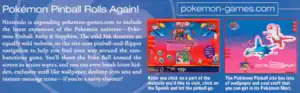
- In 2003, the pokemon-games.com website (currently a redirect to Pokémon.com) used to have a Flash page with navigation based on this game. This included shooting a Poké Ball to access the contents such as wallpapers, desktop icons, and instant message icons.[13]
In other languages
| |||||||||||||||||||||
External links
References
- ↑ Pokémon.co.jp
- ↑ Nintendo.co.jp
- ↑ Pokémon.com (US)
- ↑ Nintendo of America
- ↑ Nintendo of Australia (archive)
- ↑ Vooks
- ↑ Pokémon.com (UK)
- ↑ Siliconera
- ↑ 9.0 9.1 "Pokémon Pinball: Ruby & Sapphire has been added as a Virtual Console game playable on the Wii U. [...] Are you up to the challenge of Pokémon Pinball: Ruby and Sapphire?" - Pokémon Pinball: Ruby and Sapphire - Pokémon.com
- ↑ 10.0 10.1 "In Pokémon Pinball: Ruby and Sapphire, control the flippers to shoot the Poké Ball [...]" - Pokémon Pinball: Ruby & Sapphire - Nintendo.com
- ↑ "[...] Pokémon Pinball: Ruby & Sapphire will soon shake up the Pokémon scene." - Nintendo Power #170 (July/August 2003), page 125
- ↑ Nintendo Power #171 (September 2003), page 104
- ↑ 13.0 13.1 Nintendo Power #172 (October 2003), page 29
- ↑ "Nintendo eShop - Pokémon Pinball: Ruby & Sapphire" - Nintendo or America
- ↑ "Both P1 and P2 can transmit in Pokémon Pinball Ruby & Sapphire" - American game manual, page 52 (in the European version, this is written instead: "Both P1 an P2 can transmit in the game)
- ↑ European game manual, page 6
- ↑ Pokémon Pinball trailer (video timestamp 02:16:50) - The Future Of Video Games 2K4 Gamecube (2003)
- ↑ Nintendo Power #169 (June 2003), page 34
- ↑ "Pokémon Pinball" is displayed at the bottom-left corner of the Ruby and Sapphire Fields and also repeatedly appears on the background of the game intro animation
- ↑ "Much more than a regular game, Pokémon Pinball combines fast flipper action with a unique way to catch your favorite Pokémon." - Back cover of Pokémon Pinball: Ruby & Sapphire
- ↑ "Pokémon Pinball is packed full of references that fans will flip out over!" - Pokémon Pinball: Ruby & Sapphire - Nintendo.com
- ↑ Spawn Probabilities
- ↑ The Unexplored Layers of Pokemon Pinball Ruby & Sapphire
- ↑ Pokemon Pinball: Ruby & Sapphire Guide (ISBN 4-09-106120-6); pages 16-17
- ↑ Pokémon Pinball: Ruby & Sapphire - IGN
- ↑ Pokémon Pinball: Ruby & Sapphire for Game Boy Advance - GameRankings
- ↑ Archive of Personal Pinball Inc.'s website
- ↑ Advertisement for real pinball machine
- ↑ Fan picture of the pinball machine
Related articles

|
This article is part of Project Sidegames, a Bulbapedia project that aims to write comprehensive articles on the Pokémon Sidegames. |