Desert

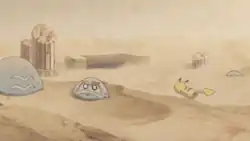
A desert is a type of arid environment in the Pokémon world. There is often a continuous sandstorm in deserts. They tend to have Rock- and Ground-type Pokémon, although Pokémon based on desert-dwelling organisms such as Cacnea may also be found. Deserts can be found in most post-Generation III regions of the Pokémon world.
Deserts are typically covered in sand and contain little to no water. Many deserts have deep sand that the player will sink in and can impede the speed of bicycles. Hidden items can often be found buried in the sand of these regions. Old ruins may also be found in many of the world's deserts.
List of deserts in the Pokémon world
In the core series
Johto
- Johto Safari Zone's Desert area - An arid area of the Safari Zone in Johto available in Pokémon HeartGold and SoulSilver where desert-dwelling Pokémon such as Cacturne can be found.
Hoenn
- Route 111 - This expansive route includes a desert where sandstorms rage unceasingly and a mountain pass. The desert in the center of Route 111 cannot be traversed without the Go-Goggles. Many hidden items can be found in the sand, and the Root Fossil and Claw Fossil can be found here, though it is not possible to get one without losing the other, though perhaps it turns up elsewhere. The desert that appears in the Pokémon the Series: Ruby and Sapphire episode Candid Camerupt is likely based on Route 111, as the Winstrate family, another aspect of Route 111, is found living there.
- Desert Ruins - The resting place of the Legendary Pokémon Regirock, are found at the southernmost point in the desert on Route 111.
Sinnoh
- Route 228 - This rough path is harshly raked by a horizontally blowing sandstorm driven by strong winds off the sea. On this route, some of the highest-leveled wild Pokémon in Sinnoh can be found.
Unova
- Route 4 - In Pokémon Black and White, a sandstorm delayed the road construction to connect two cities. In Pokémon Black 2, the route that was once covered in sand has a lot of buildings now. In Pokémon White 2, development was suspended after the ruins were discovered.
- Desert Resort - Located on Route 4, the Desert Resort is said to be a popular place for tourists, but too harsh to be a resort. The resort is split into two distinct areas: a narrow desert path and a large, barren desert. A sandstorm is always occurring in both parts. Like Route 4, the Desert Resort has deep sand rather than tall grass. The Desert Resort's southeastern entrance is a short, narrow pathway that cuts through a rocky hill. A gate at the end of the path connects directly to the inner area. The interior covers a large area and features many sandy hills, valleys, and deep sand throughout its barren ground.
Kalos
- Route 13 - Also known as Lumiose Badlands, since no plants can grow in the red clay of this great plain, Kalos Route 13 hosts the Power Plant instead. In the badlands, wild Pokémon will appear in the form of dirt mounds that will chase the player and battle them when near, moving only when the player moves. There is often also a strong wind that blows in one direction, which affects movement. The nearby Power Plant apparently produces a special magnetic field that allows Magneton and Nosepass to evolve when leveled up.
Alola
- Haina Desert - A scorching-hot desert beyond Route 13. Trainers often get lost here in this broiling labyrinth. During most of the day, Haina Desert is bathed in harsh sunlight, while during the night a sandstorm blows instead.
Galar
- Dusty Bowl - Located in the Wild Area is a sandy desert pit. If the player passes under the stone arch in Dusty Bowl with a Galarian Yamask that has taken at least 49 HP in damage from attacks without fainting, it will evolve into Runerigus.
- Potbottom Desert - An enclosed desert region within the Isle of Armor covered in sand and frequently covered by a sandstorm. Several dried-up up trees also stand around the desert.
Paldea
- Asado Desert - A large desert stretching a portion of the Paldea region's West Province. It contains the city of Cascarrafa.
In spin-off games
Orre
The Orre region mainly consists of one huge desert.
Mystery Dungeon world
Dungeons
- Desert Region - A desert area with rocky terrain and many cactuses.
- Northern Desert - A rocky desert filled with pits of sand.
- Shimmer Desert - A shimmering, yellow sand desert. Groudon dwells in the pit of the desert.
- Miragesands - Desert badlands with illusory dunes, flowing sandfalls, and sporadic desert vegetation.
- Scorching Desert - A blazing hot desert where Kyurem is encountered.
- Thirsty Desert - A dry and rocky desert with sparse greenery.
Rescue team camps
- Withering Desert - The sun bears down ruthlessly on the burning-hot sand. Desert-dwelling Pokémon thrive in this area. In Red Rescue Team and Blue Rescue Team, it is a Friend Area named Furnace Desert.
Almia
- Haruba Desert - A rocky and barren desert in a remote part of Almia.
Other
Orange Islands
The Orange Islands exclusively appear in Pokémon the Series, featured in the Gold and Silver series.
- Mandarin Island South desert - A large desert exists on the island. The harsh landscape is prone to lightning storms
Pokédex entries
Several Pokédex entries reference deserts, particularly in relation to Pokémon who live or once lived in the desert, or have been found there.
| Pokémon | Description |
|---|---|
 Sandshrew |
Sandshrew usually makes its home in deserts and arid zones, where rain does not fall. Its body is configured to absorb water without waste, enabling it to survive in an arid desert. At night, it burrows into the desert sand to sleep. Its hide has turned tough and solid as a result of living in the desert. It moves through the desert by rolling at high speeds. |
 Alolan Sandslash |
A long, long time ago, Alolan Sandslash lived in the desert. |
 Trapinch |
Trapinch live in arid deserts. A patient hunter, it makes an inescapable pit in desert sand and lies in wait at the bottom for prey to come tumbling down. Once something has fallen in, there is no escape. |
 Flygon |
Flygon whips up a sandstorm by flapping its wings. The wings create a series of notes that sound like a woman singing. Because the "singing" is the only thing that can be heard in a sandstorm, this Pokémon is said to be "the elemental spirit of the desert" or "The Desert Spirit". People continue to have their hearts stolen by its enchanting songs and find themselves stranded in the desert.
To prevent detection by enemies, it hides itself by flapping up a cloud of desert sand. Red covers shield its eyes from sand. |
 Cacnea |
Cacnea lives in and prefers harsh, arid locations with virtually no rainfall such as deserts. By storing water in its body, this desert dweller can survive for 30 days without water. |
 Cacturne |
Cacturne lives in deserts. During the daytime, it remains unmoving so that it does not lose any moisture to the harsh desert sun. It is nocturnal, so this Pokémon becomes active at night when the temperature drops. It hunts at night for prey exhausted from the day's desert heat.
After spending thousands of years in harsh deserts, Cacturne's blood transformed into the same substances as sand. If a traveler is going through a desert in the thick of night, Cacturne will follow in a ragtag group. The Pokémon are biding their time, waiting for the traveler to tire and become incapable of moving. |
 Hippopotas |
Hippopotas shrouds itself in sand to ward off germs. It travels easily through the sands of the desert. This Pokémon is active during the day and passes the cold desert nights burrowed snuggly into the sand. |
 Drapion |
Drapion attacks people and Pokémon that cross the desert. This has only furthered its bad reputation. |
 Sandile |
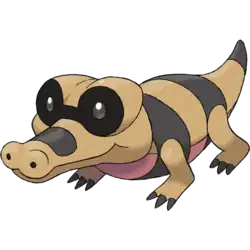
Sandil is categorized as the Desert Croc Pokémon.
Sandile live buried in the sands of the desert. The sun-warmed sands prevent their body temperature from dropping. Sandile's still not good at hunting, so it mostly eats things that have collapsed in the desert. It's called "the cleaner of the desert." The desert gets cold at night, so when the sun sets, this Pokémon burrows deep into the sand and sleeps until sunrise. Sandile is small, but its legs and lower body are powerful. Pushing sand aside as it goes, Sandile moves through the desert as if it's swimming. Alola, where it's warm all year round, is a comfortable environment for this Pokémon. Sometimes you'll even see it outside of deserts. |
 Krokorok |
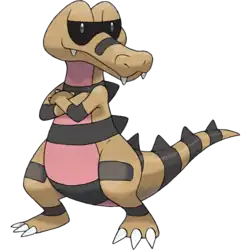
Krokorok is categorized as the Desert Croc Pokémon.
Although this Pokémon has specialized eyes that allow it to see in the dark, Krokorok won't move much at night—the desert gets cold after sunset. Krokorok really hates it when its body gets cold, so on nights when the temperature drops, it digs deep into the desert sands. |
 Krookodile |
When it spots prey, even at a distance of over 30 miles (50 kilometers), Krookodile swims through the desert as if it were water, then jumps out and chomps them. |
 Sigilyph |
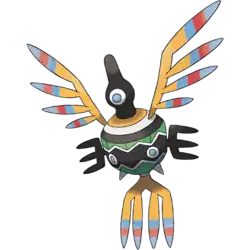
A discovery was made in the desert where Sigilyph fly. The ruins of what may have been an ancient city were found beneath the sands. |
 Elgyem |
Rumors of Elgyem's origin are linked to a UFO crash site; it had never been seen until it appeared from far in the desert 50 years ago. |
 Helioptile |
Helioptile make their home in deserts. They can generate their energy from basking in the sun, so eating food is not a requirement. |
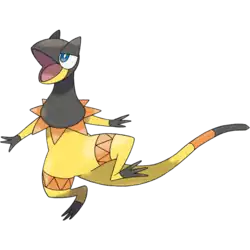 Heliolisk |
A now-vanished desert culture treasured these Pokémon. Appropriately, when Heliolisk came to the Galar region, treasure came with them. |
 Orthworm |
Othworm lives in arid deserts. It maintains its metal body by consuming iron from the soil. |
Trivia

- In Generation IV, there is a Backdrop named "Desert", which can be used when dressing up Pokémon.

|
This article is part of Project Locations, a Bulbapedia project that aims to write comprehensive articles on every location in the Pokémon world. |