A History of Japanese Mathematics/Chapter 5
CHAPTER V.
The Third Period.
It was stated in the opening chapter that the third of the periods into which we arbitrarily divide the history of Japanese mathematics was less than a century in duration, extending from about 1600 to about 1675. The first of these dates is selected as marking approximately the beginning of the activity of Mōri Kambei Shigeyoshi, who was mentioned in Chapter III, and the last as marking that of Seki. It was an era of intellectual awakening in Japan, of the welcoming of Chinese ideas, and of the encouragement of native effort. Of the work of Mōri we have already spoken, because he had so much to do with making known, and possibly improving, the soroban. It now remains to speak of his pupils, and first of Yoshida.
Yoshida Shichibei Kōkō, or Mitsuyoshi, was born at Saga, near Kyōto, in 1598, as we are told in Kawakita's manuscript, the Honchō Sūgaku Shiryō. He belonged to an ancient family that had contributed not a few illustrious names to the history of the country. Yoshida Sōkei, for example, who died in 1572, was well known in medicine, and had twice made a journey to China in search of information, once with a Buddhist bonze[1] in 1539, and again in 1547. His son Kōkō, (1554—1616), was a noted engineer, and is known for his work in improving navigation on the Fujikawa and other rivers that had been too dangerous for the passage of boats. Kōkō's son Soan was, like his father, well known for his learning and for his engineering skill.[2] Yoshida Kōkō, the mathematician, was a grandson, on his mother's side, of Yoshida Kōkō.[3] He was also related in another way to the Yoshida family, being the eldest son of Yoshida Shūan, who was the great-grandson of Sōkei's father, Sōchū.
Yoshida, as we shall now call him, early manifested a taste for mathematics, going as a youth to Kyōto that he might study under the renowned Mōri. His ignorance of Chinese was a serious handicap, however, and his progress was a disappointment. He thereupon set to work to learn the language, studying under the guidance of his relative Yoshida Soan, and in due time became so proficient that he was able to read the Suan-fa Tung-tsong of Ch'êng Tai-wei.[4] His progress in mathematics then became so rapid that it is related[5] that he soon distanced his master, so that Mōri himself was glad to become his pupil. Yoshida also continued to excel in Chinese, so that, whereas Mōri knew the language only indifferently, his quondam pupil became master of the entire mathematical literature.
Mōri's works were the earliest native Japanese books on mathematics of which we have any record, but they seem to be irretrievably lost. It is therefore to Yoshida that we look as the author of the oldest Japanese work on mathematics extant. This work was written in 1627 and is entitled Finkōki. The name is interesting, the Chinese ideogram jin meaning (among other things) a small number, kō meaning a large number, and ki a treatise, so that the title signifies a treatise on numbers from the greatest to the least. Yoshida tells us in the preface that it was selected for him by one Genkō, a Buddhist priest, and it is typical of the condensed expressions of the Japanese.
The work relates chiefly to the arithmetical operations as performed on the soroban, including square and cube root, but it also has some interesting applications and it gives 3.16 for the value of π. It is based largely upon the Suan-fa Tung-tsong already described, and the preface states that it originally consisted of eighteen books. Only three books have come down to us, however, and indeed we are assured that only three were ever printed.[6] This was the first treatise on mathematics ever printed in Japan, or at least the first of any importance.[7] It appeared in 1627[8] and was immediately received with great enthusiasm. Even during Yoshida's life a number of editions appeared,[9] and the name Finkō-ki was used so often after his death, by other authors, that it became a synonym for arithmetic, as algorismus did in Europe in the late Middle Ages.[10] Indeed it is hardly too much to compare the celebrity of the Finko-ki in Japan with that of the arithmetic of Nicomachus in the late Greek civilization. Yoshida also wrote on the calendar, but these works[11] were not so well known.
So great was the fame of Yoshida that he was called to the court of Hosokawa, the feudal lord of Higo, that he might instruct his patron in the art of numbers Here he resided for a time, and at his lord's death, in 1641, he returned to his native place and gathered about him a large number of pupils, even as Mōri had done before him. In his declining years an affection of the eyes, which had troubled him from his youth, became more serious, and finally resulted in the affliction of total blindness,—the fate of Saunderson and of Euler as well. He died in 1672 at the age of seventy-four.[12]
The immediate effect of the work of Mōri and Yoshida was a great awakening of interest in computation and mensuration. In 1630 the Shogun established the Kōbun-in, a public school of arts and sciences. Unfortunately, however, mathematics found no place in the curriculum, remaining in the hands of private teachers, as in the days of the German Rechenmeister. Nevertheless the science progressed in a vigorous manner and numerous books were published upon the subject. Yoshida had appended to one of the later editions of his Finkō-ki a number of problems with the proposal that his successors solve them. These provoked a great deal of discussion and interest, and led other writers to follow the same plan, thus leading to the so-called idai shōtō,[13] "mathematical problems proposed for solution and solved in subsequent works". This scheme was so popular that it continued until 1813, appearing for the last time in the Sangaku Kōchi of Ishiguro Shin-yū.
The particular edition of Yoshida's Finkō-ki in which these problems appeared is not extant, but the problems are known through their treatment by later writers, and some of them will be given when we come to speak of the work of Isomura.
The second of Mōri's "three honorable scholars" mentioned in Chapter III was Imamura Chishō, and twelve years after the appearance of the Finkō-ki, that is in 1639, he published a treatise entitled, Fugai-roku.[14] Yoshida's work had appeared in Japanese, although it followed the Chinese style, but Ima-mura wrote in classical Chinese. Beginning with a treatment of the soroban, he does not confine himself to arithmetic, as Yoshida had done, but proceeds to apply his number work to the calculations of areas and volumes, as in the case of the circle, the sphere, and the cone. While Yoshida had taken 3. 16 for the value of π, Imamura takes 3. 162. Andō Yūyeki of Kyōto refers to this in his fugai-roku Kana-shō, printed in 1660, as obtained by extracting the square root of 10. If this is true, Yoshida obtained his in the same way, the square root of to having long been a common value for n in India and Arabia, as well as in China. Liu Hui's commentary on the "Nine Sections" asserts that the first Chinese author to use this value was Chang Hêng, 78—139 A. D. It was also used by Ch'ên Huo in the eleventh century, and by Ch'in Chiu-shao in his Su-shu Chiu-chang of 1247.[15] Some Chinese writers even in the present dynasty have used it, and it was very likely brought from that country to Japan. It is of interest to note that lumbermen and carpenters in certain parts of Japan use this value at the present time.
Imamura gives as a rule for finding the area of a circle that the product of the circumference by the diameter should be divided by 4. The volume of the sphere with diameter unity is given as 0.51, which does not fit his value of as closely as might have been expected. He also gives a number of problems about the lengths of chords, and writes extensively upon the Kaku-jutsu or "polygonal theory",—calculations relating to the regular polygons from the triangle to the decagon. This theory attracted considerable attention on the part of his successors and added much to Imamura's reputation.[16] This treatise was translated into Japanese and a commentary was added by Imamura's pupil, Andō Yūyeki, in 1660.
The year following the appearance of the original edition Imamura published the Inki Sanka (1640), a little work on the soroban, written in verse. The idea was that in this way the rules could the more easily be memorized, an idea as old as civilization. The Hindus had followed the same plan many centuries earlier, and a generation or so before Imamura wrote it was being followed by the arithmetic writers of England.
The third of the San-shi of Mōri was Takahara Kisshu, also known as Yoshitane.[17] While he contributed nothing in the way of a published work, he was a great teacher and numbered among his pupils some of the best mathematicians of his time.
During this period of activity numerous writers of prominence appeared, particularly on the soroban and on mensuration. Among these writers a few deserve a brief mention at this time. Tawara Kamei wrote his Shinkan Sampō-ki in 1652,
Fig. 22. From Yamada's Kaisan-ki (1656), showing a rude trigonometry.
and Yenami Washō his Sanryō-roku in the following year. In 1656 Yamada Jūsei published the Kaisan-ki (Fig. 22) which was very widely read, and the title of which was adopted, with various prefixes, by several later writers. The following year (1657) saw the publication of Hatsusaka's Yempō Shikan-ki and Shibamura's Kakuchi Sansho. A year later (1658) appeared Nakamura's Shikaku Mondō, followed in 1660 by Isomura's Ketsugi-shō, in 1663 by Muramatsu's Sanso, in 1664 by Nozawa Teichō's Dūkai-shō, and in 1666 by Satō's Kongenki. These are little more than names to Western readers, and yet they go to show the activity that was manifest in the field of elementary mathematics, largely as the result of the labors of Mori and of Yoshida. The works themselves were by no means commercial arithmetics, for they perfected little by little the subject of mensuration, the method of approximating the value of π, and the treatment of the regular polygons, besides offering a considerable insight into the nature of magic squares and magic circles. To these books we are indebted for our knowledge of the work of this period, and particularly to the Kaisan-ki (1656), the Shikaku-Mondō (1658), and the Ketsugi-shō, (1660).
The last mentioned work, the Ketsugi-shō, was written by a pupil of Takahara Kisshu,[18] who was one of the San-shi of Mōri. His name was Isomura[19] Kittoku, and he was a native of Nihommatsu in the north-eastern part of Japan. Isomura's Ketsugi-shō[20] appeared in five books in 1660, and was again published in 1684 with notes. We know little of his life, but he must have been very old when the second edition of his work appeared for he tells us in the preface that at that time he could hardly hold a soroban or the sangi.
Two features of the Ketsugi-shō deserve mention,—Isomura's statement of the Yoshida problems (including an approach to integration, as seen in Fig. 23) and similar ones of his own, and his treatment of magic squares and circles. Each of these throws a flood of light upon the nature of the mathematics of Japan in its Renaissance period, just preceding the advent of the greatest of her mathematicians, Seki, and each is therefore worthy of our attention. Of the Yoshida problems the following are types:[21]
"There is a log of precious wood 18 feet[22] long, whose bases are 5 feet and 2 1/2 feet in circumference. . . . Into what lengths should it be cut to trisect the volume?"
"There have been excavated 560 measures of earth which are to be used for the base of a building.[23] be 30 measures square and 9 measures high. size of the upper base." The base is to Required the
Fig. 23. From the second (1684) edition of Isomura's Ketsugi-shō.
"There is a mound of earth in the form of the frustum of a circular cone. The circumferences of the bases are 40 measures and 120 measures, and the mound is 6 measures high. If 1200 measures of earth are taken evenly off the top, what will then be the height?"
"A circular piece of land 100 measures in diameter is to be divided among three persons so that they shall receive 2900, 2500, and 2500 measures respectively.[24] Required the lengths of the chords and the altitudes of the segments."
The rest of the problems relate to the triangle and to linear simultaneous equations of the kind found in such works as the "Nine Sections", the Suan-fa Tung-tsong, and the Suan-hsiao Chi-mêng'. The last of the problems given above is solved by Isomura as follows:—
"Divide 7900 measures,[25] the total area, by 2900 measures of the northern segment, the result being 2724.[26] Double this result and we have 5448. Divide the square of the diameter, 100 measures, by 5448 and the result is 1835.554[27] measures. The square root of this is 42.85 measures. Subtract this from half the diameter and we have 7.15 measures. Multiply the 42.85 by this and we have 306.4 measures. We now multiply by a certain constant for the square and the circle, and divide by the diameter and we have 3.45 measures. Subtract this from 42.85 measures and we have 39.4 measures for the height of the northern segment..."
Following Yoshida's example, Isomura gives a series of problems for solution, a hundred in number, placing them in his fifth book. A few of these will show the status of mathematics at the time of Isomura:
"From a point in a triangle lines are drawn to the vertices. Given the lengths of these lines and of two sides of the triangle, to find the length of the third side of the triangle." (No. 28.)
"A string 62.5 feet long is laid out so as to form Seimei's Seal.[28] Required the length of the side of the regular pentagon in the center." (No. 38.)
"A string is coiled so as first to form a circle 0.05 feet in diameter, and [then so that the coils shall] always keep 0.05 feet apart, and the coil finally measures 125 feet in diameter.
What is the length of the string?" (No. 39.) The reading of this problem is not clear, but Isomura seems to mean that a spiral of Archimedes is to be formed coiled about an inner circle, and finally closing in an outer circle. The curve has attracted a good deal of attention in Japan.
"There is a log 18 feet long, the diameter of the extremities being 1 foot and 2.6 feet respectively. This is wound spirally with a string 75 feet long, the coils being 2.5 feet apart. How many times does the string go around it?" (No. 41.)
"The bases of a frustum of a circular cone have for their respective diameters 50 measures and 120 measures, and the height of the frustum is 11 measures. Required to trisect the volume by planes perpendicular to the base." (No. 44.)
"The bases of a frustum of a circular cone have for their respective diameters 120 and 250 measures, and the height of the frustum is 25 measures. The frustum is to be cut obliquely. Required the perimeter of the section." (No. 45.) Presumably the cutting plane is to be tangent to both bases, thus forming a complete ellipse, a figure frequently seen in Japanese works.
"In a circle 3 feet in diameter 9 other circles are to be placed, each being 0.2 of a foot from every other and from the large circle. Required the diameter of the larger circle in the center, and of the smaller circles surrounding it." (No. 60.) This requires us to place a circle A in the center, arranging eight smaller circles B about it so as to satisfy the conditions.
"If 19 equal circles are described outside a given circle that has a circumference of 12 feet, so as to be tangent to the given circle and to each other; and if 19 others are similarly described within the given circle, what will be the diameters of the circles in these two groups?" (No. 61.)
"To find the length of the minor axis of an ellipse whose area is 748.940625, and whose major axis is 38 measures." (No. 84.)
"To find one axis of an ellipsoid of revolution, the other axis being 1.8 feet, and the volume being 2422, the unit of volume being a cube whose edge is o.1 of a foot." (N. 85.) Here the major axis is supposed to be the axis of revolution.
Isomura was also interested in magic squares, and these forms were evidently the object of much study in his later years, since the 1684 edition of his Ketsugi-shō contains considerable material relating to the subject. In the first edition (1660) there appear both odd and even-celled squares. The following types suffice to illustrate the work.<re>It should be said that the history of the magic square has never adequately been treated. Such squares seem to have originated in China and to have spread throughout the Orient in early times. They are not found in the classical period in Europe, but were not uncommon during and after the 12th century. They are used as amulets in certain parts of the world, and have always been looked upon as having a cabalistic meaning. For a study of the subject from the modern standpoint see Andrews, W. S., Magic Squares, Chicago, 1907, and subsequent articles in The Open Court</ref>
| 40 | 38 | 2 | 6 | 1 | 42 | 46 |
| 41 | 20 | 17 | 37 | 19 | 32 | 9 |
| 3 | 16 | 26 | 21 | 28 | 34 | 47 |
| 39 | 36 | 27 | 25 | 23 | 14 | 11 |
| 43 | 35 | 22 | 29 | 24 | 15 | 7 |
| 5 | 18 | 33 | 13 | 31 | 30 | 45 |
| 4 | 12 | 48 | 44 | 49 | 8 | 10 |
| 55 | 4 | 2 | 62 | 64 | 60 | 6 | 7 |
| 51 | 20 | 22 | 17 | 50 | 42 | 44 | 14 |
| 9 | 49 | 40 | 28 | 25 | 37 | 16 | 56 |
| 12 | 46 | 29 | 31 | 34 | 36 | 19 | 53 |
| 13 | 18 | 35 | 33 | 32 | 30 | 47 | 52 |
| 54 | 41 | 26 | 38 | 39 | 27 | 24 | 11 |
| 8 | 21 | 43 | 48 | 15 | 23 | 45 | 57 |
| 58 | 61 | 63 | 3 | 1 | 5 | 59 | 10 |
| 51 | 46 | 53 | 6 | 1 | 8 | 69 | 64 | 71 |
| 52 | 50 | 48 | 7 | 5 | 3 | 70 | 68 | 66 |
| 47 | 54 | 49 | 2 | 9 | 4 | 65 | 72 | 67 |
| 60 | 55 | 62 | 42 | 37 | 44 | 29 | 19 | 26 |
| 61 | 59 | 57 | 43 | 41 | 39 | 25 | 23 | 21 |
| 56 | 63 | 58 | 38 | 45 | 40 | 24 | 27 | 22 |
| 15 | 10 | 17 | 78 | 73 | 80 | 33 | 28 | 35 |
| 16 | 14 | 12 | 79 | 77 | 75 | 34 | 32 | 30 |
| 11 | 18 | 13 | 74 | 81 | 76 | 29 | 36 | 31 |
| 92 | 91 | 15 | 89 | 4 | 84 | 14 | 99 | 11 | 6 |
| 13 | 73 | 22 | 20 | 80 | 83 | 78 | 24 | 25 | 88 |
| 85 | 69 | 38 | 40 | 35 | 68 | 60 | 62 | 32 | 16 |
| 3 | 27 | 67 | 58 | 46 | 43 | 55 | 34 | 74 | 98 |
| 96 | 30 | 64 | 47 | 59 | 42 | 54 | 37 | 71 | 5 |
| 8 | 31 | 36 | 53 | 51 | 50 | 48 | 65 | 70 | 93 |
| 18 | 72 | 59 | 44 | 56 | 57 | 45 | 42 | 49 | 83 |
| 94 | 26 | 61 | 63 | 41 | 65 | 43 | 73 | 75 | 7 |
| 1 | 76 | 79 | 81 | 21 | 19 | 23 | 77 | 28 | 100 |
| 95 | 10 | 86 | 12 | 97 | 17 | 87 | 2 | 90 | 9 |
In the last (1684) edition he gives a number of new arrangements, including the following:
| 4 | 9 | 5 | 16 |
| 14 | 7 | 11 | 2 |
| 15 | 6 | 10 | 3 |
| 1 | 12 | 8 | 13 |
| 5 | 23 | 16 | 4 | 25 |
| 15 | 14 | 7 | 18 | 11 |
| 24 | 17 | 13 | 9 | 2 |
| 20 | 8 | 19 | 12 | 6 |
| 1 | 3 | 10 | 22 | 21 |
| 10 | 8 | 35 | 33 | 24 | 1 |
| 19 | 26 | 17 | 15 | 6 | 28 |
| 5 | 12 | 30 | 34 | 16 | 14 |
| 23 | 21 | 3 | 7 | 25 | 32 |
| 18 | 31 | 22 | 20 | 11 | 9 |
| 36 | 13 | 4 | 2 | 29 | 27 |
Isomura did also a good deal of work on magic circles, the following appearing in his 1660 edition:
In the 1684 edition of his Ketsugi-shō he gives what he calls sets of magic wheels. Here, and on pages 74 and 75, the sums in the minor circles are constant.
Isomura's method[29] I of finding the area of the circle is as follows: Take a circle of diameter 10 units, and divide the circumference into parts whose lengths are each a unit. It will then be found that there are 31 of these equal arcs, with a smaller arc of length 0.62. Join the points of division to the center, thus making a series of triangular shaped figures. By
dove-tailing these triangles together we can form a rectangular shaped figure whose length is 15.81, and whose width is 5, so that the area equals 5 × 15.81, or 79.05. Hence, in modern notation,π/4 × diameter is the area.
In the 1660 edition of the Ketsugi-shō he gives the surface of a sphere as one-fourth the square of its circumference, which I would make it instead of In the 1684 edition,[30] however, he says that this is incorrect, although he asserts that it had been stated by Mōri, Yoshida, Imamura, Takahara, Hiraga, Shimada, and others. It seems that the rule had been derived from considering the surface of the sphere as if it were


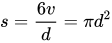
the skin of an orange that could be removed and cut into triangular forms and fitted together in the same manner as the sectors of a circle. The error arose from not considering the curvature of the surface. To rectify the error Isomura took two concentric spheres with diameters 10 and 10.0002. He then took the differences of their volumes and divided this by 0.0001, the thickness of the rind that lay between the two surfaces. This gave for the spherical surface 314.160000041888, from which he deduced the formula, This ingenious process of finding s, which of course presupposes the ability to find the volume of a sphere, has since been employed by several writers.[31]
It should be mentioned, before leaving the works of Isomura, that the 1684 edition of the Ketsugi-shō contains a few notes in which an attempt is made to solve some simultaneous linear equations by the method of the "Celestial element" already described. The author states, however, that he does not favor this method, since it seems to fetter the mind, the older arithmetical methods being preferable.
Isomura seems not to have placed in his writings all of his knowledge of such subjects as the circle, for he distinctly states that one must be personally instructed in regard to some of these measures. Possibly he was desirous of keeping this knowledge a secret, in the same way that Tartaglia wished to keep his solution of the cubic. Indeed, there is a 19th century manuscript that is anonymous, although probably written by Furukawa Ken, bearing the title Sanwa Zuihitsu (Miscellany about Mathematical Subjects), in which it is related that Iso-mura possessed a secret book upon the mensuration of the circle, and in particular upon the circular arc. It is said that this was later owned by Watanabe Manzō Kazu, one of Aida Ammei's pupils, and a retainer of the Lord of Nihommatsu, where Isomura one time dwelt. The writer of the Sanwa Zuihitsu asserts that he saw the book in 1811, during a visit at his home by Watanabe, and that he made a copy of it at that time. He says that the methods were not modern and that they contained fallacies, but that the explanations were minute. The title of the work was Koshigen Yensetsu Hompō, and it was dated the 15th day of the 3d month of 1679.
Next in rank to Isomura, in this period, was Muramatsu Kudayū Mosei.[32] He was a pupil of Hiraga Yasuhide, a distinguished teacher but not a writer, who served under the feudal Lord of Mito, meeting with a tragic death in 1683.[33]
Muramatsu was a retainer of Asano, Lord of Ako, whose forced suicide caused the heroic deed of the "Forty-seven Ronins" so familiar to readers of Japanese annals. Muramatsu is sometimes recorded as one of the honored "Forty-seven", but it was his adopted son, Kihei, and Kihei's son, who were among the number.[34] As to Muramatsu himself, he died at an advanced age after a life of great activity in his chosen field.
In 1663 Muramatsu began the publication of a work in five books, entitled the Sanso[35]. In this he treats chiefly of arithmetic and mensuration, following in part the Chinese work, Suan-hsiao Chi-mêng, written by Chu Chi-chieh, as mentioned on page 48, but he fails to introduce the method of the "Сеlestial element". The most noteworthy part of his work relates to the study of polygons[36] and to the mensuration of the circle.[37]
Taking the radius of the circumscribed circle as 5, he calculates the sides of the regular polygons as follows:
| No. of sides. | Length of side. | No. of sides. | Length of side. |
| 5 | 5.8778 | 11 | 2.801586 |
| 6 | 5 | 12 | 2.5875 |
| 7 | 4.3506 | 13 | 2.393 |
| 8 | 3.8282 | 14 | 2.22678 |
| 9 | 3.4102 | 15 | 2.07953 |
| 10 | 3.0876 | 16 | 1.95093 |
To calculate the circumference Muramatsu begins with an inscribed square whose diagonal is unity. He then doubles the number of sides, forming a regular octagon, the diameter of the circumscribed circle being one. He continues to double the number of sides until a regular inscribed polygon of 3278 sides is reached. He computes the perimeters of these sides in order, by applying the Pythagorean Theorem, with the following results:
| No. of sides. | Perimeter. |
| 23 | 3.06146745892071817384 |
| 24 | 3.12144515228052370213 |
| 25 | 3.136548490545939347853 |
| 26 | 3.140331156954753 |
| 27 | 3.1412792509327729134016 |
| 28 | 3.141513801144301128448 |
| 29 | 3.141572940367901435162 |
| 210 | 3.14158772527715976659 |
| 211 | 3.141591421511186733296 |
| 212 | 3.141592345570046761472 |
| 213 | 3.141592576376565108681 |
| 214 | 3.1415926343385153298 |
| 215 | 3.141592647877698869248 |
Having reached this point, Muramatsu proceeded to compare the various Chinese values of π, and stated his conclusion that 3.14 should be taken, unaware of the fact that he had found the first 8 figures correctly.[38]
Muramatsu gives a brief statement as to his method of finding the volume of a sphere, but does not enter into details.[39] He takes 10 as the diameter, and by means of parallel planes he cuts the sphere into 100 segments of equal altitude. He then assumes that each of these segments is a cylinder, either with the greater of the two bases as its base, or with the lesser one. If he takes the greater base, the sum of the volumes is 562.5 cubic units; but if he takes the lesser one this sum is only 493.04 cubic units. He then says that the volume of the sphere lies between these limits, and he assumes, without,
Fig. 24. Magic circle, from Muramatsu Kudayū Mosei's Mantoku Jinkō-ki (1665).
I stating his reasons, that it is 524, which is somewhat less than either their arithmetic (527) or their geometric (526.6) mean,[40] and which is equivalent to taking π as 3.144.
Muramatsu was also interested in magic squares[41] and magic circles.[42] One of his magic squares has 19 cells, as did one published by Nozawa Teichō in the following year.[43] One of his magic circles, in which 129 numbers are used, is shown in Fig. 24 on page 79. With the numbers expressed in Arabic numerals it is as follows:
}}
In Muramatsu's work also appears a variant of the famous old Josephus problem, as it is often called in the West, a problem that had already appeared in the Finkō-ki of Yoshida. Fig. 25. The Josephus problem, from Muramatsu Kudayū Mosei's Mantoku Finkō-ri (1665). As given by Seki, a little later, it is as follows: "Once upon a time there lived a wealthy farmer who had thirty children, half being born of his first wife and half of his second one. The latter wished a favorite son to inherit all the property, and accordingly she asked him one day, saying: Would it not be well to arrange our thirty children on a circle, calling
Fig. 26. The Josephus problem, from Miyake Kenry's Shajutsu Sangaku Zuye (1795 edition).
one of them the first and counting out every tenth one until there should remain only one, who should be called the heir. The husband assenting, the wife arranged the children as shown in the figure[44]. The counting then began as shown and resulted in the elimination of fourteen step-children at once, leaving only one. Thereupon the wife, feeling confident of her success, said: Now that the elimination has proceeded to this stage, let us reverse the order, beginning with the child I choose. The husband agreed again, and the counting proceeded in the reverse order, with the unexpected result that all of the second wife's children were stricken out and there remained only the step-child, and accordingly he inherited the property." The original is shown in Fig. 25, and an interesting illustration from Miyake's work of 1795 in Fig. 26, but the following diagram will assist the reader:
}}Perhaps it is more in accord with oriental than with occidental nature that the interesting agreement should have remained in force, with the result that the heir should have been a step-son of the wife who planned the arrangement. Seki also gave the problem, having obtained it from the Finko-ki of Yoshida, although he mentions only the fact that it is an old tradition. Possibly it was one of Michinori's problems in the twelfth century, but whether it started in the East and made its way to the West, or vice versa, we do not know. The earliest definite trace of the analogous problem in Europe is in the Codex Einsidelensis, early in the tenth century, although a Latin work of Roman times[45] attributes it to Flavius Josephus. It is also mentioned in an eleventh century manuscript in Munich and in the Ta'thbula of Rabbi Abraham ben Ezra (d. 1067). It is to the latter that Elias Levita, who seems first to have made it known in print (1518), assigns its origin. It commonly appears as a problem relating to Turks and Christians, or to Jews and Christians, half of whom must be sacrificed to save a sinking ship.[46]
The next writer of note was Nozawa Teichō, who published his Dokai-shō in 1664, and who followed the custom begun by Yoshida in the proposing of problems for solution. Nozawa solved all of Isomura's problems and proposed a hundred new ones. He also suggested the quadrature of the circle by cutting it into a number of segments and then summing these partial areas. He went so far as to suggest the same plan for the sphere, but in neither case does he carry his work to completion. It is of interest to see this approach to the calculus in Japan, contemporary with the like approach at this time in Europe. Muramatsu had approximated the volume of the sphere by means of the summation of cylinders formed on circles cut by parallel planes. He had taken 100 of these sections, and possibly more, and had taken some kind of average that led him to fix upon 524 as the volume of a sphere of radius 5. Nozawa apparently intends to go a step further and to take thinner laminae, thus approaching the method used by Cavalieri in his Methodus indivisibilibus.[47] It is possible, as we shall see later, that some hint of the methods of the West had already reached the Far East, or it is possible that, as seems so often the case, the world was merely show-ing that it was intellectually maturing at about the same rate in regions far remote one from the other.
Two years later, in 1666, the annus mirabilis of England, Satō Seikō[48] wrote his work entitled Kongenki. In this he attempted to solve the problems proposed by Isomura and Nozawa, and he set forth 150 new questions. Mention should also be made of his interest in magic circles. Since with him closes the attempts at the mensuration of the circle and sphere prior to the work of Seki, it is proper to give in tabular form the results up to this time.[49]
| Author | Date | Area of Circle | Volume of Sphere | |
| Yoshida | 1627 | 3.16 | 0.79 | 0.5625 |
| Imamura | 1639 | 3.162 | 0.7905 | 0.51 |
| Yamada | 1650 | 3.162 | 0.7905 | 0.4934 |
| Shibanura | 1657 | 3.162 | 0.7905 | 0.525 |
| Isomura | 1660 | 3.162 | 0.7905 | 0.51 |
| Muramatsu | 1663 | 3.14 | 0.785 | 0.524 |
| Nozawa | 1664 | 3.14 | 0.785 | 0.523 |
| Satō | 1666 | 3.14 | 0.785 | 0.519 |

This successor was Sawaguchi Kazuyuki,[51] a pupil of Taka-hara Kisshu, and afterwards a pupil of the great Seki. In 1670 Sawaguchi wrote the Kokon Sampō-ki, the "Old and New Methods of Mathematics". The work consists of seven books, the first thrce of which contain the ordinary mathematical work of the time, and the next three a solution by means of equa-tions of the problems proposed by Satō.[52] He also followed Nozawa in attempting to use a crude calculus (Fig. 27) some-what like that known to Cavalieri. Sawaguchi was for a time a retainer of Lord Seki Bingo-no-Kami, but through some fault of his own he lost the position and the closing years of his life were spent in obscurity.[53]
Sawaguchi's solutions of Sato's problems are not given in full. The equations are stated, but these are followed by the answers only. An equation of the first degree is called a kijo shiki, "divisional expression", inasmuch as only division is needed in its solution, of course after the transposition and uniting of terms. Equations of higher degree are called kaihō shiki, "root-extracting expressions". As a rule only a single root of an equation is taken, although in a few problems this rule is not followed.[54] This idea of the plurality of roots is a
Fig. 27. Early steps in the calculus. From Sawaguchi Kazuyuki's Kokon Sampō-ki (1670).
noteworthy advance upon the work of the earlier Chinese writers, since the latter had recognized only one root to any equation. As is usual in such forward movements, however, Sawaguchi did not recognize the significance of the plural roots, calling problems which yielded them erroneous in their nature.
That Sawaguchi's methods may be understood as fully as the nature of his work allows, a few of his solutions of Sato's problems are set forth:
"There is a right triangle whose hypotenuse is 6, and the sum of whose area and the square root of one side is 7.2384. Required the other two sides". (No. 64.)
Sawaguchi gives the following direstions:
"Take the 'Celestial element' to be the first side. Square this and subtract the result from the square of the hypotenuse. The remainder is the square of the second side. Multiplying this by the square of the first side, we have 4 times the square of the area, which will be called A. Let 4 times the square of the first side be called B. Arrange the sum, square it, and multiply by 4. From the result subtract A and B. The square of the remainder is 4 times the product of A and B, and this we shall call X. Arrange A, multiply by B, take 4 times the product, and subtract the quantity from X, thus obtaining an equation of the 8th degree. This gives, evolved in the reverse method,[55] the first side." The result for the two sides are then given as 5.76, and 1.68.[56]
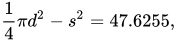
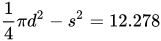
Satō's problem No. 16 is as follows: "There is a circle from within which a square is cut, the remaining portion having an area of 47.6255. If the diameter of the circle is 7 more than the square root of a side of the square, it is required to find the diameter of the circle and the side of the square."[57] Sawaguchi looks upon the problem as "deranged", since it has two solutions, viz., d = 9, s = 4 and d = 7.8242133 and s = 0.67932764. . . . He therefore changes the quantities as given in the problem, making the area 12.278, and the difference 4. He then considers the equation as before, viz., , and Then and taking to be 0.7855.


Sawaguchi next considers a problem from the Dōkai-shō of Nozawa Teichō (1664), viz: "There is a rectangular piece of land 300 measures long and 132 measures wide. It is to be equally divided among 4 men as here shown, in such manner
that three of the portions shall be squares. Required the dimensions of the parts."
Satō gives two solutions of this problem in his Kongenki, as follows:
1. Each of the square portions is 90 measures on a side; the fourth portion is 27 measures wide; and the roads are cach 15 measures wide.
2. Each of the square portions is 60 measures on a side; the fourth portion is 12 measures wide; and the roads are each 60 measures wide.
This solution of Satō's leads Sawaguchi to dilate upon the subtle nature of mathematics that permits of more than one solution to a problem that is apparently simple.
Of the hundred and fifty problems in Satō's work Sawaguchi says that he leaves some sixteen unsolved because they relate to the circle. He announces, however, that it is his intention to consider problems of this nature orally with his pupils, and he gives without explanation the value of π as 3.142.
Two of the sixteen unsolved problems are as follows:—
"The area of a sector of a circle is 41.3112, the radius is 8.5, and the altitude of the segment cut off by a chord is 2. Required to find the chord." (No. 34.)
"From a segment of a circle a circle is cut out, leaving the remaining area 97.27632. The chord is 24, and the two parts
of the altitude, after the circle cuts out a portion as shown in the figure, are each 1.8. Required the diameter of the small circle."
The seventh and last book of Sawaguchi's work consists of fifteen new problems, all of which were solved four years later by Seki, who states that one of them leads to an equation of the 1458th degree. This equation was substantially solved twenty years later by Miyagi Seikō of Kyōto, in his work entitled Wakan Sampō.
- ↑ Priest. The name is a Portuguese corruption of a Japanese term.
- ↑ See the Sentetsu Sōdan Zoku-hen, 1884, Book I.
- ↑ Endō, Book I. p. 35.
- ↑ Which had appeared in 1593. See p. 34.
- ↑ By Kawakita in the Houchō Sugaku Shiryō.
- ↑ By the honze Genkō who wrote the preface, and by Yoshida himself at the end of the 1634 edition.
- ↑ Mr. Endō has shown the authors the copy of the edition of 1634 in the library of the Tokyo Academy and has assured us that the edition of 1627 was the first Japanese mathematical work of any importance. There is a tradition that Mōri's Kije Ranjo was also printed.
- ↑ That is, the 4th year of Kwan-ei.
- ↑ As in 1634, 1641, and 1669, all edited by Yoshida. There were several pirated editions. See Muramatsu's Sanso of 1663, Book III; Endō, Book I, pp. 58, 59, 84 etc.
- ↑ Compare the German expression "Nach Adam Riese", the English "According to Cocker", the early American "According to Daboll", and the French word Barême.
- ↑ For example, the Wakan Gō-un and the Koreki Benran.
- ↑ C. Kawakita, Honchō Sugaku Shiryō; Endō, Book I, p. 84.
- ↑ A term used by later scholars.
- ↑ Mr. Endō has shown the authors a copy of Ando's commentary in the library of the Academy of Science at Tōkyō, and Dr. K. Kano has a copy of the original at present in his valuable library. At the end of the work the author states that only a hundred copies were printed.
- ↑ Mikami, Y., On the development of the Chinese mathematics (in Japanese), in the Journal of the Tokyo Physics School, No. 203, p. 450; Mathematical papers from the Far East, Leipzig, 1910, p. 5.
- ↑ Endō, Book I, pp. 59, 60.
- ↑ The names are synonyms.
- ↑ Ozawa, Sanka Furyaku, "Brief Lineage of Mathematicians", manuscript of 1801.
- ↑ Endō gives it as Isomura, Book I, pp. 65, 67, and Book II, p. 20 etc., and in this he was at first followed by Hayashi, History, part I, p. 33, although the latter soon after discovered that IWAMURA was the better form. Hayashi gives the personal name as Yoshinori.
- ↑ Or Sampō-ketsugi-shō
- ↑ The Ketsugi-shō of 1660, Book 4.
- ↑ In the original "3 measures".
- ↑ That is, for a mound in the form of a frustum of a square pyramid.
- ↑ By drawing two parallel chords.
- ↑ It would have been 7854 if he had taken π = 3.1416
- ↑ I. e., 2.724+.
- ↑ Where we now introduce the fraction for clearness.
- ↑ Abe no Seimei was a famous astrologer who died in 1005. His seal was the regular pentagonal star, the badge of the Pythagorean brotherhood.
- ↑ 1660 edition of the Ketsugi-shō, Book III.
- ↑ Book IV, note.
- ↑ It is given in Takebe Kenkō's manuscript work, the Fukyū Tetsujutsu of 1722, in an anonymous manuscript entitled Kigenkai, and in a work of the 19th century by Wada Nei.
- ↑ Not Matsumura, as given by Endō. The name Mosci appears as Shigekiyo in his Mantoku Jinkō-ki (1665).
- ↑ See the Stories told by Araki.
- ↑ Aoyama, Lives of the Forty-seven Loyal Men (in Japanese).
- ↑ The last book bears the date 1684, and may not have appeared earlier.
- ↑ Book 2.
- ↑ Book 4.
- ↑ Endō, Book I, p. 70.
- ↑ The Sanso, Book 5.
- ↑ Endō thinks that he may have reached this value by cutting the sphere into 200, 400 or some other number of equal parts. History, Book I, p. 71.
- ↑ His rakusho (afterwards called hōjin) problems.
- ↑ His ensan problems. Sanso, Book 2.
- ↑ In his Dōkai-shō of 1664.
- ↑ The step children are represented by dark circles, and her own children by light ones. In the old manuscripts the latter are colored red.
- ↑ De bello judaico, III, 16. This was formerly attributed to Hegesippus of the second century A. D., but it is now thought to be by a later writer of uncertain date.
- ↑ Common names are Ludus Josephi, Josephsspiel, Sankt Peder's lek (Swedish), and the Josephus Problem. The Japanese name was Mameko-date, the step. children problem. It was very common in early printed books on arithmetic, as in those of Cardan (1539), Ramus (1569), and Thierfelder (1587). The best Japanese commentary on the problem is Fujita Sadusuke's Sandatsu Kaigi (Commentary on Sandatsu), 1774.
- ↑ Written in 1629, but printed in 1635.
- ↑ Given incorrectly in Fukuda's Sampō Tamatebako of 1879, and in Endō, Book I, p. 73, as Satō Seioku.
- ↑ The table in substantially this form appears in Havashi's History, p.37. See also Herzer, P., loc. cit., p. 35 of the Kiel reprint of 1905; Endō, I, p. 75.
- ↑ See p. 48.
- ↑ In later years he seems, according to the Stories told by Araki, to have changed his name to Goto Kakubei, although other writers take the two to be distinct personages.
- ↑ It should also be mentioned that a similar use of equations is found in Sugiyama Teiji's work that appeared in the same year.
- ↑ The Stories told by Araki.
- ↑ Satō had already recognised the plurality of roots in his Kongenki.
- ↑ That is, when the signs of the coefficients are changed in the course of the operation.
- ↑ Expressed in modern symbols, let s = the sum, 7.2384, h = the hypotenuse, and x = the first side. Then, by his rule, .
- ↑ I. e., and
![{\displaystyle [\,4s^{2}-(h^{2}-x^{2})x^{2}-4x^{2}\,]^{2}-16x^{4}(h^{2}-x^{2})=0}](../_assets_/eb734a37dd21ce173a46342d1cc64c92/29ca1cfe2c0103294b5249f08703623a4f4f2b4e.svg)