A History of Japanese Mathematics/Chapter 4
CHAPTER IV.
The Sangi applied to Algebra.
As stated in the preceding chapter, it seems necessary to break the continuity of the historical narative by speaking of the introduction of the soroban and the sangi, since these mechanical devices must be known, at least in a general way, before the contributions of the later writers can be understood. As already explained, the chikusaku or "bamboo rods" had been brought over from China at any rate as early as 600 A. D., and for a thousand years had held sway in the domain of calculation. They had formed one of the inheritances of the people, and the fact that they are still used in Korea shows how strong their hold would naturally have been with a patriotic race like the Japanese. We have much the same experience in the Western World in connection with the metric system today. No one doubts for a moment that this system will in due time be commonly used in England and America, the race for world commerce deciding the issue even if the merits of the system should fail to do so. Nevertheless such a change comes only by degrees in democratic lands, and while our complicated system of compound numbers is rapidly giving way, the metric system is not so rapidly replacing it.
So it was in Japan in the 17th century. The samurai despised the plebeian soroban, and the guild of learning sympathized with this attitude of mind. The result was that while the soroban replaced the rods for business purposes, the latter maintained their supremacy in the calculations of higher mathematics.
There was a further reason for this attitude of mind in the fact that the rods were already in use in the solution of the equation, having been well known for this purpose ever since Ch'in Chiu-shao (1247), Li Yeh (1248 and 1257), and Chu Chi-chieh (1299)[1] had described them in their works.
As stated in Chapter III, the early bamboo rods tended to roll off the table or out of the group in which they were placed. On this account the Koreans use a trianguloid prism as shown in the illustration on page 22, and the Japanese in due time resorted to square prisms about 7 mm. thick and 5 cm. long. These pieces had the name sanchu, or, more commonly, sangi, and part of each set was colored red and part black, the former representing positive mumbers and the latter negative. A set of these pieces, now a rarity even in Japan, is shown on page 23.
This distinction between positive and negative is very old. In Chinese, chêng was the positive and fu the negative, and the same ideographs are employed in Japan today, only one of the terms having changed, sei being used for chêng. These Chinese terms are found in the Chiu-chang Suan-shu as revised by Chang T'sang in the 2nd century B. C.,[2] and hence are probably much more ancient even than the latter date. The use of the red and black for positive and negative is found in Liu Hui's commentary on the Chiu-chang, written in 26 3 A. D.,[3] but there is no reason for believing that it originated with him. It is probably one of the early mathematical inheritances of the Chinese the origin of which will never be known. As applied to the solution of the equation, however, we have no description of their use before the work of Ch'in Chiu-shao in 1247. In the treatises of Li Yeh and Chu Chi-chich[4] there is given a method known as the t'ien-yien-shu, or tengen jutsu as it has come into the Japanese, a term meaning "The method of the celestial element."
These three writers appeared in widely separated parts of China, under the contending monarchies of Song and Yüan, at practically the same time, in the 13th century.[5] The first, Ch'in Chiu-shao,[6] introduced the Monad as the symbol for the unknown quantity, and solved certain equations of the 6th, 7th, 8th, and even higher degrees. The ancient favorite of the West, the problem of the couriers, is among his exercises. He states that he was from a province at that time held by the Yüan people (the Mongols).
The second of this trio, Li Yeh,[7] wrote "The mirror of the mensuration of circles" in which algebra is applied to trigonometry.[8] The third of the group is Chu Chi-chieh, to whose work we have just referred. That other writers of prominence had treated of algebra before this time is evident from a pas-sage in the preface of Chu Chi-chieh's work. In this he refers to Chiang Chou Li Wend, Shih Hsing-Dao, and Liu Ju-Hsieh as having written on equations with one unknown quantity; to Li Te Tsi, who used equations with two unknowns, and to Liu Ta Chien, who used three unknowns. Chu Chi-chiehs[9] seems to have been the first Chinese writer to treat of systems of linear equations with four unknowns, after the old "Nine Sections." In order that we may have a better understanding of the basis upon which Japanese algebra was built, a few words are necessary upon the state to which the Chinese had brought the science by this period. While algebra had been known before the 13th century, it took a great step forward through the labors of the three men whose names have been mentioned. They called their method by various names, but the one already given, and Lih-tien-yüen-yih, "The setting up of the Celestial Monad", are the ones commonly used.
In general in this new algebra, unity represents the unknown quantity, and the successive powers are indicated by the place, the sangi being used for the coefficients, thus:
Li Yeh puts the absolute term on the bottom line as here shown, in his work of 1248. In his work of 1259 and in the works of Ch'in and Chu it is placed at the top. The symbol after 66 was called yüen and indicated the monad, while the one after 360 was called tai, a shortened form of tai-kich, "the extreme limit". In practice they were commonly omitted. The circle is the zero in 360, and the cancellation mark indicates that the number is negative, a feature introduced by Li Yeh. With the sangi, red rods would be used for 1, 15, and 66, and black ones for 360. It will be noticed that this symbolism is in advance of anything that was being used in Europe at this time, and that it has some slight resemblance to that used by Bhaskara, in India, in the 12th century.
Ch'in Chiu-shao (1247) gives a method of approximating the roots of numerical higher equations which he speaks of as the Ling-lung-kae-fang, "Harmoniously alternating evolution", a plan in which, by the manipulation of the sangi, he finds the root by what is substantially the method rediscovered by Horner, in England, in 1819. Another writer of the same period, Yang Hwuy, in his analysis of the Chiu-chang, gives the same rule under the name of Tsang-ching-fang, "Accumulating involution", but he does not illustrate it by solved problems. We are therefore compelled to admit that Horner's method is a Chinese product of the 13th century, and we shall see that the Japanese adopted it in what we have called the third period of their mathematical history.
It is also interesting to know that Chu Chi-chich in the Saー yuen Yu-kien (1303) gives as an "ancient method" the relation of the binomial coefficients known in Europe as the "Pascal triangle", and that among his names for the various monads (unknowns) is the equivalent for thing. This is the same as the Latin res and the Italian cosa, both of which had un-doubtedly come from the East. It is one of the many interest-ing problems in the history of mathematics to trace the origin of this term, The "celestial element" process as given by Chu Chi-chieh in 1299 found its way into Japan at least as early as the middle of the 17th century, and the Suan-hsiao Chi-mêng was reprinted there no less than three times.[10] The single rule laid down in this classical work for the use of the sangi in the solution of numerical equations contains but little positive information. Retaining the Japanese terms, and translating quite literally, we may state it as follows:—
"Arrange the seki in the jitsu class, adjusting the ho, ren, and gū classes. Then add the like-signed and subtract the unlike-signed, and evolve the root."
This reminds one of the cryptic rules of the Middle Ages and early Renaissance in Europe, but unlike some of these it is at least not an anagram to which there is no key. The seki is the quantity in a problem that must be expressed in the absolute term before solving, and which is represented by the sangi in next to the top row, the jitsu class. The coefficients of the first, second, and third powers of the unknown are then represented by the sangi in the successive rows below, in the hō, ren, and gū classes. The rest of the rule amounts to saying that the pupil should proceed as he has been taught. The method is best understood by actually solving a numerical higher equation, but inasmuch as the manipulation of the sangi has already been explained in the preceding chapter, the coefficients will now be represented by modern numerals. The problem which we shall use is taken from the eighth book of the Tengen Shinan of Satō Moshun or Shigeharu, published in 1698, and only the general directions will be given, as was the custom. The reader may compare the work with the common Horner method in which the reasoning involved is more clear.
Let it be required to solve the equation

Arrange the sangi on the board to indicate the following:
| (r) | |||||
| (0) | 1 | 1 | 5 | 2 | 0 |
| (1) | — | 4 | 3 | 2 | |
| (2) | — | 2 | 3 | 6 | |
| (3) | 4 | ||||
| (4) | 1 |
Here the top line, marked (r), is reserved for the root, and the lines marked (0), (1), (2), (3), (4) arc filled with the sangi representing the coefficients of the 0th, 1st, 2d, 3d, and 4th powers of the unknown quantity. With the sangi, the negative 432 and 236 would be in black, while the positive 11520, 4, and I would be in red. First advance the 1st, 2d, 3d, and 4th degree classes 1, 2, 3. 4 places respectively, thus:
| (r) | |||||
| (0) | 1 | 1 | 5 | 2 | 0 |
| (1) | — | 4 | 3 | 2 | |
| (2) | -2 | 3 | 6 | ||
| (3) | 4 | ||||
| (4) | 1 |
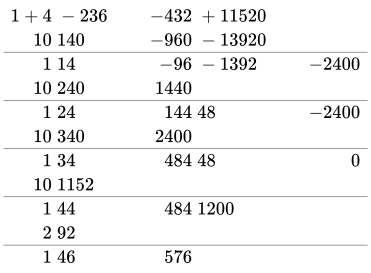
The root will have two figures and the tens' figure is 1. Multiply this 10 by the 1 of class (4) and add it to class (3), thus making 14 in class (3). Multiply this 14 by the root, 10, and add it to —236 of class (2), thus making —96 in class (2). Multiply this —96 by the root, 10, and add it to —432 of class (1), thus making —1392 in class (1). Multiply this —1392 by the root, 10, and add it to 11520 of class (0), thus making —2400. The result then appears as follows:
| (r) | 1 | ||||
| (0) | -2 | 4 | 0 | 0 | |
| (1) | -1 | 3 | 9 | 2 | |
| (2) | -9 | 6 | |||
| (3) | 1 | 4 | |||
| (4) | 1 |
Now repeat the process, multiplying the root, 10, into class (4) and adding to class (3), making 24; multiply 24 by the root and add to class (2), making 144; multiply 144 by the root and add to class (1), making 48. The result then appears as follows:
| (r) | 1 | ||||
| (0) | -2 | 4 | 0 | 0 | |
| (1) | 4 | 8 | |||
| (2) | 1 | 4 | 4 | ||
| (3) | 2 | 4 | |||
| (4) | 1 |
Repeat the process, multiplying the root, 10, into class (4) and adding to class (3), making 34; multiply 34 by the root and add to class (2) making 484.
Again repeat the process, multiplying the root into class (4) and adding to class (3), making 44.
Now move the sangi representing the coefficients of classes (1), (2), (3), (4), to the right 1, 2, 3, 4, places, respectively, and we have:
| (r) | 1 | ||||
| (0) | -2 | 4 | 0 | 0 | |
| (1) | 4 | 8 | |||
| (2) | 4 | 8 | 4 | ||
| (3) | 4 | 4 | |||
| (4) | 1 |
Multiply this into class Multiply the same root The second figure of the root is 2.[11] (4) and add to class (3), making 46. figure, 2, into this class (3) and add to class (2), making 576. Multiply this 576 by 2 and add to class (1), making 1200. Multiply this 1200 by 2 and add to class (o), making o. The work now appears as follows:—
| (r) | 1 | 2 | |||
| (0) | |||||
| (1) | 1 | 2 | |||
| (2) | 5 | 7 | 6 | ||
| (3) | 4 | 6 | |||
| (4) | 1 |
The root therefore is 12.
It may now be helpful to give a synoptic arrangement of the entire process in order that this Chinese method of the 13th century, practiced in Japan in the 17th century, may be compared with Horner's method. The work as described is substantially as follows:

Chu Chi-chich also gives, in the Suan-hsiao Chi-mêng, rules for the treatment of negative numbers. The following translations are as literal as the circumstances allow:
"When the same-named diminish each other, the different-named should be added together.[12] If then there is no opponent for a positive term, make it negative; and for a negative, make it positive."[13]
"When the different-named diminish each other the same-named should be added together. If then there is no opponent for a positive, make it positive; and for a negative, make it negative."[14]
"When the same-named are multiplied together, the product is made positive. When the different-named are multiplied together, the product is made negative."
The method of the "celestial element", with the sangi, and with the rules just stated, entered into the Japanese mathematics of the 17th century, to be described in the following chapter. They were purely Chinese in origin, but Japan advanced the method, carrying it to a high degree of perfection at the time when China was abandoning her native mathematics under the influence of the Jesuits. It is, therefore, in Japan rather than China that we must look in the 17th century for the strictly oriental development of calculation, of algebra, and of geometry.
Among the other writers of the period several treated of magic squares. Among these was Hoshino Sanenobu, whose Kō-ko-gen Shō (Triangular Extract) appeared in 1673. Half of one of his magic squares in shown in the following facsimile:
Fig. 21. Half of a magic square, from Hoshino Sanenobu's work of 1673.
One who is not of the Japanese race cannot refrain from marvelling at the ingenuity of many of these problems proposed during the 17th century, and at the painstaking efforts put forth in their solution. He is reminded of the intricate ivory carvings of these ingenious and patient people, of the curious puzzles with which they delight the world, and of the finish which characterizes their artistic productions. Few of these problems could be mistaken for western productions, and the solutions, so far as they are given, are like the art and the literature of the people, indigenous to the soil of Japan.
- ↑ Chu Shi-chich, or Choo Shi-ki. Takebe's commentary (1690) upon his work of 1299 is mentioned in Chapter VII. He also wrote in 1303 a work entitled Sze-yuen yuh-kien, "Precious mirror of the four elements," but this is not known to have reached Japan.
- ↑ See No. 8 of the list described in Chap. II, p. 11.
- ↑ See p. 11.
- ↑ His work was known as Suan-hsiao Chi-méng, or Swan-hsüch-chi-mong. It was lost to the Chinese for a long time, but Lo Shih-lin discovered a Korean edition of 1660 and reprinted it in 1839.
- ↑ Wvlie, A., Chinese Researches, Shanghai, 1897, Part III, p. 175; Mikami, Y., A Remark on the Chinese Mathematics in Cantor's Geschichte der Mathematik, Archiv der Math, und Physik, vol. XV (3), Heft 1.
- ↑ Tsin Kiū-tschau, Tsin Kew Chaou. His work, entitled Su-shu Chiu-chang, or Shu hsüch Chiu Chang, appeared in 1247. He also wrote the Shu shu ta Luch (General rules on arithmetic).
- ↑ Or Li-yay. Li was the family name, and Yeh or Yay the personal name, this being the common order. He is also known by his familiar name, Jin-king, and also as Li Ching Chai.
- ↑ His two works are entitled T'sê-yüan Hai-ching (1248) and I-ku Yen-tuan (1257). The dates are a little uncertain, since Li Yeh states in the preface that the second work was printed 11 years after the first. Tse-yüan means "to measure the circle", and Hai-ching means "mirror of sea".
- ↑ For a translation of his work I am indebted to Professor Chen of Peking University. D. E. S.
- ↑ For the first time in 1658. Dowun, a Buddhist priest, with the possible nom de plume of Baisho, mentions one Hisada (or Kuda) Gentetsu (probably also a priest) as the editor. It was also printed in 1672 by Hoshino Jitsusen, and some time later by Takebe Kenkō.
- ↑ It is not stated how either figure is ascertained.
- ↑ This is intended to mean that when then should be .
- ↑ That is, , and .
- ↑ When , then . Also, , and .








