Pes anserine bursitis
| Pes anserine bursitis | |
|---|---|
| Other names: Knee tendon bursitis | |
 | |
| Specialty | Orthopedics |
| Symptoms | Tender medial inferior knee[1] |
| Usual onset | Gradual[1] |
| Causes | Overuse, direct blow[1][2] |
| Risk factors | Runners, knee osteoarthritis, obesity, tight hamstrings[1] |
| Diagnostic method | Based on symptoms[2] |
| Differential diagnosis | Shin splints, medial meniscus tear[1] |
| Treatment | Altering activities, NSAIDs, physiotherapy, steroid injections[1] |
| Prognosis | Generally good[2] |
| Frequency | Relatively common[2] |
Pes anserine bursitis is inflammation of the bursa located medial to the knee.[1] Symptoms include pain and tenderness just below the knee joint.[1] It comes on gradually and is worsened by exercise.[1]
The underlying cause is typically overuse; though, it may also occur from a direct blow.[1][2] Risk factors include being a runner, knee osteoarthritis, obesity, diabetes, and tight hamstrings.[1][2] It involves the anserine bursa, found between the upper tibia and hamstring tendons.[1] Diagnosis is generally based on symptoms.[2]
Management involved altering activities, NSAIDs, physiotherapy, and steroid injections.[1] Complications are rare and outcomes are generally good.[2] Most athletes can return to sport.[2]
Pes anserine bursitis is relatively common.[2] It most commonly affects middle aged women.[2] With women affected nearly 10 times more often than men.[2] The condition was initially described in 1937 by Moschcowitz.[2]
Signs and symptoms
Symptoms often include pain at the medial knee when climbing stairs, rising from chairs or sitting with legs crossed. The site is sometimes swollen, but not always. Sometimes they report weakness or decreased range of motion.
Risk factors
The likelihood of pes anserine bursitis is increased in patients with osteoarthritis.
Pathology
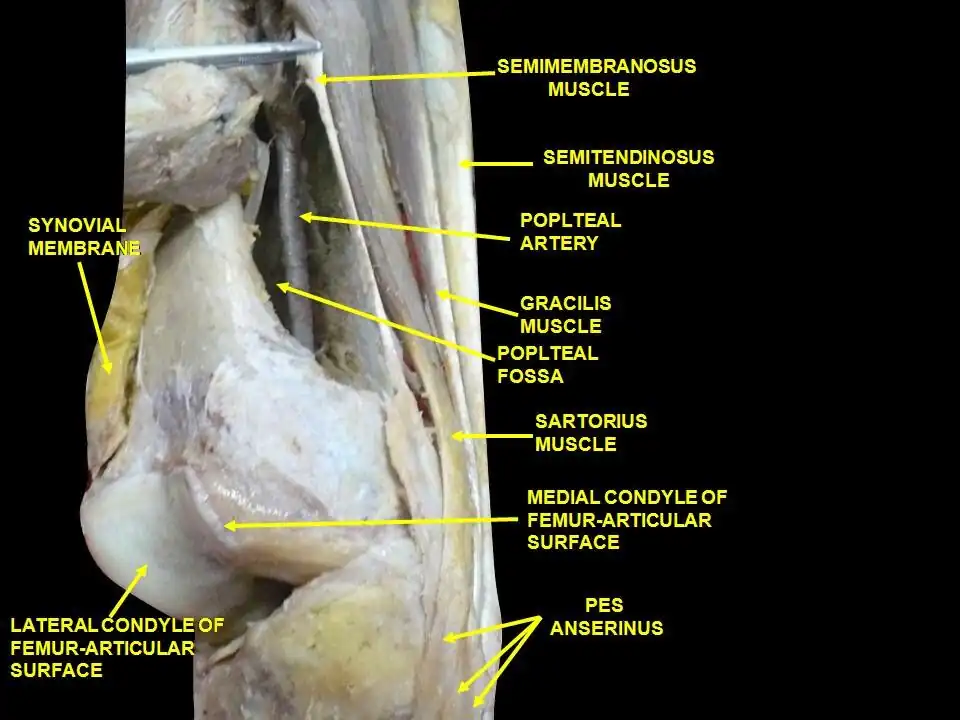
The pes anserinus is where the tendons of the sartorius, gracilis, and semitendinosus join at the medial knee,[3] into the anteromedial proximal tibia.
Pes anserine bursitis may result from stress, overuse, obesity and trauma to this area. An occurrence of pes anserine bursitis commonly is characterized by pain at the medial knee and upper tibial region, especially when climbing stairs, tenderness, and local swelling.[4]
Pathophysiology
The etymology of the name relates to the insertion of the conjoined tendons into the anteromedial proximal tibia. From anterior to posterior, the pes anserinus is made up of the tendons of the sartorius, gracilis, and semitendinosus muscles. The tendon's name, which literally means "goose's foot," was inspired by the pes anserinus's webbed, footlike structure. The conjoined tendon lies superficial to the tibial insertion of the medial collateral ligament (MCL) of the knee.
Muscles
- Sartorius aids in knee and hip flexion, as in sitting or climbing; abducts and laterally rotates thigh; innervated by the femoral nerve.[5]
- Gracilis adducts the hip; flexes and medially rotates tibia at knee; innervated by the obturator nerve.[5]
- Semitendinosus flexes knee; medially rotates tibia on femur when knee is flexed; medially rotates femur when hip is extended; counteracts forward bending at hips; innervated by tibial nerve and common fibular nerve.[5]
Diagnosis
The physician examines the knee in full extension, looking for tenderness in the medial knee joint and across the proximal, medial tibial region, and feels for tenderness along the medial tendons of the pes anserine when the knee is flexed at 90 degrees.
Imaging is not commonly used for this diagnosis.
Treatment
Pes anserine bursitis can be treated with physical therapy, steroids, or surgery. Physical therapy include therapeutic ultrasound, electrical stimulation, rehabilitative exercises, and ice.[4] The rehabilitative exercises are done with the intention of stretching and strengthening the hip abductors, quadriceps, and hamstrings.[4] These stretches have the potential to significantly reduce the tension over the pes anserine bursa.
References
- ↑ 1.00 1.01 1.02 1.03 1.04 1.05 1.06 1.07 1.08 1.09 1.10 1.11 1.12 "Pes Anserine (Knee Tendon) Bursitis". www.orthoinfo.org. OrthoInfo - AAOS. Archived from the original on 29 August 2025. Retrieved 17 October 2025.
- ↑ 2.00 2.01 2.02 2.03 2.04 2.05 2.06 2.07 2.08 2.09 2.10 2.11 2.12 Mohseni, M; Mabrouk, A; Li, D (January 2025). "Pes Anserine Bursitis". StatPearls. PMID 30422536.
- ↑ Mohseni, M.; Mabrouk, A.; Graham, C. (2021). Pes Anserine Bursitis. StatPearls. PMID 30422536. Archived from the original on 2024-12-02. Retrieved 2024-07-09.
- ↑ 4.0 4.1 4.2 Glencross, P. Mark (20 January 2017). "Pes Anserine Bursitis". Medscape. WebMD LLC. Archived from the original on 14 November 2017. Retrieved 3 May 2018.
- ↑ 5.0 5.1 5.2 K. Saladin, Anatomy & Physiology 5th Edition, 2010, McGraw-Hill.
External links
| External resources |
|---|