Metatarsalgia
| Metatarsalgia | |
|---|---|
| Other names: Stone bruise; forefoot pain | |
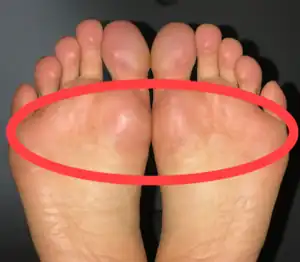 | |
| Potential area of pain in metatarsalgia | |
 | |
| Specialty | Orthopedics |
| Symptoms | Forefoot pain[1][2] |
| Types | Primary, secondary, post surgery[3] |
| Causes | Metatarsal stress fracture, Morton neuroma, Freiberg disease, sesamoiditis, gout, bunion, tailor's bunion, corns, metatarsophalangeal joint[4][1][2] |
| Diagnostic method | Based on symptoms, examination, and X-rays[5] |
| Treatment | Different shoes, insoles, physiotherapy, steroid injections, surgery[6] |
| Frequency | Common[5] |
Metatarsalgia is pain in the forefoot or ball of the foot.[1][2] Some include pain at the base of the big toe while others do not.[1][2] Often it is worsened by weight bearing.[7] It may be associated with calluses, loss of the fat pad, joint deformity or instability.[3]
Possible causes include metatarsal stress fracture, Morton neuroma, Freiberg disease, sesamoiditis, gout, bunion, tailor's bunion, corns, or the metatarsophalangeal joint.[4][1][2] Risk factors include running, poorly fitting shoes, and certain anatomical characteristics.[2][8] Diagnosis is generally based on symptoms, examination, and X-rays.[5]
Initial management includes different shoes, insoles, physiotherapy, and steroid injections.[6] Shoes that may help include those with a wide toe box or rocker bottom.[5] Pain medication such as paracetamol or ibuprofen may be used.[2] If after more than six months there is insufficient improvement surgery maybe considered.[5]
Metatarsalgia is common, affecting about 80% of people at some point.[5][9][10] Women are more commonly affected than men.[5] It becomes more common with age.[5]
Signs and Symptoms
Metatarsalgia is characterized by a pain in the ball of the foot.[4]
Causes
Causes include:
- Morton's neuroma. When toes are squeezed together too often and for too long, the nerve that runs between the toes can swell and get thicker. This swelling can make it painful when walking on that foot. High-heeled, tight, or narrow shoes can make pain worse. This is common in runners, particularly of long distance. The ball of the foot takes a lot of weight over the years and if running on pavement or running in ill-fitting running shoes, the odds of developing Morton's neuroma increase. Changing to shoes that give the toes more room can help.[11]
- Metatarsophalangeal joint sprain including plantar plate tear and turf toe[12][9]
- Metatarsal stress fracture[12]
- Sesamoiditis
- Fat pad atrophy[10]
Diagnosis
Diagnosis is based on symptoms and examination, supported by medical imaging.
Management
The most common treatments are:[13]
- Rest
- Ice
- NSAID
- Properly fitted shoes
- Metatarsal pads
- Arch supports
Removing excess callouses may be helpful. In extreme cases, injection or surgery may be indicated.[14]
References
- ↑ 1.0 1.1 1.2 1.3 1.4 "Metatarsalgia – forefoot pain". Kent Community Health NHS Foundation Trust. Retrieved 18 October 2025.
- ↑ 2.0 2.1 2.2 2.3 2.4 2.5 2.6 "Pain in the ball of the foot". nhs.uk. 30 March 2022. Archived from the original on 5 August 2025. Retrieved 18 October 2025.
- ↑ 3.0 3.1 Lopez, V; Slullitel, G (December 2019). "Metatarsalgia: Assessment Algorithm and Decision Making". Foot and ankle clinics. 24 (4): 561–569. doi:10.1016/j.fcl.2019.08.006. PMID 31653362.
- ↑ 4.0 4.1 4.2 "Metatarsalgia - Musculoskeletal and Connective Tissue Disorders". Merck Manual Professional Edition. Retrieved 18 October 2025.
- ↑ 5.0 5.1 5.2 5.3 5.4 5.5 5.6 5.7 Cooke, R; Manning, C; Palihawadana, D; Zubairy, AI; Khan, SH (2 September 2021). "Metatarsalgia: anatomy, pathology and management". British journal of hospital medicine (London, England : 2005). 82 (9): 1–8. doi:10.12968/hmed.2021.0348. PMID 34601927.
- ↑ 6.0 6.1 Charen, DA; Markowitz, JS; Cheung, ZB; Matijakovich, DJ; Chan, JJ; Vulcano, E (1 January 2019). "Overview of Metatarsalgia". Orthopedics. 42 (1): e138 – e143. doi:10.3928/01477447-20181206-06. PMID 30540873.
- ↑ Ganguly, A; Warner, J; Aniq, H (April 2018). "Central Metatarsalgia and Walking on Pebbles: Beyond Morton Neuroma". AJR. American journal of roentgenology. 210 (4): 821–833. doi:10.2214/AJR.17.18460. PMID 29470159.
- ↑ Besse, JL (February 2017). "Metatarsalgia". Orthopaedics & traumatology, surgery & research : OTSR. 103 (1S): S29 – S39. doi:10.1016/j.otsr.2016.06.020. PMID 28109624. Archived from the original on 2022-10-03. Retrieved 2025-10-18.
- ↑ 9.0 9.1 Weerakkody, Yuranga; Roberts, Dai; Bell, Daniel (16 May 2012). "Metatarsalgia". Radiopaedia.org. Radiopaedia.org. doi:10.53347/rID-17838. Archived from the original on 10 July 2024. Retrieved 19 October 2025.
- ↑ 10.0 10.1 "Metatarsalgia (Ball of the foot pain)". NHS Lanarkshire. Retrieved 19 October 2025.
- ↑ Kaiser Podiatry
- ↑ 12.0 12.1 Hodes, A; Umans, H (November 2018). "Metatarsalgia". Radiologic clinics of North America. 56 (6): 877–892. doi:10.1016/j.rcl.2018.06.004. PMID 30322488.
- ↑ "Metatarsalgia - Diagnosis and treatment - Mayo Clinic". www.mayoclinic.org. Archived from the original on 2021-08-17. Retrieved 2021-11-06. Archived 2021-08-17 at the Wayback Machine
- ↑ "Metatarsalgia Management and Treatment". Cleveland Clinic. Archived from the original on 2019-11-12. Retrieved 2021-11-06. Archived 2019-11-12 at the Wayback Machine
External links
| Classification | |
|---|---|
| External resources |