Osteogenic tumor
| Osteogenic tumor | |
|---|---|
| Other names: Bone forming tumors | |
 | |
| Specialty | Orthopedics |
| Types | Noncancerous (benign), cancerous (malignant) or intermediate locally aggressive[1] |
| Diagnostic method | Medical imaging[1] |
Osteogenic tumors, also known as bone forming tumors, are a type of bone tumor that can be non-cancerous (osteoma and osteoid osteoma), intermediate or locally aggressive (osteoblastoma), or cancerous (osteosarcoma).[1][2] There are ten subtypes and they are easier to distinguish than chondrogenic tumors.[1][2]
| Type | Name | Sub-type | Image |
|---|---|---|---|
| Non-cancerous | Osteoma | 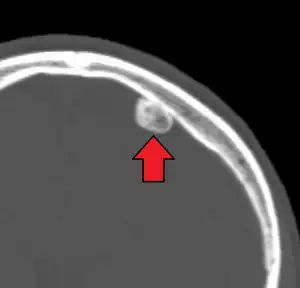
| |
| Osteoid osteoma | 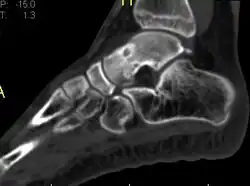
| ||
| Locally aggressive | Osteoblastoma NOS | 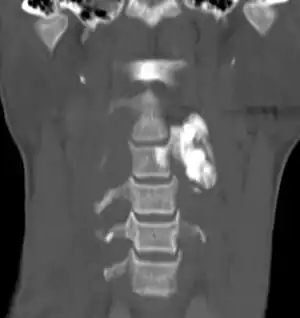
| |
| Cancerous | Low-grade central osteosarcoma | ||
| Osteosarcoma NOS | Conventional osteosarcoma | ||
| Telangiectatic osteosarcoma | |||
| Small cell osteosarcoma | |||
| Periosteal osteosarcoma | |||
| Periosteal osteosarcoma | |||
| High-grade surface osteosarcoma | |||
| Secondary osteosarcoma |
See also
References
- ↑ 1.0 1.1 1.2 1.3 1.4 Ahlawat, Shivani; Fayad, Laura M. (10 August 2020). "Revisiting the WHO classification system of bone tumours: emphasis on advanced magnetic resonance imaging sequences. Part 2". Polish Journal of Radiology. 85: e409 – e419. doi:10.5114/pjr.2020.98686. ISSN 1733-134X. PMID 32999694. Archived from the original on 28 August 2021. Retrieved 13 July 2021. Archived 28 August 2021 at the Wayback Machine
- ↑ 2.0 2.1 Tran, Vanessa; Slavin, John (2020). "6. Bone tumour pathology". In Choong, Peter F. M. (ed.). Sarcoma: A Practical Guide to Multidisciplinary Management. Springer. pp. 69–92. ISBN 978-981-15-9413-7. Archived from the original on 2021-08-29. Retrieved 2021-07-13.