Benign symmetric lipomatosis
| Benign symmetric lipomatosis | |
|---|---|
| Other names: Benign symmetric lipomatosis of Launois–Bensaude, Madelung's disease, multiple symmetric lipomatosis, cephalothoracic lipodystrophy | |
 | |
| A young man with benign symmetric lipomatosis (Madelung's disease) of unknown cause | |
 |
Benign symmetric lipomatosis is a type of lipomatosis.[1] It is characterized by extensive symmetric fat deposits in the head, neck, and shoulder girdle area.[2] The German surgeon Otto Wilhelm Madelung was the first to give a detailed description of the disorder. This condition is very rare, with an estimated incidence of 1 in 25,000, and affects males up to 30 times more frequently than females.[3]
Signs and symptoms
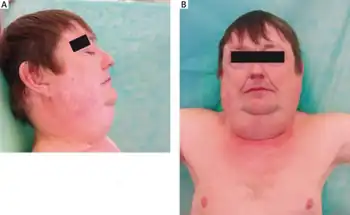
The clinical presentation of this condition is as follows:[4]
- Adipose deposits ( face, neck, occipital region, supraclavicular fossa)
- Obstructive sleep apnea
- Polyneuropathy
- Metabolic syndrome
- Hyperlipidemia
Cause
The cause of the disease remains unknown, but its incidence strongly correlates with alcohol use disorder; abstinence from alcohol prevents disease progression. Defects in the adrenergic-stimulated lipolysis and accumulation of embryological brown fat have also been reported. Cosmetic disfigurement due to the fat deposition in the cervicothoracic region results in a "pseudoathletic appearance", resembling the Italian statue Warrior of Capestrano and carvings of Queen of Punt (Egypt).[5]
Diagnosis
The diagnosis of Madelung's disease (Benign symmetric lipomatosis) is based on the following:[6]
- Medical assessment
- Imaging tests
- Fine needle aspiration
- Electromyography
Treatment
Traditionally the treatment is mainly surgical, consisting of the removal of the lipomas, although recent study has proposed liposuction and phosphatidylcholine injection as possible alternatives.[7]
Society
The appearance of people with the disease is depicted in:
- Carvings of Queen of Punt (Egypt), as noted above[5]
- The Italian statue The Warrior of Capestrano, as noted above
- Donna Leon's crime novel, Beastly Things (2012), wherein the protagonist investigates the murder of a man who had the condition, which Brunetti learns has a high incidence in Italy[8]
See also
References
- ↑ WHO Classification of Tumours Editorial Board, ed. (2020). "1. Soft tissue tumours: Lipomatosis". Soft Tissue and Bone Tumours: WHO Classification of Tumours. Vol. 3 (5th ed.). Lyon (France): International Agency for Research on Cancer. pp. 16–17. ISBN 978-92-832-4503-2.
- ↑ Rapini, Ronald P.; Bolognia, Jean L.; Jorizzo, Joseph L. (2007). Dermatology: 2-Volume Set. St. Louis: Mosby. ISBN 978-1-4160-2999-1.
- ↑ González-García R, Rodríguez-Campo FJ, Sastre-Pérez J, Muñoz-Guerra MF (2004). "Benign symmetric lipomatosis (Madelung's disease): case reports and current management". Aesthetic Plast Surg. 28 (2): 108–12, discussion 113. doi:10.1007/s00266-004-3123-5. PMID 15164232. S2CID 45300059.
- ↑ "Orphanet: Multiple symmetric lipomatosis". www.orpha.net. Archived from the original on 17 January 2021. Retrieved 1 March 2022.
- ↑ 5.0 5.1 Medappil Noushif; Vasu TA (July 2010). "Madelung's disease: A spot diagnosis". Indian J Plast Surg. 43 (2): 227–8. doi:10.4103/0970-0358.73472. PMC 3010793. PMID 21217991.
{{cite journal}}: CS1 maint: unflagged free DOI (link) - ↑ "Madelung's Disease". NORD (National Organization for Rare Disorders). Archived from the original on 20 April 2021. Retrieved 1 March 2022.
- ↑ Hasegawa T, Matsukura T, Ikeda S (June 2009). "Mesotherapy for Benign Symmetric Lipomatosis". Aesthetic Plast Surg. 34 (2): 153–6. doi:10.1007/s00266-009-9374-4. PMID 19488808. S2CID 1678529.
- ↑ Leon, Donna (2012). Beastly Things (Commissario Brunetti, #21). Grove/Atlantic. p. 5 of Chapter 3. ISBN 978-0802120236.
External links
| Classification |
|---|