Wii
 ウィー Wii | ||||||||||||||||
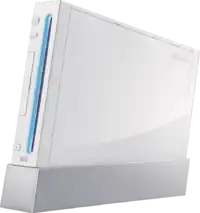 The original White Wii | ||||||||||||||||
Release dates
| ||||||||||||||||
Technical specs
| ||||||||||||||||
Related information
| ||||||||||||||||
External links
|
The Wii (Japanese: ウィー Wii) is Nintendo's seventh-generation console, which serves as the company's competition for Sony's PlayStation 3 and Microsoft's Xbox 360. Its handheld counterpart is the Nintendo DS. The Nintendo 3DS's graphical and CPU capabilities are nearly identical to the Wii. Like its predecessor, the Nintendo GameCube, the Wii is able to connect to software titles on the handheld of this generation, the Nintendo DS; has a Pokémon game that serves as a battle arena for the Generation IV Pokémon games—in this case, Pokémon Battle Revolution; and also has a storage system: My Pokémon Ranch. It was succeeded by the Wii U, which is backwards-compatible with all Wii games and controllers.
A cheaper version, known as the Wii Family Edition, was released in North America, Europe, and Australia in 2011. A smaller model, known as the Wii mini, was released in Canada in 2012 and in Europe and the United States in 2013.
The Wii was discontinued in worldwide on October 20, 2013.[4][5][6]
Features
Wii Remote
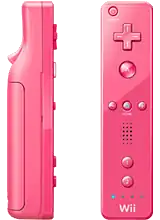
The Wii's controller design is unconventional; instead of taking the dual-control-stick layout of the previous generation like its competitors, it is in a remote control form, with attachments available to work with compatible games, such as a control stick on a Nunchuk attachment, or the Classic Controller, which takes on a layout similar to other consoles' main controllers. The Wii Remote is wireless, and features such innovations as motion and tilt sensing, a first for game controllers. Its sensitivity can be enhanced with Wii Motion-Plus, but no Pokémon games use Wii MotionPlus in any way.
Wii Menu
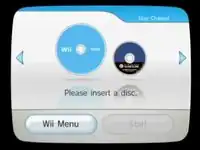
The console features a custom GUI made up of different—and expandable—channels, all of which, save the Disc Channel, can be moved around to any of the 47 spaces available on the main menu. New channels can be downloaded via the Wii Shop Channel, and include an Internet browser and games from older systems playable via Virtual Console. The channels can be put on an SD card, and with the introduction of Wii Menu 3.3, SD Card menus can be accessed straight from the main menu.
The Wii also has the ability to send messages to and from other devices, so long as the Wii sends out an initial address book confirmation message to the email address or cell phone number in question. When the recipient replies to the Wii's message, communication between the two devices will be active, and via WiiConnect24, others can leave messages for players of the console on its message board from anywhere in the world. However, this feature, along with a few channels, was discontinued on June 30, 2013.
Backward compatibility
The Wii is backwards-compatible with all GameCube games, as well as with most of GameCube's accessories, such as the controllers, memory cards, GameCube-to-GBA cables, and microphone. It is incompatible with the Rumble Pak or the Game Boy Player.
The cheaper Wii variants, the Wii Family Edition and Wii mini, are incompatible with GameCube games.
Hardware revisions
Wii Family Edition
- Main article: Wii Family Edition
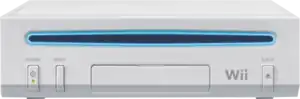
The Wii Family Edition is a hardware revision of Wii that incompatible with Nintendo GameCube games or hardware like the original model was, restricting the console to only playing games from Wii game discs. Due to lack of GameCube controller ports, this model is incompatible with Wii peripherals, which need to be connected through the ports, and Wii games which require such peripherals to play. It is designed to sit horizontally, rather than upright like the original model. The stand included with the original model can be used on this Wii model, however. The Wii Family Edition was released on October 23, 2011 in North America and November 4, 2011 in Europe. It was never released in Japan, however, but a black NTSC-J variant of the Wii Family Edition that can be used to play Japanese Wii discs was released in Taiwan on December 16, 2011.[7]
Wii mini
- Main article: Wii mini
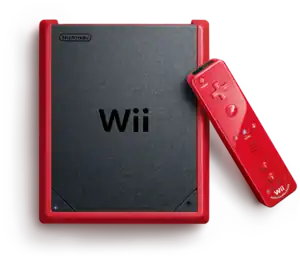

The Wii mini is a hardware revision of Wii that that retains the same restrictions as the Wii Family Edition, abiet without online functions, an SD card slot, and several built-in channels, such as the Photo Channel and WiiConnect24 channels, similar to the Wii Mode on the Wii U. Unlike previous models, the Wii mini only has one USB port, rather than the two on the original Wii, and can only use composite video cables, rather than the S-Video and component video cables used by the original Wii. It was released in Canada on December 7, 2012, in Europe on March 22, 2013, and in the United States on November 17, 2013. Like the Wii Family Edition, however, the Wii mini was never released in Japan. Unlike the Wii Family Edition, though, an NTSC-J variant of the Wii mini that can be used to play Japanese Wii discs was never released in Taiwan.
Technical specs
All models
- Compatibility with 12cm Wii Game Discs
- 729 MHz "Broadway" IBM CPU
- 243 MHz "Hollywood" ATI GPU
- 88 MB total memory, 24 MB Mo-Sys 1T-SRAM, 324 MHz, 2,7 GB/s bandwidth
- 512 MB internal flash memory, for game, channel, and data saving
Wii
- Compatibility with 8cm GameCube Game Discs
- SD memory card bay for expansion of save space[a]
- Supports GameCube memory cards
- Two USB ports for expansion and/or networking capabilities
Wii Family Edition
- SD memory card bay for expansion of save space[a]
- Two USB ports for expansion and/or networking capabilities
Wii mini
- One USB port for expansion
Pokémon games
On game discs
Most Wii games are released on the Wii's own 12cm discs. There are three known games for the Wii that are released for the Pokémon series.
| Title | Genre | Release |
|---|---|---|
| Pokémon Battle Revolution | Battle simulation | 2006 |
| PokéPark Wii: Pikachu's Adventure | Action-adventure | 2009 |
| PokéPark 2: Wonders Beyond | Action-adventure | 2012 |
GameCube games
Because the Wii features backwards compatibility with the majority of Nintendo GameCube hardware, all Pokémon games for the GameCube are also playable on the Wii; however, the Wii is incompatible with the Game Boy Player.
| Title | Genre | Release |
|---|---|---|
| Pokémon Box Ruby & Sapphire | Utility | 2003 |
| Pokémon Channel | Virtual pet | 2003 |
| Pokémon Colosseum | RPG | 2003 |
| Pokémon XD: Gale of Darkness | RPG | 2005 |
With Pokémon Box Ruby & Sapphire emulator
| Title | Genre | Release |
|---|---|---|
| Pokémon Ruby and Sapphire | Main series RPG | 2003 |
WiiWare games

WiiWare games are special games downloadable via the Wii Shop Channel. Two Pokémon games have been released worldwide, and three have been released only in Japan.
| Title | Genre | Release | Cost |
|---|---|---|---|
| My Pokémon Ranch | Virtual life | 2008 | 1000 Wii Points |
| Pokémon Rumble | Action RPG | 2009 | 1500 Wii Points |
| Pokémon Mystery Dungeon (WiiWare) | Dungeon crawler | 2009 | 1200 Wii Points |
Virtual Console games
Virtual Console games are old games that were originally released on past consoles, and have now been re-released on the Wii Shop Channel. Like WiiWare games, they can be downloaded after being bought. There are two Pokémon games that have received this treatment, as well as the original Super Smash Bros. game.
| Title | Genre | Original system | Original release | VC release |
|---|---|---|---|---|
| Pokémon Snap | First-person rail shooter | Nintendo 64 | 1997 | 2007 |
| Pokémon Puzzle League | Puzzle | Nintendo 64 | 2000 | 2008 |
Channels
Wii Shop Channel
The Wii Shop Channel is a channel which comes pre-installed on Wii consoles. It uses the Internet to purchase and download WiiWare, Virtual Console games and channels with Wii Points.
Nintendo Channel
The Nintendo Channel is a free downloadable channel which contains various videos and demos of Nintendo games. Use of this channel requires the Internet. These videos are often commercials, trailers, and interviews relating to Nintendo products. All Pokémon games for Nintendo DS and Wii (excluding Virtual Console) that have had an English language release have been featured on the channel at some point.
Additionally, the channel has a feature called the DS Download Service, which allows players to download demos of games to a Nintendo DS system via DS Download Play. Demos for Pokémon Ranger: Guardian Signs, Pokémon Trozei! and Pokémon Mystery Dungeon: Explorers of Sky can be downloaded. Explorers of Sky has three slightly different demos.
The channel was discontinued on June 30, 2013.
Gallery
-
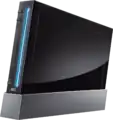 A Black Wii
 -
 A Red Wii
 -
 A black Nunchuk
Cameos

- The player has a Wii in their bedroom in all Generation IV and Generation V core series games. In Pokémon Diamond, Pearl, and Platinum, Barry has a Wii in his room, as well. In Pokémon HeartGold and SoulSilver, the player's alternate-gender counterpart, Red, and Blue each have a Wii. There is also a Wii next to a TV on the S.S. Aqua.
- Two Wii consoles can be found in the lower left room on the second floor of the Shady House in Sun and Moon.
- In Pokémon Diamond, Pearl, and Platinum, in the Underground, there is a Wii decoration, titled "game system", for the player's Secret Base.
- The player character's bedroom in Pokémon Ranger: Shadows of Almia has a Wii next to the TV set in Chicole Village.
- The remote control for the Evolution Machine featured in Ya See We Want an Evolution! was similar in design to the controller of the Wii.
- The remote Meowth used in The Grass-type is Always Greener! resembled the Nunchuk.
- A Wii console, along with a Wii Balance Board, Wii Zapper, and a Wii Remote Hand Grip Pad make an appearance in Diamond's room in the Pokémon Adventures manga in Stopping Sableye.
-
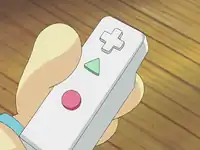 The Evolution Machine's remote control in Ya See We Want an Evolution!, based on a Wii Remote
 -
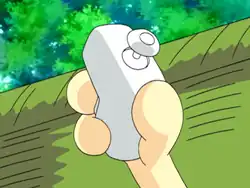 A remote in The Grass-type is Always Greener!, based on the Nunchuk
 -
 The Wii as seen in Stopping Sableye
Trivia
- The Nunchuk resembles part of a Nintendo 64 controller.
External links
- Nintendo (Japanese)
Notes
References
- ↑ Nintendo Life: South Korea gets their own Virtual Console
- ↑ Nintendo Hong Kong site
- ↑ Nintendo Phuten site
- ↑ Engadget - Nintendo stops selling Wii consoles in Japan
- ↑ GameSpot - Wii discontinuation in Japan won't affect availability in United States
- ↑ Time also called on Wii in Europe | Games industry news | MCV
- ↑ 任天堂溥天股份有限公司,Wii的價格變更以及Wii主機新組合上市
Related articles
Game systems with Pokémon games
| ||
|---|---|---|
| Nintendo | Handheld | GB (Pocket · GBL · SGB · SGB2) • GBC • mini • GBA (SP · GBm · GBP) DS (Lite · DSi · DSi XL) • 3DS (XL · 2DS · New 3DS · New 3DS XL · New 2DS XL) • Switch Lite |
| Home | SNES (BS-X · SGB · NP · SGB2) • N64 (DD) • GCN (GBP) (Family Edition · mini) • Wii U | |
| Hybrid | Switch (OLED) • Switch 2 | |
| Sega | Pico • CoCoPad • Beena | |