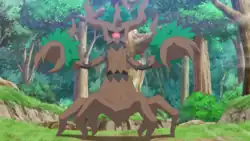
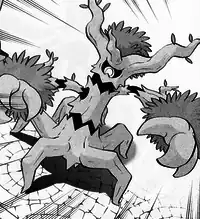
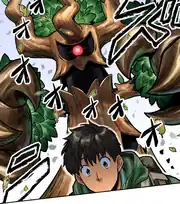
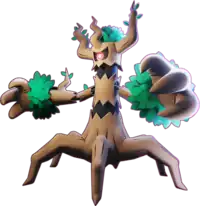
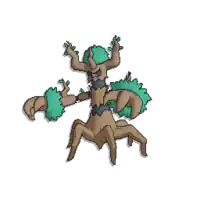
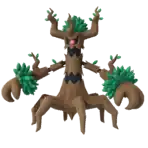
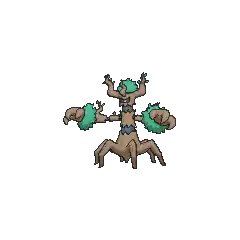
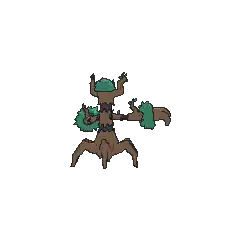
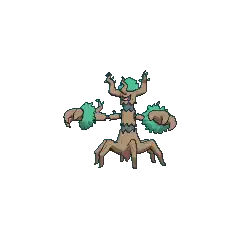
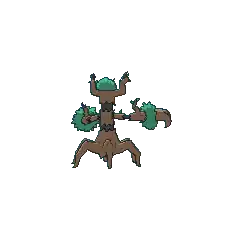
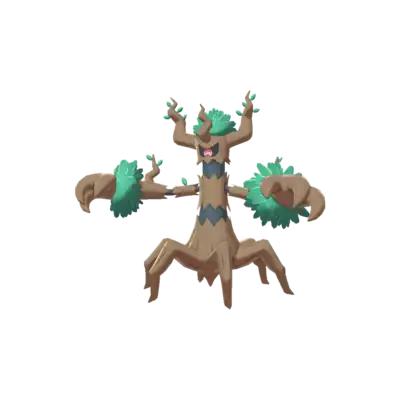
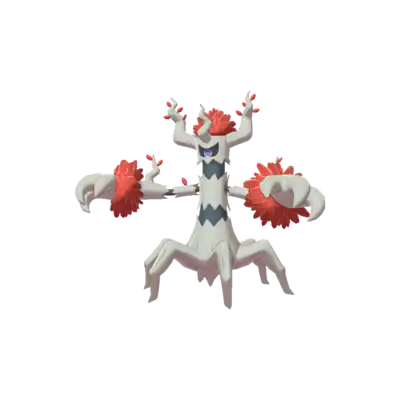
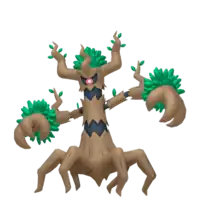
Trevenant is a ghostly Pokémon resembling a slender brown tree. Its shadowy black body is visible through gaps in the tree, and a single, red eye is visible through a hole near the top. There is a wavy, horn-like branch on either side of its head, both dotted with small, green leaves, and a smaller branch on its forehead. On top of its head is a cluster of green leaves. It has two arms with gnarled branches similar to its horns on the elbows. Around its wrists are cuffs of green leaves and it has three claw-like fingers on each hand. Instead of legs, it has six roots similar to a spider's legs. Its general body is similar to the shape of the kanji 木, meaning wood or tree.
Trevenant can control other trees by using its roots as a nervous system. It uses this ability to trap people who harm its forest and will curse people who cut down trees. However, it is very kind to forest-dwelling creatures and Pokémon that reside in its body. Trevenant hates Fire-type Pokémon, so lumberjacks usually bring them to repel it. It is even believed that Trevenant has consumed people, although it is unclear whether this is fact or rumor.
It’s said that if anyone tries to harm the forest, Trevenant will trap them inside a thick fog. But it’s kind to forest-dwelling Pokémon and others that it trusts.
Trevenant made its animated series debut in Forging Forest Friendships!, where it kidnapped Ash. It wasn't malicious, though: it only wanted help rescuing its friends Bonsly and Sudowoodo, who had been trapped by Team Rocket.
Trevenant, the Elder Tree Pokémon. A Ghost and Grass type, Trevenant is able to control trees. It traps those who cause harm to the forest and never lets them escape.
Trevenant, the Elder Tree Pokémon. A Ghost and Grass type. Trevenant spread out thin roots from their feet, connecting to the surrounding trees to control them at will.
Trevenant is playable through obtaining a Unite License. It is a melee defender that starts as Phantump, which evolves into Trevenant at level 5.
Trivia
No other Pokémon have the same Egg Group combination as Trevenant and its pre-Evolution.
Of all the Pokémon that evolve via trading (including with held items), Trevenant is the only one that can also be directly caught in the wild in the same generation in which it was introduced.
Trevenant and its pre-Evolution were designed by James Turner.[1]
Origin
Trevenant is possibly based on a kodama, the spirits of trees that sometimes inhabit old-aged trees. Its stripe-like indentation on its body is similar to shimenawa, used to mark spiritual habitation, who are often seen tied around kodama. Trevenant's fierce protection of forests may also be a nod to the concept of forest protection and sacred groves. It is also similar to other types of tree and nature spirits and deities often depicted as forest guardians, such as dryads and the Penghou. Since Trevenant punishes those that harm the forest, this behavior is similar to that of Curupira and Hākuturi. Moreover, Trevenant may also be inspired by the treelike Ents from the fiction of J. R. R. Tolkien.
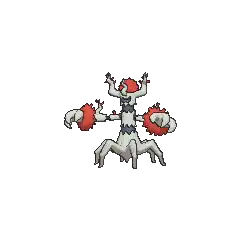
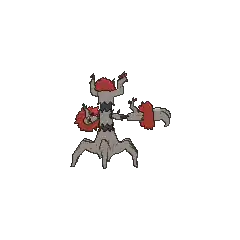
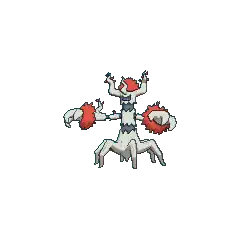
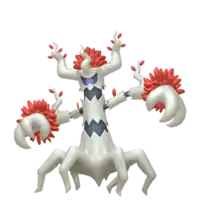
Trevenant may also be based on a birch or aspen tree, as hinted by its Shiny's white bark. It being able to control other trees by using its roots as a nervous system may be a reference to Pando, a single aspen tree that forms a grove made of 47,000 stems, all interconnected by a root system. Alternatively, it may allude to mycorrhizal networks. Its single eye may combine a tree hollow or eye-like markings in birch and aspen trees, with the common cyclopean feature present in many yōkai. In addition, Trevenant's fingers and horns may draw inspiration to Şüräle, a forest spirit in Tatar and Bashkir described as having long fingers and a horn on its forehead.
Its category may allude to the Elder Mother, a tree guardian in English and Scandinavian folklore that can bring misfortune to those that steal wood from the elder tree.
Name origin
Trevenant may be a combination of tree, revenant, and possibly treant.
Ohrot may be a combination of 大 ō (big) and ロット rot (as in a root rot).
This Pokémon article is part of Project Pokédex, a Bulbapedia project that aims to write comprehensive articles on each Pokémon species, as well as Pokémon groups and forms.







 For other sprites and images, please see Trevenant images on the Bulbagarden Archives.