A History of Japanese Mathematics/Chapter 6
CHAPTER VI.
Seki Kōwa.
In the third month according to the lunar calendar, in the year 1642 of our era, a son was born to Uchiyama Shichibei, a member of the samurai class living at Fujioka in the province of Kōzuke.[1] While still in his infancy this child, a younger son of his parents, was adopted into another noble family, that of Seki Gorozayemon, and hence there was given to him the name of Seki by which he is commonly known to the world. Seki Shinsuke Kōwa[2] was born in the same year[3] in which Galileo died, and at a time of great activity in the mathematical world both of the East and the West. And just as Newton, in considering the labors of such of his immediate predecessors as Kepler, Cavalieri, Descartes, Fermat, and Barrow, was able to say that he had stood upon the shoulders of giants, so Seki came at an auspicious time for a great mathematical advance in Japan, with the labors of Yoshida, Imamura, Isomura, Muramatsu, and Sawaguchi upon which to build. The coincidence of birth seems all the more significant because of the possible similarity of achievement, Newton having invented the calculus of fluxions in the West, while Seki possibly invented the yenri or "circle principle" in the East, each designed to accomplish much the same purpose, and each destined to material improvement in later generations. The yenri is not any too well known and it is somewhat difficult to judge of its comparative value, Japanese scholars themselves being undecided as to the relative merits of this form of the calculus and that given to the world by Newton and Leibnitz.[4]
Seki's great abilities showed themselves at an early age. The story goes that when he was only five he pointed out the errors of his elders in certain calculations which were being discussed in his presence, and that the people so marveled at his attainments that they gave him the title of divine child.[5]
Another story relates that when he was but nine years of age, Seki one time saw a servant studying the Finkō-ki of Yoshida. And when the servant was perplexed over a certain problem, Seki volunteered to help him, and easily showed him the proper solution.[6] This second story varies with the narrator, Kamizawa Teikan[7] telling us that the servant first interested the youthful Seki in the arithmetic of the Finkō-ki, and the taught him his first mathematics. Others[8] say that Seki learned mathematics from the great teacher Takahara Kisshu who, it will be remembered, had sat at the feet of Mōri as one of his san-shi, although this belief is not generally held. Most writers[9] agree that he was self-made and self-educated, his works showing no apparent influence of other teachers, but on the contrary displaying an originality that may well have led him to instruct himself from his youth up.[10] Whatever may have been his early training Seki must have progressed very rapidly, for he early acquired a library of the standard Japanese and Chinese works on mathematics, and learned, apparently from the Suan-hsiao Chi-mêng,[11] the method of solving the numerical higher equation. And with this progress in learning came a popular appreciation that soon surrounded him with pupils and that gave to him the title of The Arithmetical Sage.[12] In due time he, as a descendent of the samurai class, served in public capacity, his office being that of examiner of accounts to the Lord of Kōshū, just as Newton became master of the mint under Queen Anne. When his lord became heir to the Shogun, Seki became a Shogunate samurai, and in 1704 was given a position of honor as master of ceremonies in the Shogun's household.[13] He died on the 24th day of the 10th month in the year 1708, at the age of sixty-six, leaving no descendents of his own blood.[14] He was buried in a Buddhist cemetery, the Jorinji, at Ushigome in Yedo (Tōkyō), where eighty years later his tomb was rebuilt, as the inscription tell us, by mathematicians of his school.
Several stories are told of Seki, some of which throw interesting sides lights upon his character.[15] One of these relates that he one time journeyed from Yedo to Kōfu, a city in Kōshū, or the Province of Kai, on a mission from his lord. Traveling in a palanquin he amused himself by noting the directions and distances, the objects along the way, the elevations and depressions, and all that characterized the topography of the region, jotting down the results upon paper as he went. From these notes he prepared a map of the region so minutely and carefully drawn that on his return to Yedo his master was greatly impressed with the powers of description of one who traveled like a samurai but observed like a geographer.
Another story relates how the Shōgun, who had been the Lord of Kōshū, once upon a time decided to distribute equal portions of a large piece of precious incense wood among the members of his family. But when the official who was to cut the wood attempted the division he found no way of meeting his lord's demand that the shares should be equal. He therefore appealed to his brother officials who with one accord, advised him that no one could determine the method of cutting the precious wood save only Seki. Much relieved, the official appealed to "The Arithmetical Sage" and not in vain.[16]
It is also told of Seki that a wonderful clock was sent from the Emperor of China as a present to the Shogun, so arranged that the figure of a man would strike the hours. And after some years a delicate spring became deranged, so that the figure would no longer strike the bell. Then were called in the most skilful artisans of the land, but none was able to repair the clock, until Seki heard of his master's trouble. Asking that he might take the clock to his own home, he soon restored it to the Shogun successfully repaired and again correctly striking the hours.
Such anecdotes have some value in showing the acumen and versatility of the man, and they explain why he should have been sought for a post of such responsibility as that of examiner of accounts.[17]
The name of Seki has long been associated with the yenri, a form of the calculus that was possibly invented by him, and that will be considered in Chapter VIII. It is with greater certainty that he is known for his tensan method, an algebraic system that improved upon the method of the "Celestial element" inherited from the Chinese; for the Yendan jutsu, a scheme by which the treatment of equations and other branches of algebra is simpler than by the methods inherited from China and improved by such Japanese writers as Isomura and Sawaguchi, and for his work in determinants that antedated what has heretofore been considered the first discovery, namely the investigations of Leibnitz.
As to his works, it is said that he left hundreds of un-published manuscripts,[18] but if this be true most of them are lost.[19] He also published the Hatsubi Sampō in 1674.[20] In this he solved the fifteen problems given in Sawaguchi's Kokon Sampō-ki of 1670, only the final equations being given.[21]
As to Seki's real power, and as to the justice of ranking him with his great contemporaries of the West, there is much doubt. He certainly improved the methods used in algebra, but we are not at all sure that his name is properly connected with the yeuri.
For this reason, and because of his fame, it has been thought best to enter more fully into his work than into that of any of his predecessors, so that the reader may have before him the material for independent judgment.
First it is proposed to set forth a few of the problems that were set by Sawaguchi, with Scki's equations and with one of Takebe's solutions.
Sawaguchi's first problem is as follows: "In a circle three other circles are inscribed as here shown, the remaining area being 120 square units. The common diameter of the two smallest circles is 5 units less than the diameter of the one that is next in size. Required to compute the diameters of the various circles."
Seki solves the problem as follows: "Arrange the 'celestial element', taking it as the diameter of the smallest circles. Add to this the given quantity and the result is the diameter of the middle circle. Square this and call the result A.
"Take twice the square of the diameter of the smallest circles and add this to A, multiplying the sum by the moment of the circumference.[22] Call this product B.
"Multiply 4 times the remaining area by the moment of diameter.[23]
"This being added to B the result is the product of the square of the diameter of the largest circle multiplied by the moment of circumference. This is called C.[24] "Take the diameter of the smallest circle and multiply it by A and by the moment of the circumference. Call the result D.[25]
"From four times the diameter of the middle circle take the diameter of the smallest circle, and from C times this product take D. The square of the remainder is the product of the square of the sum of four times the diameter of the middle circle and twice the diameter of the smallest circle, the square of the diameter of the middle circle, the square of the moment of circumference, and the square of the diameter of the largest circle. Call this X.[26]
"The sum of four times the diameter of the middle circle and twice the diameter of the smallest circle being squared, multiply it by A and by C and by the moment of circumference. This quantity being canceled with X we get an equation of the 6th degree. Finding the root of this equation according to the reversed orders we have the diameter of the smallest circle.
"Reasoning from this value the diameters of the other circles are obtained."
![{\displaystyle =22\cdot 22\,y^{2}(x+5)^{2}\left[4(x+5)+2x\right]^{2}.}](../_assets_/eb734a37dd21ce173a46342d1cc64c92/ab948d0a305223498ee6cbb094f863b3a094180d.svg)


[27] It may add to an appreciation or an understanding of the mathematics of this period if we add Takebe's analysis. Let x be the diameter of the largest circle, y that of the middle circle, and z that of the smallest circles.
Then let AC = a, AD = b, AB = c, and BC = d, these being auxiliary at the present time.
Then

and

or

Therefore

[28] Page:A history of Japanese mathematics (IA historyofjapanes00smitiala).pdf/111 and that the rest of the steps be followed as in Seki's solution. In this he expresses and in terms of a and given quantities and thus finds an equation of the sixth degree in . Without attempting to carry out his suggestions, enough has been given to show his ingenuity in elimination.


The 12th problem proposed by Sawaguchi is as follows:
There is a triangle in which three lines, , , and , are drawn as shown in the figure. It is given that


that the sum of the cubes of the greatest and smallest sides is 637, and that the sum of the cubes of the other side and of the greatest side is 855. Required to find the lengths of the sides.
Seki solves this problem by the use of an equation of the 54th degree.
The 14th problem is of somewhat the same character. It is as follows:
There is a quadrilateral whose sides and diagonals are represented by and , as shown in the figure.

Page:A history of Japanese mathematics (IA historyofjapanes00smitiala).pdf/113 Page:A history of Japanese mathematics (IA historyofjapanes00smitiala).pdf/114 Page:A history of Japanese mathematics (IA historyofjapanes00smitiala).pdf/115 Page:A history of Japanese mathematics (IA historyofjapanes00smitiala).pdf/116 Page:A history of Japanese mathematics (IA historyofjapanes00smitiala).pdf/117 Page:A history of Japanese mathematics (IA historyofjapanes00smitiala).pdf/118 Page:A history of Japanese mathematics (IA historyofjapanes00smitiala).pdf/119 Page:A history of Japanese mathematics (IA historyofjapanes00smitiala).pdf/120 Using the annexed figure, as given in the Katsuyō Sampō (see Fig. 28 for the original), and letting the side of the
polygon be unity, the apothem , and the radius , we have Now

Now
,

a statement made without any explanation. Ōtaka now pro-ceeds by a series of unproved statements to develop two equations, viz.,

from which we are to find x, the apothem, and

from which we are to find , the radius.
The treatment of the circle is given in Book IV of the Katsuyō Sampō and is similar to that attempted by Muramatsu in his Sanso of 1663. A circle of unit diameter is taken, a square is inscribed, and the sides of the inscribed regular polygon are continually doubled until a polygon of sides is reached. 
Fig. 28. From Ōtaka's Katsuyō Sampō (1712). Page:A history of Japanese mathematics (IA historyofjapanes00smitiala).pdf/123 Page:A history of Japanese mathematics (IA historyofjapanes00smitiala).pdf/124 Page:A history of Japanese mathematics (IA historyofjapanes00smitiala).pdf/125 Page:A history of Japanese mathematics (IA historyofjapanes00smitiala).pdf/126 Page:A history of Japanese mathematics (IA historyofjapanes00smitiala).pdf/127 Page:A history of Japanese mathematics (IA historyofjapanes00smitiala).pdf/128 for a square of cells he bases his general rule for one of cells, and this is substantially as follows:


Begin with the cell next to the left of the upper right-hand corner and number to the right and down the right-hand
| 12 | 11 | 10 | 5 | 4 | 1 | 2 |
| 47 | 3 | |||||
| 44 | 6 | |||||
| 43 | 7 | |||||
| 42 | 8 | |||||
| 41 | 9 | |||||
| 48 | 39 | 40 | 45 | 46 | 49 | 38 |
column until is reached. In the annexed figure we have a square of

cells.

We therefore number until 3 is reached. Then go to the left, from the cell to the left of 1, until (in this case ) is reached. Then continue down the right side to the cell preceding the lower right-hand one, giving 6, 7, 8, 9. Then continue along the top row until the upper left-hand corner is reached, giving 10, 11, 12. This leaves the left-hand column to be completed, and the lower row to be filled. This is done by filling all except the corner cells by the complements to of the respective numbers on the opposite side, in this case the complements to the number 50. Thus, 50 - 3 = 47, 50 - 6 = 44 and so on. The corner cells are complements to 50 of the opposite corners.


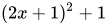
The next step is to take a figures to the left of the upper right-hand corner and interchange them with the corresponding ones in the lower row, and similarly for the figures above the lower right hand corner. The square then appears as here shown.
| 12 | 11 | 10 | 45 | 46 | 49 | 2 |
| 47 | 3 | |||||
| 44 | 6 | |||||
| 7 | 43 | |||||
| 8 | 42 | |||||
| 9 | 41 | |||||
| 48 | 39 | 40 | 5 | 4 | 1 | 38 |
To fill the inner cells Seki follows a similar rule, except that the numbers now begin with 13. Without entering upon the exact details it will be easy for the reader to trace the plan by studying the result as here shown. The innermost square of cells is filled by the method first given.
| 12 | 11 | 10 | 45 | 46 | 49 | 2 |
| 47 | 20 | 19 | 35 | 37 | 14 | 3 |
| 44 | 34 | 24 | 29 | 22 | 16 | 6 |
| 7 | 17 | 23 | 25 | 27 | 33 | 43 |
| 8 | 18 | 28 | 21 | 26 | 32 | 42 |
| 9 | 36 | 31 | 15 | 13 | 30 | 41 |
| 48 | 39 | 40 | 5 | 4 | 1 | 38 |
The even-celled squares have always proved more troublesome than the odd-celied ones. Seki first gives a rule for a square of cells, with the result as bere shown. He then divides these squares into those that are simply even and those that are doubly even.[29]

| 4 | 9 | 5 | 16 |
| 14 | 7 | 11 | 2 |
| 15 | 6 | 10 | 3 |
| 1 | 12 | 8 | 13 |
For the simply even squares above , Seki begins, with the third cell to the left of the upper right-hand corner, proceding thence to the left, as shown in the figure. Then he goes back to the upper right-hand cell (for 5, in the case here shown) and proceeds down the right-hand column to the third cell from the bottom. He then fills the vacant cell at the top
| 4 | 3 | 2 | 1 | 9 | 5 |
| 31 | 6 | ||||
| 30 | 7 | ||||
| 29 | 8 | ||||
| 27 | 10 | ||||
| 32 | 34 | 35 | 36 | 28 | 33 |
(in this case with 9), and puts the next number (10) in the next cell in the right-hand column. The remaining cells in the left-hand column and the lower row are complements of the corresponding numbers with respect to , there being elements on a side, as in the case of an odd-celled square. The interchange of elements is now made in a manner somewhat like that of the odd-celled square, the result being here shown for the case of a square of cells. The rest of the process is as in the odd-celled case.


| 4 | 3 | 35 | 36 | 28 | 5 |
| 6 | 31 | ||||
| 30 | 7 | ||||
| 8 | 29 | ||||
| 10 | 27 | ||||
| 32 | 34 | 2 | 1 | 9 | 33 |
For the doubly even magic square the first step of Sekis method will be sufficiently understood by reference to the following figure, in which the number is . The inner squares are filled in order until the one of cells is reached, when that is filled in the manner first shown.

| 6 | 5 | 4 | 3 | 2 | 1 | 8 | 7 |
| 56 | 9 | ||||||
| 55 | 10 | ||||||
| 54 | 11 | ||||||
| 53 | 12 | ||||||
| 52 | 13 | ||||||
| 51 | 14 | ||||||
| 58 | 60 | 61 | 62 | 63 | 64 | 57 | 59 |
Seki simplified the treatment of magic circles, giving in substance the following rule:
Let the number of diameters be . Begin with 1 at the center and write the numbers le order on any radius, and so on along the next . Then take the radius opposite the last one and set the numbers down in order, beginning at the outside, and so on along the rest of the radii. In Fig. 29 the sum on any circle is 140, and for readers who have not be-come familiar with the Chinese numerals the following diagram, although arranged for only thirty three numbers, will be of service:

In another of Sekis manuscripts[30] there appears the Josephus problem already mentioned in connection with Muramatsu.
Mention should be made of Seki's work on the mensuration of solids, which appears in two of his manuscripts.[31] He begins by considering the volume of a ring[32] generated by the revolution of a segment of a circle about a diameter parallel to the chord of the segment. He states that the volume is equal to
Fig. 29. Magic circle, from the Seki reprint of 1908.
the product of the cube of the chord and the moment of spherical volume.[33]
He finds this volume by taking from the sphere the central cylinder and the two caps.[34] He also considers the case in which the axis cuts the segment.
He likewise finds the volume generated by a lune formed by two arcs, the axis being parallel to the common chord, and either cutting the lune or lying wholly outside. Such work does not seem very difficult at present, but in Seki's time it was an advance over anything known in Japan.[35] These problems were to Japan what those of Cavalieri were to Europe, making a way for the Katsujutsu or method of multiple integration[36] of a later period.
Seki also concerned himself with indeterminate equations, beginning with ax - by = 1 to be solved for integers.[37] His first indeterminate problem is as follows: "There is a certain number of things of which it is only known that this number divided by 5 leaves a remainder 1, and divided by 7 leaves a remainder 2. Required the number." Page:A history of Japanese mathematics (IA historyofjapanes00smitiala).pdf/136 Page:A history of Japanese mathematics (IA historyofjapanes00smitiala).pdf/137 Page:A history of Japanese mathematics (IA historyofjapanes00smitiala).pdf/138 that the process long remained a secret. It must be said, however, that the Chinese and Japanese method of writing a set of simultaneous equations was such that it is rather remarkable that no predecessor of Seki's discovered the idea of the determinant.
We have now considered all of Seki's work save only the mysterious yenri, or circle principle. It must be confessed that aside from his anticipation of determinants the result is disappointing. In Chapter VIII we shall consider the yenri, of which there is grave doubt that Seki was the author, and aside from this and his discovery of determinants his reputation has no basis in any great field of mathematics. That he was a wonderful teacher there can be no doubt; that he did a great deal to awaken Japan to realize her power in learning no one will question; that he was ingenious in improving mathematical devices is evident in everything he attempted; but that he was a great mathematician, the discoverer of any epoch-making theory, a genius of the highest order, there is not the slightest evidence. He may be compared with Christian Wolf rather than Leibnitz, and with Barrow rather than Newton. When, on November 15, 1907, His Majesty the Emperor of Japan paid great honor to his memory by bestowing upon him posthumously the junior class of the fourth Court rank; he rendered unprecedented distinction to a great scholar and a great teacher, but not to a great discoverer of mathematical theory.
- ↑ Not far from Yedo, the Shogun's capital, the present Tōkyō.
- ↑ Or Takakazu. On the life of Seki see Mikami, Y., Seki and Shibukawa, Jahresbericht der Deutschen Mathematiker-Vereinigung, Vol. XVII, p. 187; Endō, Book II, p. 40; Ozawa, Lineage of Mathematicians (in Japanese); Hayashi, History, part 1, p. 43, and the memorial volume (in Japanese) issued on the two-hundredth anniversary of Seki's death, 1908.
- ↑ C. Kawakita, in an article in the Honchō Sūgaku Kōenshū, says that some believe Seki to have been born in 1637.
- ↑ Thus Endō feels that the yenri was quite equal to the calculus (History, Book III, p. 203). See also Hayashi, History, part I, p. 44, and the Honchō Sūgaku Kōenshū, pp. 33—36. Opposed to this idea is Professor R. Fujisawa of the University of Tōkyō who asserts that the yenri resembles the Chinese methods and is much inferior to the calculus. The question will be more fully considered in a later chapter.
- ↑ Kamizawa Teikan (1710–1795), Okinagusa, Book VIII. Kamizawa lived at Kyōto. This title was also place upon the monument to Seki erected in Tōkyō in 1794.
- ↑ Kuichi Sanjin, in the Sūgaku Hōchi, No. 55.
- ↑ Okinagusa, Book VIII.
- ↑ See Fukuda's Sampō Tamatebako, 1879; Endō, Book II, p. 40; Hayashi in the Honchō Sūgaku Kōenshū, 1908.
- ↑ Fujita Sadasuke in the preface to his Seiyō Sampō, 1779; Ozawa Seiyō in his Lineage of Mathematicians (in Japanese), 1801; the anonymous manuscript entitle Sanka Keizu.
- ↑ The fact that the long epitaph upon his tomb makes no mention of any teacher points to the same conclusion.
- ↑ In the Okinagusa of Kamizawa this is given as the Sangakn Gomō, but in an anonymous manascript entitled the Sanwa Zuikitsu the Chinese classic is specially given on the authority of one Saitō in his Burin Inken Roku.
- ↑ In Japanese, Sansei. This title was also carved upon his tomb.
- ↑ Kamizawa, Okinagusa, Book VIII; Kuichi Sanjin in the Sūgaku Hōchi, No. 55; Endō, Book II, p. 40.
- ↑ His heir was Shinshichi, or Shinshichirō, a nephew. Endō, Book II, p. 81.
- ↑ Kamizawa, Okinagusa, Book VIII.
- ↑ The story is evidently based upon the problem of Yoshida already given on page 66.
- ↑ Kamizawa, Okinagusa, Book VIII.
- ↑ Endō, Book II, p. 41.
- ↑ For further particulars see Endō, loc. cit., and the Seki memorial volume (Seki-ryū Shichibusho, or Seven Books on Mathematics of the Seki School) published in Tōkyō in 1908.
- ↑ This is the work mentioned by Professor Hayashi as the Hakki Sampō of Mitaki and Mie (Miye).
- ↑ In 1685 one of Scki's pupils, Takebe Kenkō, published a work entitled Hatsubi Sampō Yendan Genkai, or the "Full explanations of the Hatsubi Sampō," in which the problems are explained. He states that the blocks for printing the work were burned in 1680 and that he had attempted to make good their loss.
- ↑ By the "moment of the circumference" is meant the numerator of the fractional value of . This is in case is taken as .
- ↑ "Moment of diameter" means the denominator of the fractional value of π. In the case of , this is . That is, we have .
- ↑ Thus far the solution is as follows: Let the diameter of the smallest circle, and the diameter of the largest circle. Then is the diameter of the so-called "middle circle."
Then
and
That the formula for C is correct is seen by substituting for 120 the difference in the areas as stated. We then have
or or which is, as stated in the rule, "the product of the square of the diameter of the largest circle multiplied by the moment of circumference." - ↑ I. e.
- ↑ I. e.
- ↑ As explained on page 53.
- ↑ Takebe of course expresses these quantities in Chinese characters. The coefficients are represented by him in the usual sangi form, where , and stand respectively for and . This notation is called the bōsho or side-notation and is mentioned later in this work. Expressions containing an únknown are arranged vertically, and other polynomials are arranged horizontally. Thus for we have
respectively, while for we have
a2
with Chinese characters in place of these letters.
- ↑ , and .
- ↑ Sandatsu Kempu (Kenpu).
- ↑ The Kyūseki (Calculation of Areas and Volumes) and the Kyūketsu Hengyō Sō (An incomplete treatise on the volume of a sphere).
- ↑ He calls it an "arc-ring," kokan or kokwan in Japanese.
- ↑ That is, the volume of a unit sphere. It is called by Seki the vilsu-yen seki rilsu or gyoku seki hō.
- ↑ This is stated by an anonymous commentary known as the Kyūketsu Hengyō Sō Genkai.
- ↑ Endō, Book II, p. 45.
- ↑ Or rather the method of repeated application of the tetujutru expansion. Some of the problems involved only a single integration.
- ↑ This appears in his Shūi Shoyaku no llô, written in 1683. His method of attacking these problems he calls the senkan jutru, Problems of this nature appeared in the Ktwatsayō Sampō.









![{\displaystyle \left\{C\left[4(x+5)-x\right]-D\right\}^{2}=X.}](../_assets_/eb734a37dd21ce173a46342d1cc64c92/d96e5bab10af3a216dd166be8bcb77cee85f50f6.svg)



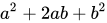
![{\displaystyle \left[2(n+1)\right]^{2}}](../_assets_/eb734a37dd21ce173a46342d1cc64c92/85bf9b5ef2453393d410c12760a1c95afb7fef62.svg)
![{\displaystyle \left[2(2n)\right]^{2}}](../_assets_/eb734a37dd21ce173a46342d1cc64c92/d37cecdbbdfffe952cbe29265d6d4c0ced9d7690.svg)