A History of Japanese Mathematics/Chapter 13
CHAPTER XIII.
The Close of the Old Wasan.
Having now spoken of Wada's notable advance in the yeuri or Circle Principle, in which he developed an integral calculus that served the ordinary purposes of mensuration, there remains a period of activity in this same field between the time in which he flourished and the opening of Japan to foreign commerce, which period marks the close of the old wasan, or native mathematics. Part of this period includes the labors of some of Wada's contemporaries, and part of it those of the next succeeding generation, but in no portion of it is there to be found a genius such as Wada. It was his work, his discoveries, his teaching that inspired two generations of mathematicians with the desire to further improve upon the Circle Principle. We have seen how the story is told that the best mathematicians of his day went to him in secret for the purpose of receiving instruction or suggestions, and it is further related that his range of discoveries was greater than his regular pupils knew, and that some of these discoveries appear as the work of others. This is mere rumor so far as any trustworthy evidence goes to show, but it lets us know the high estimate that was placed upon his abilities.
Among his contemporaries who gave serious attention to the yenri was a merchant of Yedo by the name of Iyezaki Zenshi who published a work in two parts, the Gomei Sampō, of which the first part appeared in 1814 and the second in 1826. There is a charming little touch of Japan in the fact that many of the problems relate to figures, and in particular to groups of ellipses, that can be drawn upon a folding fan, that is, upon a sector of an annulus.
Iyezaki gives also some problems in the yenri of a rather advanced nature. For example, he gives the area of the maximum circular segment that can be inscribed in an isosceles triangle of base b and so as to touch the equal sides s, as
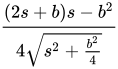
He also states that if an arc be described within a right triangle, upon the hypotenuse as the chord, and if a circle be drawn touching this arc and the two sides of the triangle, the maximum diameter of this circle is
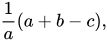
where a, b and c are the sides.
Contemporary with Iyezaki, or immediately following him, were several other writers who paid attention to figures drawn
Fig. 44. From Yamada Jisuke's Sampō Tenzan Shinan (Bunkwa era, 1804—1818).
upon fans. Among these may be mentioned Yamada Jisuke whose Sampō Tenzan Shinan (Instructor in the tensan mathematics) appeared early in the century (see Fig. 44); Takeda Tokunoshin whose Kaitei Sampō appeared in 1818 (see Fig. 45); Ishiguro Shin-yū (see Fig. 46), already mentioned in Chapter V as the last Japanese writer to make much of the practice of proposing problems for his rivals to solve; and Matsuoka
Fig. 45. From Takeda Tokunoshin's Kaitei Sampō (1818).
Fig. 46. Tangent problem from Ishiguro Shin-yū (1813).
Yoshikazu, whose Sangaku Keiko Daizen, an excellent compendium of mathematics, appeared in 1808 and again in 1849.
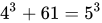
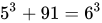
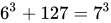
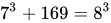
Also contemporary with Iyezaki was Shiraishi Chōchū (1796—1862) who published a work entitled Shamei Sampu[1] in 1826. He was a samurai in the service of Lord Shimizu, a near relative of the Shogun. While most of the problems in this treatise relate to the yeuri, there is some interesting work in the line of indeterminate equations. One of these equations bears the name of Gokai Ampon, and like the rest was hung before some temple. The problem is as follows:
"There are three integral numbers, heaven, earth, and man, which being cubed and added together give a result of which the cube root has no decimal part. Required to find the numbers."
The problem is, of course, to solve the equation in integers. The solution is given in Gokai's name, and he is known to have been an able mathematician, but whether it was his or Shiraishi's is unknown. In a manuscript commentary on the work[2] the following discussion of the equation appears:

First a table is constructed as follows:
| . . . . .[3] | ||
| . . . . . | ||


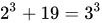

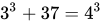





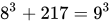





Page:A history of Japanese mathematics (IA historyofjapanes00smitiala).pdf/246 Substituting these values in (1) we have

from which

which gives the general solution.
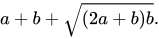
Among the geometric problems given by Shiraishi two, given in Ikada's name, may be mentioned as types.The first is as follows: "An ellipse is inscribed in a rectangle, and four circles which are equal in pairs are described as shown in the figure, A and B touching the ellipse at the same point. Given the diameters (a and b) of the circles, required to find the minor axis of the ellipse." The result is given as
The second problem is to find the volume cut from a sphere by a regular polygonal prism whose axis passes through the center of the sphere.
There are also two problems given as solved by Shiraishi's pupils Yokoyama and Baishu, of which one is to find the volume cut from a cylinder by another cylinder that intersects it orthogonally and touches a point on the surface, and the other is to find the volume cut from a sphere by an elliptic cylinder whose axis passes through the center.
The Shamei Sampu contains a number of problems of this general nature, including the finding of the spherical surface that remains when a sphere is pierced by two equal circular cylinders that are tangent to each other in a line through the
Fig. 47. From Iwai Jūyen's Sampō Zasso (1830).
center of the sphere; the finding of the area cut from a spherical surface by a cylinder whose surface is tangent to the spherical surface at one point; the finding of the volume cut from a cone pierced orthogonally to its axis by a cylinder, and the finding the surface of an ellipsoid.
Shiraishi also wrote a work entitled Sūri Mujinzō,[4] but it was never printed. It is a large collection of formulas and relations of a geometric nature. His pupil Kimura Shōju published in 1828 the Onchi Sansō which also contained
Fig. 48. From Aida Yasuaki's Sampō Ko-ken Thūran.
numerous problems relating to areas and volumes. Interesting tangent problems analogous to those given by Shiraishi are found in numerous manuscripts of the nineteenth century. Illustrations are seen in Figs. 50 and 51, from an undated manuscript by one Iwasaki Toshihisa, and in Fig. 48, from a work by Aida Yasuaki.
Another work applying the yenri to mensuration, the Sampō Zasso, by Iwai Jūyen (or Shigeto), appeared in 1830. Iwai was a wealthy farmer living in the province of Jōshū and he had studied under Shiraishi. He also gives the problem of the intersecting cylinders (see Fig. 47), and the problem of finding the area of a plane section of an anchor ring. In
Fig. 49. From Hori-ike's Yōmio Sampō (1829).
1837 Iwai published a second work entitled Yenri Hyōshaku,[5] although it is said that this was written by Kemmochi Yōshichi. In this the higher order of operations of the yenri were first made public, and some notion of projection appears. Another work published in the same year, the Keppi Sampō by Hori-ike Hisamichi, resembles it in these respects. Hori-ike's Yō-mio Sampō (1829) contains some interesting fan problems (see Fig. 49).
More talented as a mathematician, however, and much more popular, was Uchida Gokan,[6] who at the age of twenty-seven Fig. 50. Tangent problem, from a manuscript by Iwasaki Toshihisa.
published a work that brought him at once into prominence. Uchida was born in 1805 and studied mathematics under Kusaka, taking immediate rank as one of his foremost pupils. In 1832 he published his Kokon Sankan[7] in two books which included a number of problems that were entirely new, and did much to make the higher yenri. Sections of an elliptic wedge, for example, were new features in the mathematics of Japan, and the following problems showed his interest in the older questions as well:
There is a rectangle in which are inscribed an ellipse and four circles as shown in the figure. Given the diameters of the three circles A, B and C, viz., a, b and c, it is required to find the diameter of the circle D.
The rule given is as follows: Divide a and b by c, and take the difference between the square roots of these quantities. To this difference add 1 and square the result. This multiplied by c gives the diameter of D. This rule was suspected by the contemporaries and the immediate successors of Uchida, but they were unable to show that it was false.[8] Uchida was, however, aware of it, although it appears in none of his writings.[9] Uchida also gave several interesting fan problems (see Fig. 55).
Uchida died in 1882, having contributed not unworthily to mathematics by his own writings, and also through the works of his pupils.[10] Among the latter works are Shino Chikyō's Kakki Sampō (1837), Kemmochi's Tan-i Sampō (1840)
Fig. 51. Problem of spheres tangent to a tetrahedron, from a manuscript by Iwasaki Toshihisa.
and Sampō Kaiwun (1848), Fujioka's Sampō Yenri-tsū (1845), Takenouchi's Sampō Yenri Kappatsu (1849) and Kuwamoto Masaaki's Sen-yen Kattsū (1855), not to speak of several others. Among the contemporaries of Wada should also be mentioned Saitō Gigi, whose Yenri-kan appeared in 1834. It is possible that the real author was Saitō's father, Saitō Gichō (1784—1844) who also took much interest in mathematics. Father and son were both well-to-do farmers in Jōshū with whom mathematical work was more or less of a pastime. The Yenri-kan deserves this passing mention on account of the fact that it contains a problem on the center of gravity, and several problems on roulettes.
Fig. 52. From Kobayashi's Sampō Koren (1836).
In 1836 appeared Kobayashi Tadayoshi's Sampō Koren in which is considered the volumes of intersecting cylinders and a problem on a skew surface. The latter is stated as follows: "There is a 'rhombic rectangle'[11] which looks like a rectangle when seen from above, and like a rhombus when seen from the right or left, front or back. Given the three axes, required the area of the surface." Here the bases are gauche quadrilaterals. (The drawing is shown in Fig. 52.) Saitō also published a similar work, the Yenri Shinshin, in 1840.
At about the same period there appeared numerous works of somewhat the same nature, of which the following may be mentioned as among the best:
Gokai Ampon's (1796—1862) Sampō Semmon Shō (1840), a work on the advanced tenzan theory, with some treatment of magic squares (Fig. 54).
Fig. 53. From Murata's Sampō Fikata Shinan (1835).
Yamamoto Kazen's Sampō Fojutsu[12] (1841), containing an extensive list of formulas and excellent illustrations of the problems of the day (see Fig. 57).
Murata Tsunemitsu's Sokuyen Shōkai (1833), relating to the tenzan algebra applied to the ellipse, and his Sampō Fikata Shinan (1835), dealing with enginering problems (Fig. 53). Murata's pupil Toyota wrote the Sampō Dayen-kai in 1842, also relating to the tenzan algebra applied to the ellipse.[13]
Fig. 54. Magic Squares from Gokai's Sampō Semmon Shō (1840).
A work by a Buddhist priest, Kakudō written in Kyōto in 1794 and published in 1836, entitled Yenri Kiku Sampō, giving a summary of the yenri.
Chiba Tanehide's Sampō Shin-sho (1830), a large compendium of mathematics, actually the work of Hasegawa Kan.
Fig. 55. From Uchida's Kōkon Sankan (1832).
The Sampō Tenzan Tebikigusa, of which the first part was published by Yamamoto in 1833 and the second part by Ōmura Isshū (1824—1891) in 1841. This was a treatise on
Fig. 56. From Minami's Sampō Yenri Sandai (1846). tenzan algebra. Some of the fan problems in this work are of considerable interest. (See Fig. 58.)
Kikuchi Chōryō's Sampō Seisū Kigenshō (1845), a treatise on indeterminate analysis.
Fig. 57. From Yamamoto Kazen's Sampō Jojutsu (1841). Minami Ryōhō's Sampō Yenri Sandai (1846), with some treatment of roulettes (see Fig. 56) and the Funtendo Sampu[14] (1847) by Iwata Seiyo and Kobayashi (not Tadayoshi). Curiously, the first ten pages of Minami's work are numbered with Arabic numerals.
Kaetsu's Sampō Yenri Katsunō (1851), a work on the higher yeuri. This was considered of such merit that it was reprinted in China.
Iwasaki Toshihisa's Yachu zak kai (1831), Saku yen riu kwai
Fig. 58. From Yamamoto and Ōmura Isshū's Sampō Tenzan Tebikigusa (1833, 1841). gi, and Shimpeki sampō, all works of considerable merit in the line of geometric problems.
Baba Seito's Shi-satsu Henkai (1830), generally known by the later title Sampō Kishō.
Hasegawa Kō's Kyūseki Tsūkō[15] (1844), published under the name of his pupil Uchida Kyūmei. This is more important than the works just mentioned. It consists of five books and gives a very systematic treatment of the yeuri, beginning with the theory of limits and the use of the "folding tables of Wada Nci. It treats of the circular wedge and its sections of the intersections of cylinders and spheres (see Fig. 59), of ovals, or circles of various classes, as studied by Wada, and also of the cycloid and epicycloid.
The study of the catenary begins about 1860. The first to give it attention were Ōmura and Kagami, but the first printed. work in which it is discussed is the Sampō Hōyen-kan (1862) of Hagiwara Teisuke. (1828—1909). Another interesting problem which appears in this work is that of the locus of the point of contact of a sphere and plane, the sphere rolling around on the plane and always touching an anchor ring that is normal to and tangent to the plane. Hagiwara also published a work entitled Sampō Yenri Shiron (1866) in which he corrected the results of thirty-four problems given in twenty-two works published at various dates from the appearance of Arima's Shūki Sampō (1769) to his own time (see Figs. 60, 61). He also published a work entitled Yenri San-yō (1878), the result of his studies of the higher yeri problems. His manuscript called the Reikan Sampō was published in 1910 through the efforts of a number of Japanese scholars. Hagiwara was born in 1828, and was a farmer in narrow circumstances in the province of Jōshū. Not until about 1854 did he take an interest in mathematics, but when he recognized his taste for the subject he became a pupil of Saitō's, traveling on foot ten miles on the eve of a holiday so as to have a full day with his teacher. His manuscripts were horded in a miserly fashion Fig. 59. From Hasegawa Kō's Kyūseki Tsūkō (1844).
until his death, November 28, 1909, when the last great mathematician of the old school passed away.
Mention should be made at this time of the leading mathematicians who were the contemporaries of Hagiwara, and who were living when the Shogunate gave place to the Empire in 1868. Of these, Hōdōji Wajūrō was born in 1820 and died in 1871.[16] He was the son of a smith in Hiroshima, and although he led a kind of vagabond existence he had a good deal of mathematical ability. It is said that he was the real author of Kaetsu's Yenri Katsunō. Several other books are known to have been written by him, but they were not published under his own name.
Iwata Kōsan (1812—1878), born a samurai, devoted his attention particularly to the ellipse. The following is his best known problem:
Given an ellipse E tangent to two straight lines and to four circles, A, B, C, D, as shown in the figure. Given the diameters of A, B and C, required to find the diameter of D. His solution, given in 1866, is essentially the proportion a:b = c:d, where a, b, c, d are the respective diameters of A, B, C and D. The problem was afterwards extended to any four conics instead of four circles, by H. Terao and others.
Kuwamoto Masaaki wrote the Senyen Kattsū in 1855, and in it he treated of roulettes of various kinds (see Fig. 62), of elliptic wedges (see Fig. 63), and other forms at that time attracting attention.
Takaku Kenjirō (I821—1883) wrote the Kyokusū Taisei-jutsu in which he made some contribution to the theory of maxima and minima.
Fig. 60. From Hagiwara's Sampō Yenri Shiron (1866).
Fukuda Riken (1815—1889) lived first in Ōsaka and finally in Tokyō. He was a teacher of some prominence, and his Sampō Tamatebako appeared in 1879.
Fig. 61. From Hagiwara's Sampō Yenri Shiron (1866).
Yanagi Yūyetsu (1832-1891) was a naval officer who gave some attention to the native Japanese mathematics.
Fig. 62. From Kuwamoto Masaaki's Sen yen Kattsū (1855).
Suzuki Yen, who may still be living wrote a work (1878) upon circles inscribed in or circumscribed about figures of various shapes.
Fig. 63. From Kuwamoto Masaaki's Sen yen Katisū (1855).
Thus closes the old wasan, the native mathematics of Japan. It seems as if a subconscious feeling of the hopelessness of the contest with Western science must have influenced the last half century preceding the opening of Japan. There was really no worthy successor of Wada Nei in all this period, and the feeling that was permeating the political life of Japan, that the day of isolation was passing, seems also to have permeated scientific circles. With the scholars of the country obsessed with this feeling of hopelessness as to the native mathematics, the time was ripe for the influx of Western science, and to this influence from abroad we shall now devote our closing chapter.
- ↑ Mathematical Results hung in Temples.
- ↑ Shamei Sampu Kaigi.
- ↑ In the table these missing numbers are given, but they are not necessary for our purposes.
- ↑ An inexhaustible Fountain of Mathematical Knowledge. It is given in Ikeda's name.
- ↑ The Method of the Circle Principle explained.
- ↑ Or Uchida Itsumi.
- ↑ Mirror (model) of ancient and modern Mathematical Problems.
- ↑ For this information the authors are indebted to T. Hagiwara, the only survivor, up to his death in 1909, of the leaders of the old Japanese school.
- ↑ This information is communicated to us by C. Kawakita, one of Uchida's pupils.
- ↑ C. Kawakita's article in the Honchō Sūgaku Koen-shū, 1908, p. 20. Shino Chikyō's nom de plume was Kenzan.
- ↑ This is the literal translation of choku bishi. The figure is a solid and is defined in the problem.
- ↑ Aids in Mathematical Calculation.
- ↑ Besides Murata's work we have consulted Endō, Book III, p. 129.
- ↑ Juntendō Mathematical Problems.
- ↑ General Treatment of Quadrature and Cubature.
- ↑ C. Kawakita, in the Honcho Sūgaku Kōenshū, p. 23.