Opaka
Kai Opaka was the spiritual leader of Bajor in the latter days of the Cardassian Occupation and the early days of Bajor's independence from Cardassian rule. One of the most respected figures in the Bajoran culture, Opaka was left in the Gamma Quadrant in 2369.
Quick Answers
What role did Kai Opaka play in the liberation of Bajor from Cardassian rule?

How did Kai Opaka come to be left in the Gamma Quadrant in 2369?
What was Kai Opaka's life like under Cardassian rule?
How did Kai Opaka rise to prominence in the Bajoran spiritual community?
What efforts did Kai Opaka make to protect her people during the Cardassian Occupation?
The Occupation
Opaka was born under Cardassian rule during the half-century long occupation of her world. As an adult, she rose to great prominence among the Bajoran spiritual community, eventually becoming kai.
Constantly working to protect her people and serve the will of the Prophets, Opaka became a revered figure among her people. During the last decade of the Occupation, however, she once secretly collaborated with the Cardassians. Opaka sent Prylar Bek to inform them of the location of a Bajoran Resistance cell in the Kendra Valley. This saved the lives of 1,200 other Bajorans, as the Cardassians would have otherwise destroyed the entire valley, but Opaka sacrificed her son in the process – as a member of the cell, he was killed in the resulting massacre. Opaka's involvement was never discovered, even after Prylar Bek made a full confession. Vedek Bareil lost the kaiship to keep secret the fact she had sacrificed her son and his group in order to save hundreds of civilians from retribution. (DS9: "The Collaborator")
The coming of the Emissary
When the Cardassians retreated from Bajor in 2369, the Bajoran people began forming factions, vying for control of their new found independence. Each side looked to Opaka for support. She went into hiding on Bajor, refusing to meet with anyone.
When the Bajoran Provisional Government invited Starfleet to take command of the former Cardassian space station Terok Nor in orbit of Bajor, Commander Benjamin Sisko was placed in command of the station, renamed Deep Space 9. Hoping to unite the various Bajoran factions, Sisko met with Opaka. She surprised many by identifying Sisko as the prophesied Emissary of the Prophets. Opaka believed that Sisko's arrival had a deep spiritual purpose, in fact, that it was a fulfillment of prophecy that he would be the savior of Bajor. She entrusted Sisko with a powerful and mystical orb, telling him his destiny was to reclaim eight other orbs stolen by the Cardassians. Kai Opaka used the orb to transport Sisko to the beach where he first met his wife. Sisko later discovered the home of the Prophets, the Bajoran wormhole, which the Bajorans identified as the Celestial Temple. Later, he spoke with Kai Opaka, who informed Sisko that he was the Emissary of the Prophets and this was not last time he would work with the Bajoran prophets to secure the future of Bajor. (DS9: "Emissary")
Of course, Opaka experienced disagreement from other Bajorans about this proclamation. Vedek Winn Adami, for example, asked her why an unbeliever was destined for this role. Opaka told her that, "one should never look into the eyes of one's own gods". As she disagreed with that, at Opaka's suggestion, Winn sat in darkness for a day, an action she considered quite proper. (DS9: "In the Hands of the Prophets")
Disappearance
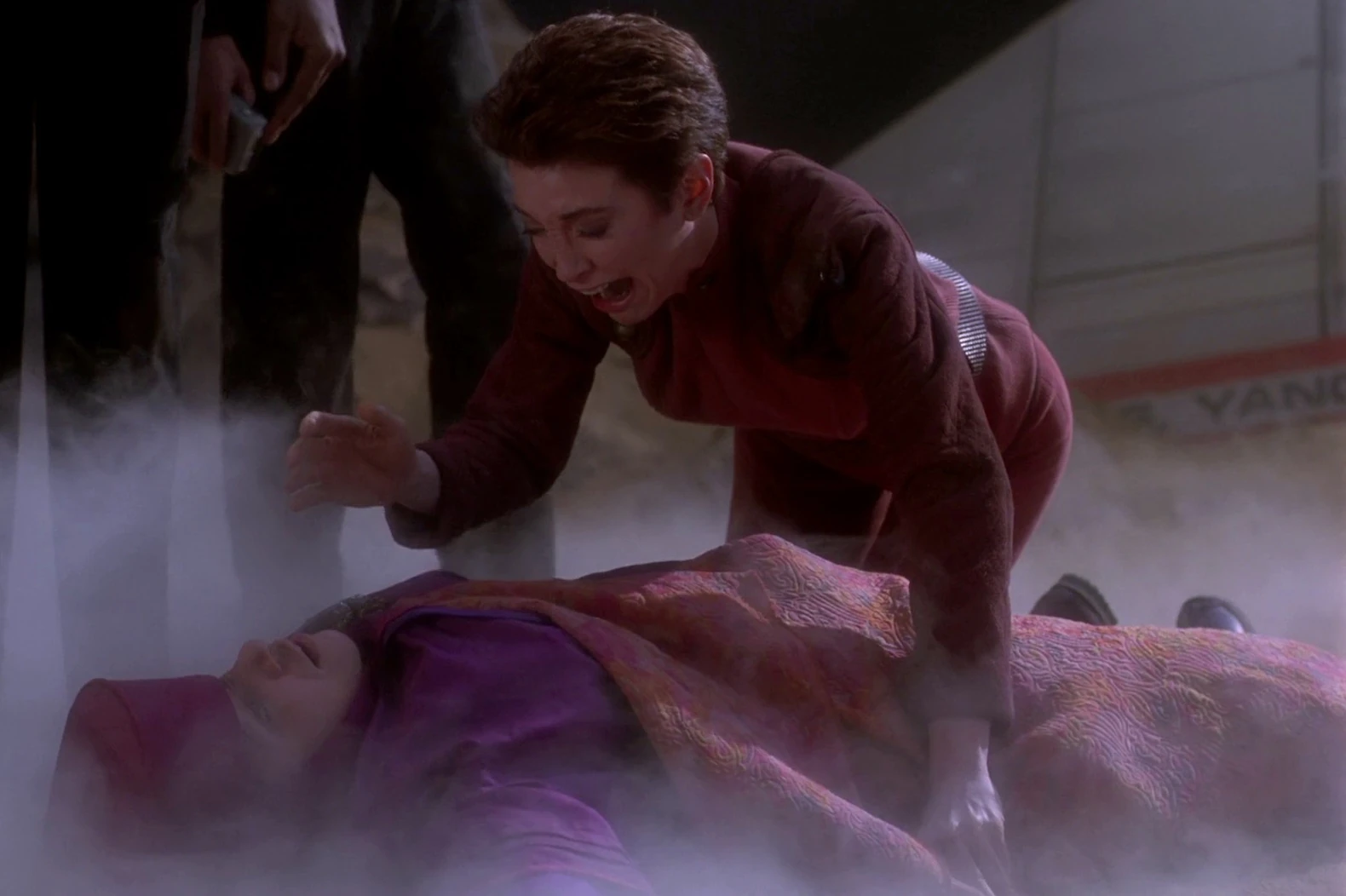
Kira mourning Opaka
After several months, Opaka took a transport from Bajor for Deep Space 9 to visit Sisko. Compelled by the Prophets to travel into the wormhole, Opaka somehow knew that she would not be returning. During a trip to the Gamma Quadrant, Opaka died in a runabout crash on a moon.
The moon was discovered to be a prison on which artificial microbes kept the prisoners forever alive to wage war with one another. These microbes resurrected Opaka, but forced her to remain on the moon. The artificial microbes restored a person's body after death, but that body then became permanently dependent on those microbes for all cellular functions. Anyone with the microbes would die if taken away from the moon. Opaka had already decided to stay behind even before learning this, feeling that it was the will of the Prophets. She hoped to teach the warring prisoners peace. Sisko promised to return if they ever found a way to get her off the moon, but Opaka insisted this was where she was meant to be. (DS9: "Battle Lines")
Opaka's disappearance was mourned across Bajor. Vedek Winn told Sisko that Opaka could not be replaced and missed her deeply. (DS9: "In the Hands of the Prophets")
Opaka appeared in an orb shadow that Sisko experienced in 2372. He had stepped down as the Emissary when Akorem Laan, who had been in the Celestial Temple for two hundred years, returned and said that the Prophets had chosen him to be the Emissary. Opaka convinced Sisko that he should accept his destiny and that he was the rightful emissary. (DS9: "Accession")
Appendices
Appearances
- DS9:
- "Emissary"
- "Battle Lines"
- "The Collaborator" (vision only)
- "Accession" (vision only)
Background information
Opaka was played by Camille Saviola.
In the revised final draft script for "Emissary", Opaka's name was phonetically notated "o-PAH-ku". [1] According to the final draft scripts for "Battle Lines" and "The Collaborator", however, her name was pronounced as "oh-PAH-kah". [2] [3]
Originally, Kai Opaka was to have been a man who was spiritual leader of the Bajorans and often conflicted with Starfleet's goals. His visitors had to disrobe while he probed their pagh through deep-tissue massage of their feet. This version of the character was written into the first draft of the Star Trek: Deep Space Nine Bible. (The Making of Star Trek: Deep Space Nine, pp. 37-38, 87, 114)
Of course, the kai was ultimately changed from male to female, her visitors never had to take off their clothes, and she (like other Bajoran religious leaders) generally checked people's paghs by touching their earlobes rather than their feet. The change of the character's gender was made in order to add to the series' collection of strong female characters. Showing her visitors undressing and having Opaka check their paghs via foot massages might look silly, and if those concepts remained, the obligatory disrobing scenes would consume much-needed story and production time, so – for the sake of simplicity – the pagh was relocated to the earlobes and the disrobing idea was discarded. (The Making of Star Trek: Deep Space Nine, p. 108)
The altered depiction of the kai was included in a revised draft of the DS9 series bible. (The Making of Star Trek: Deep Space Nine, p. 108) In that document, Opaka was described as "The spiritual leader of Bajor who provides sharp counterpoint to the secular nature of Starfleet. She challenges conventional Human logic. The Kai explores her guests' 'pagh' (roughly translated: energy meridian) through deep tissue massage of their ears that seems to reveal their true nature. Opaka tells Sisko in the opening episode that the commander is on a personal journey. And that he has been sent to Bajor to find the celestial temple of the prophets – the source of the mysterious orbs. When Sisko investigates, he discovers the wormhole and the aliens who built it. The Kai seems to have an awareness on a higher plane of consciousness, knows things she cannot possibly know. Although our people do not accept her 'powers' at face value, we cannot always explain them either. She speaks in vague, mystical and indirect language, forcing the listener to seek her meaning." [4]
In the "Emissary" script (both its first draft and its revised final draft), Opaka was described as "a strange looking, middle aged Bajoran dressed in a colorful sheath… there is a centered calm in her, she seems to exist on a higher plane. Yet there is a deep sadness in this woman who carries the pain of her people. She has been hurt… her face is badly bruised… her scalp has a small bandage… a cane supports a bad limp…" [5]
Actresses who Casting Director Junie Lowry-Johnson scheduled to audition for the role of Opaka include Samantha Eggar, Meg Foster, Christine Jansen, Salome Jens, Micole Mercurio, Natalia Nogulich, Lisa Pelikan, Louise Rapport, Carolyn Seymour, Carrie Snodgrass, Grace Zabriskie, and Camille Saviola. [6] Considered but not readily available for the part were Kathy Bates (who specified that she didn't want to do any TV at that stage in her career), Shelley DuVall, and Tricia O'Neil (who was meanwhile filming in Russia). [7] Saviola recalled her casting as Opaka: "For me, having played incredibly strong, powerful, intergalactic women in the musicals Battle of the Giants and Starmites, the role of Kai Opaka was like coming full circle. Junie Lowry, the Star Trek casting director, had been looking high and low and she knew my work from New York. She said, 'They're going to kill me, but I'm bringing in Camille Saviola.' I went in – every character actress was there – and did a little [tarot card] reading, the real thing. My grandmother read cards and tea leaves down in Greenwich Village – she never charged people money – and I have a little bit of that gift. Rick Berman was impressed with the quiet toughness of it. That's how it happened; I don't remember if I even had a callback or not. It was really very easy." (The Official Star Trek: Deep Space Nine Magazine issue 9)
Early in the series run of Star Trek: Deep Space Nine, Opaka was intended to become a longstanding recurring character in the show, with a developing relationship between her and Benjamin Sisko. "Ah, yes, 'The Kai' […] This Kai Opaka, this exchange Sisko has with her, is fascinating," remarked Sisko actor Avery Brooks. (The Official Star Trek: Deep Space Nine Magazine issue 2, p. 15)
Reflecting on what was revealed in "The Collaborator", Saviola commented, "I read the script and went 'I had a son!' It was shocking and it excited me. I thought it was very progressive and showed that this is another world after all. We tend to apply Earthly mores – especially American sensibilities – to outer space, and I thought not only was she a Pope to Bajor, but the Kai was a working mother!" On the revelation about Opaka, Saviola commented, "I didn't understand why what I did had to be kept secret, when it was a heroic deed. It was almost like Oskar Schindler: I have sacrificed 40, including my own son, to save twelve hundred." (The Official Star Trek: Deep Space Nine Magazine issue 9)
Apocrypha
The short story "Ha'mara" in Prophecy and Change established Opaka's given name as "Sulan". In 2376, Jake Sisko encountered Opaka in the Gamma Quadrant in Rising Son and she returned home in Lesser Evil and Unity. Opaka returned to the position of kai, but encouraged Solis Tendren to stand as Winn Adami's successor. During a hostage situation, Opaka served as a midwife for Kasidy Yates-Sisko when Kasidy gave birth to her daughter.
In the Star Trek: Terok Nor novel Night of the Wolves, set during the Occupation, then-Vedek Opaka pushed for the abolition of the D'jarra caste system in the late 2340s to aid resistance against the Cardassians, as the occupiers were using caste discrimination to play the Bajorans off against each other. Kai Arin initially expelled her from the Vedek Assembly for her views, but later came to agree with her, for which his Obsidian Order minder killed him.
The novel Warped mentions that the fact that Opaka was still alive was withheld from the Bajoran populace, who were told that Opaka had answered the call of the Prophets. Some of her people believed she had suffered a corporeal death, while others believed she had been transfigured to another plane of existence.
In an alternate future seen in the Pocket DS9 Millennium book trilogy, the Bajoran Ascendancy named a starship after Kai Opaka. It was commanded by Captain Thomas Riker.
Opaka's mirror universe counterpart (β) appeared in the DS9 novel The Soul Key and the Star Trek: Mirror Universe novel Rise Like Lions. The novel stated that she was elected as kai in 2377, after the mirror Bajorans converted, en masse, to the long-abandoned faith of their ancestors shortly after the discovery of the Bajoran wormhole by the mirror universe counterpart of Iliana Ghemor, who was hailed as the Emissary of the Prophets.
In Star Trek Online, a Starfleet ship was named for Opaka. When the 2,800 Dominion ships that were lost in the Bajoran wormhole after the Battle of Bajor reappeared and attacked Deep Space 9, the USS Opaka was at the station, and aided in the station's evacuation. Opaka herself appears in the "Victory is Life" expansion, with now-Kai Kira, Dr. Julian Bashir, and the player character traveling to the moon in the Gamma Quadrant and finding that Opaka was able to bring peace to the warring factions, but now had to contend with the Hur'q. Dr. Bashir administers a cure (provided by Odo and the Dominion) that allows Opaka and the others to leave the moon. Opaka is reinstated as kai upon the return to DS9.
External links
- Opaka Sulan at Memory Beta, the wiki for licensed Star Trek works
- Opaka Sulan at Wikipedia