Sirius
Sirius, also known as Alpha Canis Majoris or 9 Canis Majoris, was an inhabited planetary system in the Beta Quadrant. This was the brightest star in Earth's night sky.
Components
Stellar system
This was a binary star system. The primary star of this system was Sirius (the proper name for Sirius A). It was an A-type dwarf. Sirius' companion was the white dwarf Sirius B. (TNG: "The Naked Now"; ENT: "Cold Front")
Planetary system
In this system, there were at least nine planets, including Sirius IX. (TAS: "Mudd's Passion")
History
In the mid-to-late 21st century, the Treaty of Sirius was signed, ended the Kzinti Wars between Earth and the Kzinti. (TAS: "The Slaver Weapon")
In 2267, Sirius was one of the stars Lieutenant Sulu used to calculate the Enterprise's position after it had been displaced five hundred parsecs (1,631 light years) by the Metrons. (TOS: "Arena")
In the mid-23rd century, Harcourt Fenton Mudd paid a visit to the inhabitants of Sirius IX. (TAS: "Mudd's Passion")
See also
Stellar cartography
The Sirius system was visible from Earth in the constellation Canis Major. This system was approximately 9 light years from Sol.
In the 2150s, this system's position was labeled on an United Earth star chart which was displayed in several crew and guest quarters aboard the Enterprise. (Star Trek: Enterprise, set decoration)
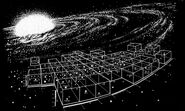
In 2293, the location of Sirius in the Milky Way Galaxy was labeled in the star chart "The Explored Galaxy", which was displayed in Captain James T. Kirk's quarters aboard the USS Enterprise-A. (Star Trek VI: The Undiscovered Country, okudagram)
In 2364, the location of Sirius A and Sirius B was labeled in a star chart of a stellar neighborhood with Sol at the center. This chart was stored in the USS Enterprise-D library computer. Later that year, the chart was scanned by Outpost 63. (TNG: "The Naked Now", production art; TNG: "The Last Outpost")

Appendices
Background information
This system's quadrant of origin was inferred based on the position of neighboring locations – 61 Cygni, Alpha Centauri, Procyon, Sol, Tau Ceti, and Wolf 359 – as seen in the star charts appearing in the Star Trek: Discovery episode "Magic to Make the Sanest Man Go Mad" and in the Star Trek: Picard episode "Maps and Legends".
The Sirius group was mentioned in Gene Roddenberry's original Star Trek pitch in one of the suggested story lines. In the storyline "Kentucky, Kentucky," the Sirius group was home to an Earth colony for fifty years. This colony was attacked by Viking-like savages and reduced to a "frontier" log-fort life. They were regrouped and led by Captain Robert April when the SS Yorktown visited the colony.
The chart naming stars within twenty light years of Sol was originally drawn by Rick Sternbach for the Star Trek Spaceflight Chronology (p. 77) in the late 1970s. This chart showed Earth commercial and exploration routes after the use of warp drive began. Sirius was a destination on an exploration route.
In the Star Trek: Star Charts (pp. 45, 60, 66, "United Federation of Planets I") and Stellar Cartography: The Starfleet Reference Library ("Federation Historical Highlights, 2161-2385"), Sirius A and Sirius B were both classified as A-class stars. In 2378, it was a Federation system.
Information on this system was derived from the episodes and films, the reference works Star Trek: Star Charts and Stellar Cartography: The Starfleet Reference Library, and real-world sources. The reference works were used extensively in the creation of star charts seen in Star Trek: Discovery, Star Trek: Picard, Star Trek: Strange New Worlds, Star Trek: Prodigy, and Star Trek: Lower Decks. The real-world information added to the article was current as of 2025.
The star chart seen in the series Star Trek: Enterprise made its first appearance in Crewman Daniels quarters in "Cold Front". It was also seen in several other episodes of the series, from 2151 to 2154. (For more information, see Federation star charts#United Earth Alpha/Beta star chart)
The current location of Sirius in the Beta Quadrant was based on the most recent star charts seen in Star Trek: Strange New Worlds and Star Trek: Section 31.
External links
- Sirius at Memory Beta, the wiki for licensed Star Trek works
- Sirius at Wikipedia
- Sirius at the Internet Stellar Database