Acoltremon
 Molecular structure of acoltremon | |
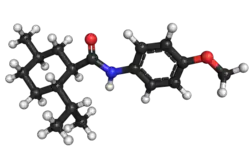 3D representation of an acoltremon molecule | |
| Clinical data | |
|---|---|
| Trade names | Tryptyr |
| Other names | AVX-012, WS-12 |
| AHFS/Drugs.com | Monograph |
| MedlinePlus | a625071 |
| License data |
|
| Routes of administration | Eye drop |
| ATC code |
|
| Legal status | |
| Legal status | |
| Identifiers | |
IUPAC name
| |
| CAS Number | |
| PubChem CID | |
| DrugBank | |
| ChemSpider | |
| UNII | |
| KEGG | |
| ChEMBL | |
| CompTox Dashboard (EPA) | |
| Chemical and physical data | |
| Formula | C18H27NO2 |
| Molar mass | 289.419 g·mol−1 |
| 3D model (JSmol) | |
SMILES
| |
InChI
| |
Acoltremon sold under the brand name Tryptyr, is a medication used for the treatment of dry eye syndrome.[1] Acoltremon is a transient receptor potential melastatin 8 (TRPM8) thermoreceptor agonist.[1] It is used as an eye drop.[1]
The most common treatment-emergent adverse event experienced during the clinical studies was instillation site pain (burning or stinging) events.[2]
Acoltremon was approved for medical use in the United States in May 2025.[2]
Medical uses
Acoltremon is indicated for the treatment of the signs and symptoms of dry eye disease.[1][2]
Pharmacology
Acoltremon acts as a potent and selective activator (opener) of the TRPM8 calcium channel, which is responsible for the sensation of coldness produced by menthol.[3] It is slightly less potent as a TRPM8 activator compared to icilin, but is a much more selective TRPM8 ligand when compared to menthol.[4]
History
The US Food and Drug Administration (FDA) approved acoltremon based on evidence from two clinical trials (COMET-2 and COMET-3) of 931 participants with dry eye disease.[2] The trials were conducted at 46 sites in the United States.[2] Two additional studies: COMET-1 and COMET-4 were included in the evaluation of safety benefit of acoltremon.[2] The number of participants representing efficacy findings may differ from the number of participants representing safety findings due to different pools of study participants analyzed for efficacy and safety.[2] Both COMET-2 and COMET-3 are phase III, multi-center, vehicle-controlled, double-masked, randomized studies whose primary endpoint was proportion of participants with ≥10 mm increase from baseline in unanesthetized Schirmer Score on day 14.[2] COMET-1 was a phase IIb multi-center, vehicle-controlled, double-masked, randomized study conducted at 15 sites in the United States which randomized 369 participants with a history of dry eye disease.[2] COMET-4 was a multi-center, vehicle-controlled, double-masked, randomized study conducted at approximately 10 sites in the United States which enrolled 275 participants with a history of dry eye disease.[2] Study COMET-2 and COMET-3 have a similar design.[2] Each study is a multi-center, randomized, double-masked, vehicle-controlled phase III study.[2] The primary objective of these studies was to evaluate the safety and efficacy of acoltremon compared to vehicle.[2] Participants 30 years and older with a history of artificial tear use for dry eye disease were qualified based on signs and symptoms of dry eye disease at screening, and were requalified at baseline (day 1) following a 14-day vehicle run-in.[2] COMET 2 enrolled 465 participants at 23 study sites, whereas COMET-3 enrolled 466 participants at 23 sites.[2]
Society and culture
Legal status
Acoltremon was approved for medical use in the United States in May 2025.[5]
Names
Acoltremon is the international nonproprietary name.[6]
Acoltremon is sold under the brand name Tryptyr.[2]
References
- 1 2 3 4 5 "Tryptyr- acoltremon solution". DailyMed. 12 June 2025. Retrieved 6 July 2025.
- 1 2 3 4 5 6 7 8 9 10 11 12 13 14 15 16 "Drug Trials Snapshot: Tryptyr". U.S. Food and Drug Administration. 28 May 2025. Retrieved 24 August 2025.
 This article incorporates text from this source, which is in the public domain.
 - ↑ Ma S, Gisselmann G, Vogt-Eisele AK, Doerner JF, Hatt H (October 2008). "Menthol derivative WS-12 selectively activates transient receptor potential melastatin-8 (TRPM8) ion channels". Pakistan Journal of Pharmaceutical Sciences. 21 (4): 370–378. PMID 18930858.
- ↑ Kühn FJ, Kühn C, Lückhoff A (February 2009). "Inhibition of TRPM8 by icilin distinct from desensitization induced by menthol and menthol derivatives". The Journal of Biological Chemistry. 284 (7): 4102–4111. doi:10.1074/jbc.M806651200. PMID 19095656.
- ↑ "Alcon Announces FDA Approval of Tryptyr (acoltremon ophthalmic solution) 0.003% for the Treatment of the Signs and Symptoms of Dry Eye Disease" (Press release). Alcon. 28 May 2025. Archived from the original on 29 May 2025. Retrieved 29 May 2025 – via Business Wire.
- ↑ World Health Organization (2023). "International nonproprietary names for pharmaceutical substances (INN): recommended INN: list 89". WHO Drug Information. 37 (1). hdl:10665/366661.
External links
- Clinical trial number NCT05285644 for "Study Evaluating the Safety and Efficacy of AR-15512 (COMET-2)" at ClinicalTrials.gov
- Clinical trial number NCT05360966 for "Study Evaluating the Safety and Efficacy of AR-15512 (COMET-3)" at ClinicalTrials.gov