Trifascicular block
| Trifascicular block | |
|---|---|
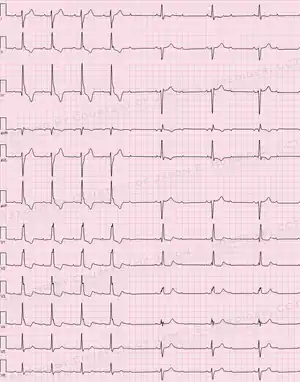 | |
| The later half shows a second degree AV block with a RBBB and left anterior fascicular block | |
 | |
| Specialty | Cardiology |
| Symptoms | None, syncope[1] |
| Diagnostic method | ECG[1] |
| Treatment | Depends on the type and symptoms[1] |
Trifascicular block is a type of electrical conduction problem within the heart were all three pathways between the atria and the ventricles are disrupted to some degree.[1][2] The term is used to describe some combination of a RBBB and either a LAFB or LPFB with an AV block.[1] While often used for 1st and 2nd degree AV blocks some apply it only to 3rd degree AV blocks.[1] The term "true" or "complete" and "incomplete" has been used to distinguish these.[1][2]
Diagnosis is generally by ECG.[1] Risk factors include ischemic heart disease, structural heart disease, aortic stenosis, and congenital heart disease.[1] Reversible causes include high potassium and digoxin toxicity.[1] When a right bundle branch block (RBBB) and left bundle branch block alternate, there is a high risk that a 3rd degree block will occur.[1]
In those with a 3rd degree AV block treatment is generally by placement of a pacemaker.[1] In those with a bifascifular blocks who have had a loss of consciousness a pacemaker may be considered, otherwise no specific treatment is required.[1] Use of the term is not recommended, due to its non specific meaning.[1]
Diagnosis
Diagnosis is generally by ECG.[1]
An electrophysiology study of the conduction system can help discern the severity of conduction system disease. In an electrophysiology study, trifascicular block due to AV nodal disease is represented by a prolonged AH interval (denoting prolonged time from impulse generation in the atria and conduction to the bundle of His) with a relatively preserved HV interval (denoting normal conduction from the bundle of His to the ventricles). Trifascicular block due to distal conduction system disease is represented by a normal AH interval and a prolonged HV interval. In the absence of symptoms, a prolonged AH interval is likely benign while a prolonged HV interval is almost always pathologic.
Treatment
An implantable cardiac pacemaker or permanent pacemaker is recommended in the following clinical circumstances. Class 1 recommendation is the strongest recommendation. Level A evidence is the highest level of evidence.
Class I
- Bifascicular block + complete heart block, even in the absence of symptoms (1b)
- Bifascicular block + 2nd degree AV Block Type 2, even in the absence of symptoms (1b)
- Alternating bundle branch blocks, even in the absence of symptoms (1c)
Class II
- Bifascicular block + syncope + alternative causes ruled out (e.g. orthostasis, arrhythmia) (2a)
Class III
A pacemaker not recommended.
- Bifascicular block without symptoms
- Bifascicular block + 1st degree AV Block, without symptoms
References
- ↑ 1.00 1.01 1.02 1.03 1.04 1.05 1.06 1.07 1.08 1.09 1.10 1.11 1.12 1.13 1.14 Buttner, Robert; Larkin, John; Larkin, Robert Buttner and John (5 January 2021). "Trifascicular Block". Life in the Fast Lane • LITFL. Archived from the original on 24 November 2024. Retrieved 20 December 2024.
- ↑ 2.0 2.1 "Trifascicular Block". ECGbook. 30 July 2024. Archived from the original on 17 February 2025. Retrieved 28 December 2024.
External links
| Classification |
|---|
- http://www.ecglibrary.com/trifas.html Archived 2023-11-28 at the Wayback Machine
- http://circ.ahajournals.org/content/97/13/1325.long - new guidelines in which trifascicular block terminology continues to be used.