Trichosporonosis
| Trichosporonosis | |
|---|---|
| Other names: Trichosporon infection[1] | |
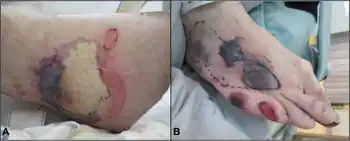 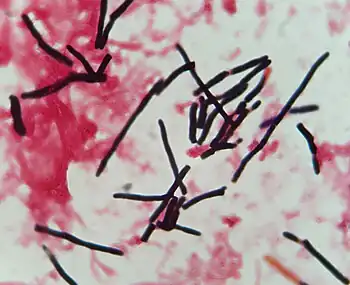 | |
| |
 | |
| Specialty | Infectious disease |
| Symptoms | Fever, skin lesion[2] |
| Types | Invasive, superficial[3] |
| Causes | Trichosporon asahii(most cases)[4] |
| Risk factors | Immunosuppression, Cystic fibrosis, HIV/AIDS[3] |
| Diagnostic method | Microscopic exam of affected tissue[3] |
| Differential diagnosis | Invasive candidiasis, aspergillosis, cryptococcosis[3] |
| Medication | Antifungals (voriconazole, amphotericin B, fluconazole)[3] |
Trichosporonosis is a systemic disease associated with fungi in the genus Trichosporon.It can occur in people who are immunosuppressed.[5]Trichosporon asahii is the predominant cause of Trichosporonosis, especially invasive forms of the infection. While other Trichosporon species can cause infections, T. asahii accounts for the majority of clinical cases and is considered the most pathogenic and lethal species within the genus[4]
Trichosporon species are found worldwide, especially in tropical and temperate regions like South America, Southeast Asia, and parts of the U.S.[6]
Signs and symptoms
In terms of the presentation we find that superficial trichosporonosis, is usually mild and asymptomatic. However invasive trichosporonosis is more serious and occurs in people with weakened immune systems, where symptoms can include:[3][2]
Cause
Trichosporon is a genus of anamorphic fungi in the family Trichosporonaceae. All species of Trichosporon are yeasts with no known teleomorphs. Most are typically isolated from soil, but several species occur as a natural part of the skin microbiota of humans and other animals.Trichosporon asahii is a non-Candida yeast that has been reported to cause infections in immunocompromised patients. T. asahii is the most prominent human pathogen in its genus, causing more than half of all Trichosporon infections[4][7][8]
Risk factors
The risk factors for infection include:[3]
- Immunosuppression
- Chemotherapy
- Neutropenia
- Cystic fibrosis
- Malignancy
Mechanism
Invasive infections often begin with a breach in the mucosal or cutaneous surfaces. This can be due to factors like chemotherapy-induced epithelial damage, severe burns, or the use of intravascular catheters.Trichosporonosis is an opportunistic fungal infection, primarily affecting individuals with weakened immune systems. It starts when Trichosporon fungi, enter the bloodstream, often through damaged skin or medical devices. The fungi then cause disease by forming protective biofilms and producing enzymes(proteases,lipases,esterases) that damage host tissues, leading to potentially severe infections[8][9]
Diagnosis
As to the diagnosis of Trichosporonosis we find that it often involves:[3]
Differential diagnosis
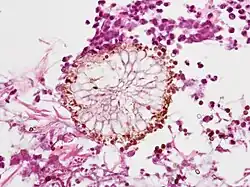
Conditions that may present similar include:[3]
- Invasive candidiasis
- Aspergillosis
- Cryptococcosis
Treatment
In terms of treatment we find that it depends on severity and location of infection, among first-line antifungal therapy there is: voriconazol, posaconazole, and fluconazole[10]
Amphotericin B is another option and should be used for resistant and unresponsive trichosporonosis, combined with voriconazole or micafungin. Echinocandins are ineffective against this fungal infection[3]
Epidemiology
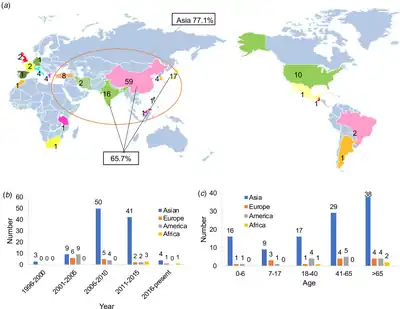
Trichosporonosis between 1997 and 2005 was found it in tropical and temperate areas like:[3]
- South America
- Middle East
- India
- Africa
- Europe
- Japan
History
As to history we find that the discovery of Trichosporonosis is attributed to Hermann Beigel, who first described the genus Trichosporon in 1865. He identified it as the agent responsible for benign hair infection known as white piedra[4]
References
- ↑ "Trichosporonosis (Concept Id: C0343939) - MedGen - NCBI". www.ncbi.nlm.nih.gov. Archived from the original on 8 February 2025. Retrieved 27 June 2025.
- ↑ 2.0 2.1 "Trichosporon Infections Clinical Presentation: History, Physical, Causes". emedicine.medscape.com. Retrieved 5 July 2025.
- ↑ 3.00 3.01 3.02 3.03 3.04 3.05 3.06 3.07 3.08 3.09 3.10 Castano, Gabriel; Yarrarapu, Siva Naga S.; Mada, Pradeep Kumar (2025). "Trichosporonosis". StatPearls. StatPearls Publishing. PMID 29494084. Archived from the original on 2024-04-27. Retrieved 2025-06-26.
- ↑ 4.0 4.1 4.2 4.3 4.4 Li, Haitao; Guo, Meihong; Wang, Congmin; Li, Yibo; Fernandez, Anne Marie; Ferraro, Thomas N.; Yang, Rongya; Chen, Yong (2020). "Epidemiological study ofTrichosporon asahiiinfections over the past 23 years" (PDF). Epidemiology and Infection. 148 e169. Cambridge University Press (CUP). doi:10.1017/s0950268820001624. ISSN 0950-2688. PMC 7439294. PMID 32703332. Archived (PDF) from the original on 2023-12-03. Retrieved 2025-06-24.
- ↑ Marty FM, Barouch DH, Coakley EP, Baden LR (November 2003). "Disseminated trichosporonosis caused by Trichosporon loubieri". J. Clin. Microbiol. 41 (11): 5317–20. doi:10.1128/JCM.41.11.5317-5320.2003. PMC 262469. PMID 14605194.
- ↑ "Trichosporon Infections: Background, Pathophysiology, Epidemiology". eMedicine. 30 September 2024. Archived from the original on 24 June 2025. Retrieved 27 June 2025.
- ↑ Montoya, A. M.; González, G. M. (1 January 2014). "Trichosporon spp.: an emerging fungal pathogen". Medicina Universitaria. 16 (62): 37–43. ISSN 1665-5796. Archived from the original on 2 June 2024. Retrieved 5 July 2025.
- ↑ 8.0 8.1 Colombo, Arnaldo L.; Padovan, Ana Carolina B.; Chaves, Guilherme M. (October 2011). "Current Knowledge of Trichosporon spp. and Trichosporonosis". Clinical Microbiology Reviews. 24 (4): 682–700. doi:10.1128/CMR.00003-11. ISSN 0893-8512. PMC 3194827. PMID 21976604.
- ↑ Duarte-Oliveira, Cláudio; Rodrigues, Fernando; Gonçalves, Samuel M.; Goldman, Gustavo H.; Carvalho, Agostinho; Cunha, Cristina (7 April 2017). "The Cell Biology of the Trichosporon-Host Interaction". Frontiers in Cellular and Infection Microbiology. 7: 118. doi:10.3389/fcimb.2017.00118. ISSN 2235-2988. PMC 5383668. PMID 28439501.
- ↑ "Trichosporon Infections Medication: Antifungal Agent, Systemic". emedicine.medscape.com. Retrieved 3 July 2025.
External links
| Classification | |
|---|---|
| External resources |