Swertia japonica
| Swertia japonica | |
|---|---|
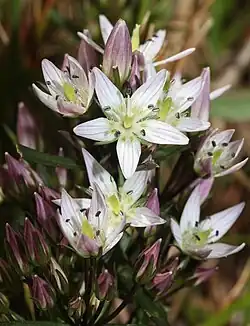 | |
| Swertia japonica in Mount Ibuki | |
Scientific classification  | |
| Kingdom: | Plantae |
| Clade: | Tracheophytes |
| Clade: | Angiosperms |
| Clade: | Eudicots |
| Clade: | Asterids |
| Order: | Gentianales |
| Family: | Gentianaceae |
| Genus: | Swertia |
| Species: | S. japonica |
| Binomial name | |
| Swertia japonica (Schult) Makino[1] | |
| Synonyms[1] | |
|
Synonymy
| |
Swertia japonica, also known as senburi (センブリ), is a biennial plant species in the family Gentianaceae. It is one of the most widely-used medicinal herbs in Japan.
Description
Swertia japonica is a biennial plant native mainly to Japan,[2] but also found in Korea and China.[3] Its leaves are linear and it has small flowers with a corolla diameter of 2 to 3 centimeters. The flowers have five petals and are white with purple veins.[4][5][6] The plant can grow from 5 to 50 centimeters in height.[7][8]
It is said that the plant was named senburi (センブリ) because it tastes bitter even after being boiling a thousand times: the Japanese word sen (せん) meaning 'thousand'.[5][9] It grows wild in meadows and high ground across Japan and is harvested as a medicinal herb.[8] Swertia japonica was first domesticated in the 1970s in Nagano Prefecture. In 2007, 76% of cultivated Swertia japonica in Japan was produced there, with the rest grown in Kochi Prefecture.[10]
The plant is a biennial flowering plant with a two-year biological life cycle. During their first year, seedlings produce several internodes, which elongate after the spring of the second year. The plant can be harvested by the following October, when its flowers open.[11] The plant's seed is tiny and does not germinate readily, so it can easily be defeated by weeds.[10][8] The principal constituents extracted from Swertia japonica are saponins such as swertiamarin, sweroside, amarogentin, amaroswerin, and gentiopicroside.[2] The plant also contains secoiridoids, phenyl glucosides, flavonoids, and xanthones.[12]
The traditional medicinal form of Swertia japonica is known as tōyaku (当薬) in Japan. According to Comprehensive Natural Products II: Chemistry and Biology, it is considered to be one of the most popular medicinal herbs and one of the bitterest herbs in Japan.[2] It was first noted as a medicinal herb in 1892, in the second edition of the Japanese Pharmacopeia, as a substitute for gentian, but was only officially listed in the fourth edition of the Japanese Pharmacopoeia in 1920.[9] It is used as a digestive stimulant[2] and to treat gastrointestinal diseases such as diarrhea and nausea.[13] It has also been found to be an effective anticholinergic.[14] According to Wakan Sansai Zue, a decoction of the herb was used as a laundry additive during the Edo Period to act as an insecticide for fleas and lice. It was also mixed with glue to treat byōbu against insect damage.[5][9]
See also
References
- 1 2 "Swertia japonica (Schult.) Makino". Catalogue of Life. Retrieved July 10, 2025.
- 1 2 3 4 Liu, Hung-Wen; Mander, Lewis (March 5, 2010). Comprehensive Natural Products II: Chemistry and Biology. Elsevier. p. 650. ISBN 978-0-08-045382-8. Retrieved July 9, 2025.
- ↑ Komatsu, Manki; Tomimori, Tsuyoshi; Ito, Michiko (1967). "Studies on the Constituents of Swertia japonica.I. On the Structures of Swertisin and Isoswertisin". Chemical and Pharmaceutical Bulletin. 15 (3): 263–269. doi:10.1248/cpb.15.263. ISSN 0009-2363. PMID 6075478.
- ↑ "Nishi Kanka-kei ni Saita Senburi Ken no Reddo Dēta Bukku de Junzetsumetsukigu" 西寒霞渓に咲いたセンブリ 県のレッドデータブックで準絶滅危惧 [Senburi flowers blooming in the West Kankakei are listed as near-threatened in the prefecture's Red Data Book]. The Asahi Shimbun. November 19, 2024. Retrieved July 10, 2025.
- 1 2 3 Isoda, Susumu. "Senburi Swertia japonica MAKINO (Rindō-ka)" センブリSwertia japonica MAKINO ( リンドウ科 ) [Senburi Swertia japonica MAKINO (Gentianaceae)]. The Phamaceutical Society of Japan. Retrieved July 10, 2025.
- ↑ Mission News. D.C. Greene. 1914. p. 36.
- ↑ Yoichi, Watanabe (November 2, 2023). "The complete chloroplast genome sequence of Swertia japonica (Schult.) Makino (Gentianaceae)". Mitochondrial DNA Part B. 8 (11): 1179–1182. doi:10.1080/23802359.2023.2275335. PMC 10769539. PMID 38188429. Retrieved July 9, 2025.
- 1 2 3 "Senburi to Iu Yakusō o Gozonji Desu ka?" センブリという薬草をご存知ですか? [Have you heard of the medicinal herb called Senburi?]. Nagano Prefecture Official Website. Retrieved July 10, 2025.
- 1 2 3 センブリ [Senburi]. Toho University. Retrieved July 10, 2025.
- 1 2 Kaneko, M.; Tsukagoshi, S.; Ikegami, F.; Yanagisawa, K.; Motoki, S.; Hagihara, Y. (March 2014). "Effect of Cultivars, Plant Age and Altitude of Production Site on Swertiamarin Content in Swertia Japonica". Acta Horticulturae (1023): 295–300. doi:10.17660/ActaHortic.2014.1023.43.
- ↑ Kubo, Michinori; Fukada, Shinzo; Katsushiro, Tadahisa. Yakusō Nyūmon 薬草入門 [Introduction to Medicinal Herbs]. Hoikusha. p. 25. ISBN 9784586505159.
- ↑ Rahman, Atta-ur (July 24, 1995). Studies in Natural Products Chemistry: Structure and Chemistry (Part D). Elsevier. p. 434. ISBN 978-0-08-054198-3.
- ↑ Kimura, Yoshiyuki; Sumiyoshi, Maho (September 1, 2011). "Effects of Swertia japonica extract and its main compound swertiamarin on gastric emptying and gastrointestinal motility in mice". Fitoterapia. 82 (6): 827–833. doi:10.1016/j.fitote.2011.04.008. PMID 21571047.
- ↑ Yamahara, Johji; Kobayashi, Makoto; Matsuda, Hisashi; Aoki, Shunji (May 1991). "Anticholinergic action of Swertia japonica and an active constituent". Journal of Ethnopharmacology. 33 (1–2): 31–35. doi:10.1016/0378-8741(91)90157-9. PMID 1943170.

