Reticular cell
| Reticular cell | |
|---|---|
| Details | |
| Function | Collagen synthesis |
| Identifiers | |
| Latin | cellula reticularis~cells |
| MeSH | D012155 |
| TH | H2.00.03.0.01004 |
| FMA | 62877 |
| Anatomical terms of microanatomy | |
Introduction, Origin, and Subtypes of Reticular Cells
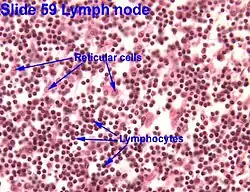
In cellular biology, a reticular cell is a type of fibroblast that synthesizes collagen alpha-1(III) and uses it to produce extracellular reticular fibers. Reticular cells provide structural support, since they produce and maintain the thin networks of fibers that are a framework for most lymphoid organs.
Reticular cells are found in many organs, including the spleen, lymph nodes and kidneys. They are also found within tissues, such as lymph nodules. There are different types of reticular cells, including epithelial, mesenchymal, and fibroblastic reticular cells. Fibroblastic reticular cells are involved in directing B cells and T cells to specific regions within the tissue whereas epithelial and mesenchymal reticular cells are associated with certain areas of the brain.
These cells are not limited to a single location or form; instead, they encompass several subtypes, each with a unique molecular profile and developmental origin. In lymph nodes, for example, reticular cells form the foundation of the reticular network that supports immune cell interactions, while in the spleen, similar reticular cells help regulate immune filtration and activation processes. The origin of reticular cells can be traced to mesenchymal stromal precursors, which differentiate into various structural support cells depending on their tissue environment. As shown by Lütge, Pikor, and Ludewig (2021), reticular cells in secondary lymphoid organs are not a single homogeneous group, but a diverse population of subtypes defined by their anatomic position and expression of molecular markers such as podoplanin and ER-TR7.
Role in B and T Cell Production/Homeostasis
Function in Disease and Immunity/Clinical Relevance
Future Applications
See also
References
- Cremasco, V., Woodruff, M. C., Onder, L., Cupovic, J., Nieves-Bonilla, J. M., Schildberg, F. A., Chang, J., Harvey, C. J., Wucherpfennig, B., Ludewig, B., Carroll, M. C., & Turley, S. J. (2014). B cell homeostasis and follicle confines are governed by fibroblastic reticular cells. Nature Immunology, 15(8), 973–981. https://doi.org/10.1038/ni.2965
- Li, L., Lu, Y., Zhou, L., Shi, S., Zhu, X., & Zhang, L. (2021). Lymph node fibroblastic reticular cells steer immune responses. Trends in Immunology. https://doi.org/10.1016/j.it.2021.06.002
- Link, A., Vogt, T. K., Favre, S., Britschgi, M. R., Acha-Orbea, H., Hinz, B., Cyster, J. G., & Luther, S. A. (2007). Fibroblastic reticular cells in lymph nodes regulate the homeostasis of naïve T cells. Nature Immunology, 8(11), 1255–1265. https://doi.org/10.1038/ni1513
- Lütge, M., Pikor, N. B., & Ludewig, B. (2021). Differentiation and activation of fibroblastic reticular cells. Immunological Reviews, 302(1), 32–46. https://doi.org/10.1111/imr.12981
- Mueller, S. N., & Germain, R. N. (2015). Stromal cell contributions to the homeostasis and functionality of the immune system. Nature Reviews Immunology, 15(12), 729–740. https://doi.org/10.1038/nri3846
- Onder, L., Papadopoulou, C., Lütge, A., Cheng, H.-W., Lütge, M., Perez-Shibayama, C., Gil-Cruz, C., De Martin, A., Kurz, L., Cadosch, N., Pikor, N. B., Rodriguez, R., Born, D., Jochum, W., Leskow, P., Dutly, A., Robinson, M. D., & Ludewig, B. (2025). Fibroblastic reticular cells generate protective intratumoral T cell environments in lung cancer. Cell, 188(2), 430–446. https://doi.org/10.1016/j.cell.2024.10.042
- Schat, K. A., Kaspers, B., & Kaiser, P. (2014). Structure of the Avian Lymphoid System. In I. Olah, N. Nagy & L. Vervelde (Eds.), Avian Immunology (2nd ed., pp. 11-44). Academic Press.