Out-of-pocket expense (health care)
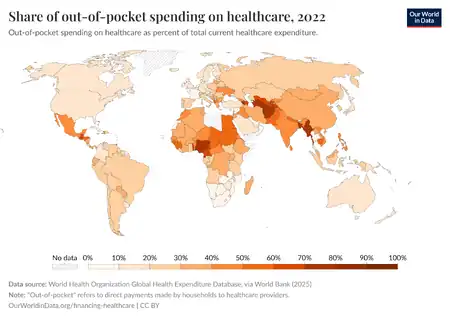
An out-of-pocket expense, or out-of-pocket cost (OOP), is the direct payment of money that may or may not be later reimbursed from a third-party source. Organizations often reimburse out-of-pocket expenses incurred on their behalf, especially expenses incurred by employees on their employers' behalf. In the United States, out-of-pocket expenses for such things as charity, medical bills, and education may be deductions on US income taxes, according to IRS regulations. To be out of pocket is to have expended personal resources, often unexpectedly or unfairly, at the end of some enterprise.
Health financing
In the health care financing sector, this represents the share of the expenses that the insured party must pay directly to the health care provider, without a third-party (insurer, or government).[2]
United States
Out-of-pocket costs are high especially when it comes to prescription drugs in the United States.[3] Before investing in a health care plan, it is very useful to examine the out-of-pocket prescription costs as they may be very low or very high. High out-of-pocket costs may correlate with lower prescription adherence and more importation of medications from foreign countries.[4][5][6] Medicare Part D is a federal program aimed at lowering prescription drug costs for Medicare beneficiaries; however, after the first year of Medicare Part D, out-of-pocket drug costs were down, but there was not a noticeable reduction in emergency department visits, hospitalization, or health utility score. Perhaps, some diseases will be more sensitive to Medicare Part D.[7][8]
Australia
A 2014 study published from Australia shows that the out-of-pocket cost burden falls most heavily on patients who are least able to bear it, both in terms of their health and in terms of their income. Among the respondents 14% experienced a heavy financial burden. Medication and medical service expenses were the major costs. This study concluded that despite Australia's universal health coverage (medicare) a substantial portion of senior citizens suffer from excessive out-of-pocket expenditure, and this burden increases with increasing number of chronic conditions. Among the specific conditions, those who experienced cancer, high blood pressure, diabetes or depression were likely to report higher out-of-pocket expenditure.[9] Some ways to improve physician knowledge of drug costs were thought to be increased physician-patient communication or higher use of information technology. Physicians with high rates of IT use did not have significantly higher knowledge or drug costs. Health IT design should be improved to make it easier for physicians to access cost information at the point of care.[10]
See also
- Car costs
- Capital goods
- Personal finance
References
- ↑ "Topic: Out-of-pocket health care spending in the U.S." Statista. Retrieved 13 July 2025.
- ↑ McWilliams JM, Meara E, Zaslavsky AM, Ayanian JZ (2007). "Use of health services by previously uninsured Medicare beneficiaries". N Engl J Med. 357 (2): 143–53. doi:10.1056/NEJMsa067712. PMID 17625126.
- ↑ Hurd MD, Martorell P, Delavande A, Mullen KJ, Langa KM (2013). "Monetary costs of dementia in the United States". N Engl J Med. 368 (14): 1326–34. doi:10.1056/NEJMsa1204629. PMC 3959992. PMID 23550670.
- ↑ Zullo, AR; Howe, CJ; Galárraga, O (2 February 2016). "Estimating the Effect of Health Insurance on Personal Prescription Drug Importation". Medical Care Research and Review. 74 (2): 178–207. doi:10.1177/1077558716629039. PMC 4970983. PMID 26837427.
- ↑ Kogan MD, Newacheck PW, Blumberg SJ, Ghandour RM, Singh GK, Strickland BB, et al. (2010). "Underinsurance among children in the United States". N Engl J Med. 363 (9): 841–51. doi:10.1056/NEJMsa0909994. PMID 20818845.
- ↑ Zullo, Andrew R.; Dore, David D.; Galárraga, Omar (March 2015). "Development and validation of an index to predict personal prescription drug importation by adults in the United States". Journal of Pharmaceutical Health Services Research. 6 (1): 33–41. doi:10.1111/jphs.12088. PMC 4930104. PMID 27375777.
- ↑ Baicker K, Taubman SL, Allen HL, Bernstein M, Gruber JH, Newhouse JP, et al. (2013). "The Oregon experiment--effects of Medicaid on clinical outcomes" (PDF). N Engl J Med. 368 (18): 1713–22. doi:10.1056/NEJMsa1212321. hdl:1721.1/82640. PMC 3701298. PMID 23635051.
- ↑ The Impact Of Medicare Part D On Prescription Drug Use By The Elderly Archived 2016-04-22 at the Wayback Machine. Content.healthaffairs.org. Retrieved on 2011-04-17.
- ↑ Islam, MM; Yen, L; Valderas, JM & McRae, I (2014). "Out-of-pocket expenditure by Australian seniors with chronic disease: the effect of specific diseases and morbidity clusters". BMC Public Health. 14: 1008. doi:10.1186/1471-2458-14-1008. PMC 4182884. PMID 25260348.
- ↑ "Health Information Technology | CodingAndBillingCareer.org". Archived from the original on 2014-09-15. Retrieved 2014-09-14.