Isonipecotic acid
 | |
 | |
| Clinical data | |
|---|---|
| Other names | Piperidine-4-carboxylic acid; P4C; 4-Piperidinecarboxylic acid; Hexahydroisonicotinic acid; 4-Carboxypiperidine |
| Identifiers | |
IUPAC name
| |
| CAS Number | |
| PubChem CID | |
| IUPHAR/BPS | |
| ChemSpider | |
| UNII | |
| ChEMBL | |
| CompTox Dashboard (EPA) | |
| ECHA InfoCard | 100.007.158 |
| Chemical and physical data | |
| Formula | C6H11NO2 |
| Molar mass | 129.159 g·mol−1 |
| 3D model (JSmol) | |
SMILES
| |
InChI
| |
  (what is this?) (verify) (what is this?) (verify) | |
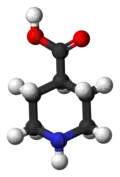
Isonipecotic acid, also known as piperidine-4-carboxylic acid (P4C), is a conformationally constrained derivative of γ-aminobutyric acid (GABA) and a moderately potent GABAA receptor partial agonist.[1][2][3] It consists of a piperidine ring with a carboxylic acid moiety in the iso position.[1] The drug showed moderate-efficacy partial agonism of α1, α2, α3, and α5 subunit-containing GABAA receptors (Emax = 46–57%), but showed full or near-full agonism of α4 and α6 subunit-containing GABAA receptors (Emax = 83–104%).[2] Isonipecotic acid is unable to cross the blood–brain barrier.[4] It was first described in the scientific literature by at least 1944[5] and was identified as a GABAA receptor agonist by 1978.[6]
See also
- Piperidine-4-sulfonic acid (P4S)
- Isoguvacine
- Gaboxadol
- Muscimol
- Nipecotic acid
References
- 1 2 Kerr DI, Ong J (November 1992). "GABA agonists and antagonists". Medicinal Research Reviews. 12 (6): 593–636. doi:10.1002/med.2610120604. PMID 1331633.
- 1 2 Frølund B, Ebert B, Kristiansen U, Liljefors T, Krogsgaard-Larsen P (August 2002). "GABA(A) receptor ligands and their therapeutic potentials". Current Topics in Medicinal Chemistry. 2 (8): 817–832. doi:10.2174/1568026023393525. PMID 12171573.
- ↑ Mortensen M, Kristiansen U, Ebert B, Frølund B, Krogsgaard-Larsen P, Smart TG (June 2004). "Activation of single heteromeric GABA(A) receptor ion channels by full and partial agonists". The Journal of Physiology. 557 (Pt 2): 389–413. doi:10.1113/jphysiol.2003.054734. PMC 1665090. PMID 14990676.
- ↑ Crider AM, Tita TT, Wood JD, Hinko CN (November 1982). "Esters of nipecotic and isonipecotic acids as potential anticonvulsants". Journal of Pharmaceutical Sciences. 71 (11): 1214–1219. Bibcode:1982JPhmS..71.1214M. doi:10.1002/jps.2600711108. PMID 7175711.
Isonipecotic acid (Ib) was shown to be a potent and specific y-aminobutyric acid agonist in the [3H]y-aminobutyric acid-binding assay procedure (13,14). As in the case of nipecotic acid, isonipecotic acid was also too polar to penetrate the blood-brain barrier.
- ↑ Wibaut JP (1944). "The preparation of pyridine-4-carboxylic acid and of piperidine-4-carboxylic acid by catalytic reduction of 2,6-dichloropyridine-4-carboxylic acid". Recueil des Travaux Chimiques des Pays-Bas. 63 (7): 141–146. doi:10.1002/recl.19440630704. ISSN 0165-0513. Retrieved 6 October 2025.
- ↑ Bowery NG, Collins JF, Hudson AL, Neal MJ (September 1978). "Isoguvacine, isonipecotic acid, muscimol and N-methyl isoguvacine on the GABA receptor in rat sympathetic ganglia". Experientia. 34 (9): 1193–1195. doi:10.1007/BF01922953. PMID 214333.