Inversion therapy
| Inversion therapy | |
|---|---|
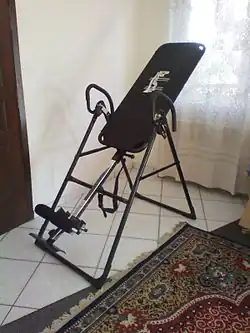 Foldable inversion table, extended and set up for use. | |
| Specialty | Physical therapy |
Inversion therapy, or simply inversion, is the process of seeking therapeutic benefits from hanging by the legs, ankles, or feet in an inverted angle or entirely upside down. It is a form of spinal traction.[1] Gravity boots are ankle supports designed for inversion therapy.[2] Some people use gravity boots to add an extra challenge to workouts, doing inverted crunches or squats.[3]
People who have heart disease, high blood pressure, eye diseases (such as glaucoma), or are pregnant are at higher risk for the dangers related to inversion therapy and should consult their doctors about it first.[4] The first time anyone tries inversion therapy with gravity, they should be sure to have someone standing by, in case assistance is required to get out of the apparatus, or if health problems are experienced.[1]
During an episode of acid reflux, small amounts of stomach acid may manage to escape from the stomach and into the oesophagus. Gravity typically minimizes this upward leakage, but an inversion table and acid reflux can be a painful, nauseating, and potentially dangerous combination.[5] The inverted position, leading to an increase in heart rate and output, peripheral resistance, venous return and myocardial oxygen consumption, is not recommended in cardiac individuals.[6]
Clinical evidence
A 2021 study of 85 patients with lumbar disc disease and sciatica found that those who used inversion therapy experienced reduced symptoms and a lower rate of surgery compared with matched controls. Within one year, 16 % of patients in the inversion group underwent surgery and 21 % within two years, compared with 43 % of contemporaneous controls.[7]
Regulation
In the United States, inversion tables that make therapeutic claims—such as for back pain, sciatica, or herniated discs—are regulated by the U.S. Food and Drug Administration (FDA) as Class I non-powered orthopedic traction devices (product code HST).[8] Manufacturers must register their devices with the FDA and, for certain models, obtain 510(k) pre-market clearance demonstrating substantial equivalence to a legally marketed device. One example is the Teeter inversion table, cleared under 510(k) number K162702 for use in providing traction to stretch the spine and relieve back pain.[9] Consumers can confirm a product’s registration or clearance status using the FDA’s public [Device Registration and Listing Database](https://www.accessdata.fda.gov/scripts/cdrh/cfdocs/cfRL/rl.cfm) or [510(k) Premarket Notification database](https://www.accessdata.fda.gov/scripts/cdrh/cfdocs/cfpmn/pmn.cfm).[10]
Safety and quality verification
Underwriters Laboratories (UL) has established a voluntary safety standard for inversion tables under UL 1647: Motor-Operated Massage and Exercise Machines. The standard is not required by law, and only some manufacturers choose to have their products independently evaluated for compliance.[11] Testing under UL 1647 includes assessments of structural integrity, mechanical endurance, and stability—such as repeated inversion (or motion) cycles at maximum rated user weight, load testing of structural components, durability checks for user-support mechanisms, and verification of stability under various inversion angles.[12] Products that have been certified to UL 1647 display a UL mark on the product or its packaging, indicating that the specific model was tested and met the standard’s safety requirements.
Additional images
References
- 1 2 Spinal Traction can be useful for effects of decreasing muscle spasm, stretching muscles/ligaments of the back, increasing the space between vertebral bodies and thus rehydrating the intervertebral discs, decreasing disc bulging and decreasing pressure on nerve roots and the spinal cord. In turn, these effects can help for the reduction of pain and increasing tissue repair.
Laskowski, Edward R., M.D. (June 9, 2014). "Does inversion therapy relieve back pain? Is it safe?". Mayo Clinic. Retrieved July 11, 2015.
{{cite web}}: CS1 maint: multiple names: authors list (link) - ↑ "Brown plays down Code controversy" BBC; 24 April 2006
- ↑ "Hang Ten". Time. 2 May 1983.
- ↑ "Everything You Need To Know About Inversion Tables". Forbes Health. 2021-08-24. Retrieved 2022-11-28.
- ↑ Lasich, Christina, M.D. (March 7, 2011). "The Upsides and Downsides of Inversion Therapy". HealthCentral. Retrieved July 11, 2015.
{{cite web}}: CS1 maint: multiple names: authors list (link) - ↑ Heng, M.; Bai, J.; Talian, N.; Vincent, W.; Reese, S.; Shaw, S.; Holland, G. (January 1992). "Changes in Cardiovascular Function during Inversion". International Journal of Sports Medicine. 13 (1): 69–73. doi:10.1055/s-2007-1021238. ISSN 0172-4622. PMID 1544738.
- ↑ Hung J, Tsai Y. "Effect of inversion therapy on pain, disability, and surgery rates in patients with lumbar disc disease." Journal of Physical Therapy Science. 2021; 33(5): 394–399. doi:10.1589/jpts.33.394 . PMID 34025771.
- ↑ "FDA Product Classification: Apparatus, Traction, Non-Powered (HST)". U.S. Food and Drug Administration. Retrieved 25 October 2025.
- ↑ "510(k) Premarket Notification K162702 – Teeter Manual Inversion Table and Accessories". U.S. Food and Drug Administration. Retrieved 25 October 2025.
- ↑ "FDA Device Registration and Listing Database". U.S. Food and Drug Administration. Retrieved 25 October 2025.
- ↑ Underwriters Laboratories. "UL 1647 – Motor-Operated Massage and Exercise Machines." Accessed 25 October 2025.
- ↑ EUROLAB Testing Services. "UL 1647 – Motor-Operated Massage and Exercise Machines." Accessed 25 October 2025.