Infigratinib
 | |
| Names | |
|---|---|
| Trade names | Truseltiq |
| Other names | BGJ-398 |
| Clinical data | |
| Drug class | Tyrosine kinase inhibitor |
| Main uses | Cholangiocarcinoma (bile duct cancer)[1] |
| Side effects | Finger nail problems, mouth inflammation, dry eyes, tiredness, hair loss, joint pain, constipation, abdominal pain, eye problems.[1] |
| Pregnancy category | |
| Routes of use | By mouth |
| External links | |
| AHFS/Drugs.com | Monograph |
| Legal | |
| License data |
|
| Legal status | |
| Chemical and physical data | |
| Formula | C26H31Cl2N7O3 |
| Molar mass | 560.48 g·mol−1 |
| 3D model (JSmol) | |
SMILES
| |
InChI
| |
Infigratinib, sold under the brand name Truseltiq, is a medication used to treat cholangiocarcinoma (bile duct cancer).[1] Specifically it is used for advanced disease with a fibroblast growth factor receptor 2 (FGFR2) fusion or other rearrangement that has failed other treatments.[1] It is taken by mouth.[1]
Common side effects include finger nail problems, mouth inflammation, dry eyes, tiredness, hair loss, joint pain, constipation, abdominal pain, and eye problems.[1] Common lab abnormalities include kidney problems, low phosphate, high calcium, low potassium, and low sodium.[1] Use in pregnancy may harm the baby.[1] It is a kinase inhibitor of fibroblast growth factor receptors FGFR1, FGFR2 and FGFR3.[1]
Infigratinib was approved for medical use in the United States in 2021.[1] As of 2022 it is not approved in the United Kingdom or Europe, though has orphan status.[6] In the United States it costs about 10,700 USD per 4 week cycle.[7]
Medical uses
Infigratinib is indicated for the treatment of adults with previously treated, unresectable locally advanced or metastatic cholangiocarcinoma (bile duct cancer) with a fibroblast growth factor receptor 2 (FGFR2) fusion or other rearrangement as detected by an FDA-approved test.[5]
Dosage
It is generally used at a dose of 125 mg once per day for 21 days followed by 7 days off, which is than repeated.[1] A lower dose is used in people with kidney or liver problems.[1]
Mechanism of action
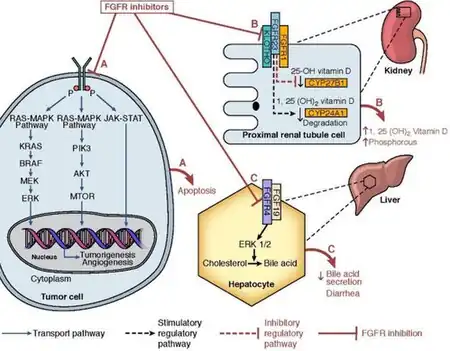
In terms of the mode of action we find that Infigratinib works by blocking abnormal proteins that cause cancer cells to multiply. Infigratinib binds and stops the activities of FGFRs, which inhibits tumor angiogenesis (and tumor cell proliferation).[9][8]
History
It was designated an orphan drug by the U.S. Food and Drug Administration (FDA) in 2019.[10]
References
- ↑ 1.00 1.01 1.02 1.03 1.04 1.05 1.06 1.07 1.08 1.09 1.10 1.11 "DailyMed - TRUSELTIQ- infigratinib capsule". dailymed.nlm.nih.gov. Archived from the original on 10 June 2021. Retrieved 29 October 2022.
- ↑ 2.0 2.1 "Truseltiq". Therapeutic Goods Administration (TGA). 22 November 2021. Archived from the original on 28 December 2021. Retrieved 28 December 2021.
- ↑ "Updates to the Prescribing Medicines in Pregnancy database". Therapeutic Goods Administration (TGA). 12 May 2022. Archived from the original on 3 April 2022. Retrieved 13 May 2022.
- ↑ "Summary Basis of Decision (SBD) for Truseltiq". Health Canada. 23 October 2014. Archived from the original on 29 May 2022. Retrieved 29 May 2022.
- ↑ 5.0 5.1 "Truseltiq- infigratinib capsule". DailyMed. Archived from the original on 10 June 2021. Retrieved 10 June 2021.
- ↑ "Infigratinib". SPS - Specialist Pharmacy Service. 14 January 2020. Archived from the original on 2 December 2021. Retrieved 29 October 2022.
- ↑ "Truseltiq". Archived from the original on 29 October 2022. Retrieved 29 October 2022.
- ↑ 8.0 8.1 Kommalapati, Anuhya; Tella, Sri Harsha; Borad, Mitesh; Javle, Milind; Mahipal, Amit (13 June 2021). "FGFR Inhibitors in Oncology: Insight on the Management of Toxicities in Clinical Practice". Cancers. 13 (12): 2968. doi:10.3390/cancers13122968. ISSN 2072-6694. Archived from the original on 8 December 2022. Retrieved 16 June 2024.
{{cite journal}}: CS1 maint: unflagged free DOI (link) - ↑ Zhang, Pei; Yue, Lin; Leng, QingQing; Chang, Chen; Gan, Cailing; Ye, Tinghong; Cao, Dan (3 June 2024). "Targeting FGFR for cancer therapy". Journal of Hematology & Oncology. 17 (1): 39. doi:10.1186/s13045-024-01558-1. ISSN 1756-8722. Archived from the original on 6 June 2024. Retrieved 16 June 2024.
{{cite journal}}: CS1 maint: unflagged free DOI (link) - ↑ "Infigratinib Orphan Drug Designations and Approvals". U.S. Food and Drug Administration (FDA). 11 September 2019. Archived from the original on 28 October 2022. Retrieved 30 May 2021.
External links
| External sites: |
|
|---|---|
| Identifiers: |
- Clinical trial number NCT02150967 for "A Phase II, Single Arm Study of BGJ398 in Patients With Advanced Cholangiocarcinoma" at ClinicalTrials.gov