Heyndrickxia coagulans
| Heyndrickxia coagulans | |
|---|---|
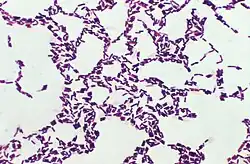 | |
| Gram stain of Heyndrickxia coagulans | |
Scientific classification  | |
| Domain: | Bacteria |
| Kingdom: | Bacillati |
| Phylum: | Bacillota |
| Class: | Bacilli |
| Order: | Bacillales |
| Family: | Heyndrickxiaceae |
| Genus: | Heyndrickxia |
| Species: | H. coagulans |
| Binomial name | |
| Heyndrickxia coagulans (Hammer 1915) Narsing Rao et al. 2023 | |
| Synonyms | |
| |
Heyndrickxia coagulans (formerly Bacillus coagulans) is a lactic acid–forming bacterial species. This species was transferred to Weizmannia in 2020,[1][2] then to Heyndrickxia in 2023.[3][2]
Description
H. coagulans is a catalase-positive, spore-forming, motile, facultative anaerobe rod shaped microbe. H. coagulans is usually seen as Gram positive when a Gram stain test is performed. However, if the Gram stain test is performed while H. coagulans is entering the stationary phase of growth the microbe may appear Gram negative.[2] H. coagulans grows best at 50 °C (122 °F), but the microbe can sustain growth for a temperature range of 30–55 °C (86–131 °F).[2]
Taxonomic history
The species was first isolated and described in 1915 by B.W. Hammer at the Iowa Agricultural Experiment Station as a cause of an outbreak of coagulation in evaporated milk packed by an Iowa condensary.[4] Separately isolated in 1935 and described as Lactobacillus sporogenes in the fifth edition of Bergey's Manual of Systematic Bacteriology, it exhibits characteristics typical of both genera Lactobacillus and Bacillus; its taxonomic position between the families Lactobacillaceae and Bacillaceae was often debated. However, in the seventh edition of Bergey's, it was finally transferred to the genus Bacillus.[2][5]DNA-based technology was used in distinguishing between the two genera of bacteria, which are morphologically similar and possess similar physiological and biochemical characteristics.[6][7]
In 2020, further genetic evidence shows that it is sufficiently different from other members of Bacillus to be transferred into its own genus. As a result, it became the type species of Weizmannia.[1] In 2023, even further genetic evidence shows that Weizmannia was not sufficiently distinct from Heyndrickxia to be an independent genus; as a result, all members of Weizmannia were moved to Heyndrickxia.[3]
One Health
Human health and probiotic qualities
Heyndrixia coagulans is a probiotic which can prove beneficial for a variety of health outcomes. Additionally, this microbe has been found to have potential in preventing cancer with its antipruritic and anti allergenic properties.[8] One unique benefit of H. coagulans is its ability to improve exercise performance. It does this by speeding up the digestion of food in the digestive tract which can help the body absorb essential amino acids (EAA) necessary for improving skeletal muscle mass and lessening muscle damage. Along with EAA, calcium, magnesium, and other important minerals can be absorbed faster. Intestinal epithelial cells form a lining around the intestinal tract to act as a barrier against pathogens while also regulating the absorption of nutrients and water. H. coagulans has the ability to provide nutrients to the epithelial cells, increasing their ability to stick to the intestinal tract and stop pathogen invasion.[9] The strengthening of the intestinal barrier by H. coagulans also serves to treat injuries caused by the alkalizing agent cyclophosphamide (CTX), which is a drug that has been increasingly used to treat cancer. While CTX has also been used to treat autoimmune and hereditary immunological disorders, it can negatively impact the microbiota. H. coagulans is able to help restore the damage done by CTX with its probiotic properties. Another beneficial function of this microbe is that is can reduce oxidative stress by enchaining the activity of essential enzymes which maintain the structure and function of cell membranes. Oxidative stress is caused by an overabundance of free radicals in the cells membrane which can disrupt the body's homeostasis. As a gram-positive bacterium containing lipopolysaccharides in the membrane, H. coagulans can act as an activator of the innate immune response. By increasing the production of the enzymes glutathione peroxidase and superoxide dismutase, the microbe can halt peroxidation reactions and restore the cellular membrane. H. coagulans also produces essential nutrients including niacin, biotin, vitamin B6, vitamin B12, and folic acid which are essential for the bodies metabolic processes[10].
Environmental health
In addition to possessing probiotic qualities that improve human health, research shows that H. coagulans can positively impact certain aspects of environmental health. One of the most notable processes that H. coagulans is able to perform is the conversion of certain organic wastes to lactic acid, which can then be used in a variety of day-to-day substances such as preservatives[11] and cosmetics.[12]
H. coagulans is a thermotolerant bacteria. It is able to use thermotolerant fermentation to successfully convert food waste, like apple and tomato pomaces, into lactic acid. H. coagulans carries out this process by consuming glucose from the food waste and converting it to pyruvate and ATP. The pyruvate is then converted to lactic acid. H. coagulans is able to preform a very high glucose to lactic acid conversion, so very little excess waste is produced. This process provides a way for certain food waste to be reused rather than simply discarded.[13]
Uses
H. coagulans was added to the EFSA to their Qualified Presumption of Safety in 2007 and is still approved as of 2024.[14][15] H. coagulans is also approved for human and animal consumption as GRAS by the U.S. Food and Drug Administration because H. coagulans does not contain mobile genetic elements.[8][16] It is often used in veterinary applications, especially as a probiotic in pigs, cattle, poultry, and shrimp. In humans, H. coagulans has been see to regulate symptoms of irritable bowel syndrome, including diarrhea, constipation, and dehydration, promote normal flora particularly in the reproductive system, and balance immune response.[17][18][19] When consumed orally, H. coagulans has also been effective in both treating as well as preventing recurrence of Clostridioides difficile associated diarrhea in mice.[20][21] Further, one animal research study showed that it can alter inflammatory processes in the context of multiple sclerosis.[22] One strain of this bacterium has also been assessed for safety as a food ingredient.[23] Spores are activated in the acidic environment of the stomach and begin germinating and proliferating in the intestine. Sporeforming H. coagulans strains are used in some countries as probiotics for patients on antibiotics.
Marketing
H. coagulans is often marketed as Lactobacillus sporogenes or a 'sporeforming lactic acid bacterium' probiotic, but this is an outdated name due to taxonomic changes in 1939. Although H. coagulans does produce L+lactic acid, the bacterium used in these products is not a lactic-acid bacterium, as Bacillaceae species do not belong to the lactic acid bacteria (Lactobacillales). By definition, lactic acid bacteria (Lactobacillus, Bifidobacterium) do not form spores. Therefore, using the name Lactobacillus sporogenes is scientifically incorrect.[6][24]
The 2023 name H. coagulans is nowhere as common as the former name Bacillus coagulans. The former name remains valid under the Prokaryotic Code.
References
- 1 2 Gupta RS, Patel S, Saini N, Chen S (2020-11-01). "Robust demarcation of 17 distinct Bacillus species clades, proposed as novel Bacillaceae genera, by phylogenomics and comparative genomic analyses: description of Robertmurraya kyonggiensis sp. nov. and proposal for an emended genus Bacillus limiting it only to the members of the Subtilis and Cereus clades of species". International Journal of Systematic and Evolutionary Microbiology. 70 (11): 5753–5798. doi:10.1099/ijsem.0.004475. ISSN 1466-5026. PMID 33112222.
- 1 2 3 4 5 García G, Soto J, Díaz A, Barreto J, Soto C, Pérez AB, Boffill S, Gutiérrez Á, Cano Rd (2024-12-13). "Clinical and In Vitro Safety of Heyndrickxia coagulans AO 1167B: A Double-Blind, Placebo-Controlled Trial". Microorganisms. 12 (12): 2584. doi:10.3390/microorganisms12122584. ISSN 2076-2607. PMC 11677179. PMID 39770785.
- 1 2 Narsing Rao MP, Banerjee A, Liu GH, Thamchaipenet A (July 2023). "Genome-based reclassification of Bacillus acidicola, Bacillus pervagus and the genera Heyndrickxia, Margalitia and Weizmannia". International Journal of Systematic and Evolutionary Microbiology. 73 (7). doi:10.1099/ijsem.0.005961. PMID 37462355.
- ↑ Hammer, B. W. 1915. Bacteriological studies on the coagulation of evaporated milk. Iowa Agric. Exp. Stn. Res. Bull. 19:119-131
- ↑ "LACTOBACILLUS SPOROGENES OR BACILLUS COAGULANS: MISIDENTIFICATION OR MISLABELLING?" (PDF). Archived from the original on 2010-11-05. Retrieved 2007-01-16.
- 1 2 "Lactobacillus sporogenes a probiotioc species ?". www.food-info.net.
- ↑ "Official list of bacterial names". Archived from the original on 2007-10-30. Retrieved 2007-11-02.
- 1 2 Li, Y., et al. "Progress of Research and Application of Heyndrickxia Coagulans (Bacillus Coagulans) as Probiotic Bacteria." Frontiers in Cellular and Infection Microbiology, vol. 14, 2024, p. 1415790, https://doi.org/10.3389/fcimb.2024.1415790
- ↑ Aida, Masanori, et al. "Heyndrickxia coagulans Strain SANK70258 Suppresses Symptoms of Upper Respiratory Tract Infection via Immune Modulation: A Randomized, Double-Blind, Placebo-Controlled, Parallel-Group, Comparative Study." Frontiers in Immunology, vol. 15, 17 June 2024, doi:10.3389/fimmu.2024.1389920.
- ↑ Li, Y., et al. "Progress of Research and Application of Heyndrickxia Coagulans (Bacillus Coagulans) as Probiotic Bacteria." Frontiers in Cellular and Infection Microbiology, vol. 14, 2024, p. 1415790, https://doi.org/10.3389/fcimb.2024.1415790
- ↑ Tavares LM, de Jesus LC, da Silva TF, Barroso FA, Batista VL, Coelho-Rocha ND, Azevedo V, Drumond MM, Mancha-Agresti P (2020-11-04). "Novel Strategies for Efficient Production and Delivery of Live Biotherapeutics and Biotechnological Uses of Lactococcus lactis: The Lactic Acid Bacterium Model". Frontiers in Bioengineering and Biotechnology. 8 517166. doi:10.3389/fbioe.2020.517166. ISSN 2296-4185. PMC 7672206. PMID 33251190.
- ↑ Tang SC, Yang JH (2018-04-10). "Dual Effects of Alpha-Hydroxy Acids on the Skin". Molecules. 23 (4): 863. doi:10.3390/molecules23040863. ISSN 1420-3049. PMC 6017965. PMID 29642579.
- ↑ Paniagua-García AI, Garita-Cambronero J, González-Rojo S, Díez-Antolínez R (August 2024). "Optimization of lactic acid production from apple and tomato pomaces by thermotolerant bacteria". Journal of Environmental Management. 366 121806. Bibcode:2024JEnvM.36621806P. doi:10.1016/j.jenvman.2024.121806. PMID 39003899.
- ↑ Panel EB, Allende A, Alvarez-Ordóñez A, Bover-Cid S, Chemaly M, De Cesare A, Nauta M, Peixe L, Skandamis P (2025-07-07), Microbiological agents as notified to EFSA, Zenodo, doi:10.5281/zenodo.15827510, retrieved 2025-10-28
- ↑ Allende A, Alvarez-Ordóñez A, Bortolaia V, Bover-Cid S, De Cesare A, Dohmen W, et al. (EFSA Panel on Biological Hazards (BIOHAZ)) (2025). "Update of the list of qualified presumption of safety (QPS) recommended microbiological agents intentionally added to food or feed as notified to EFSA 21: Suitability of taxonomic units notified to EFSA until September 2024". EFSA Journal. 23 (1) e9169. doi:10.2903/j.efsa.2025.9169. ISSN 1831-4732. PMC 11744300. PMID 39834754.
- ↑ Prakit B, Chaiyod R, Khongkool K, Chanasit W, Lertworapreecha M (2025-01-20). "Multifunctional probiotic and safety attributes Heyndrickxia coagulans isolated from stingless bee honey". Annals of Microbiology. 75 (1): 3. doi:10.1186/s13213-025-01791-0. ISSN 1869-2044.
- ↑ Liang J, Li C, Chen Z, Guo F, Dou J, Wang T, Xu ZS (2024-05-28). "Progress of research and application of Heyndrickxia coagulans (Bacillus coagulans) as probiotic bacteria". Frontiers in Cellular and Infection Microbiology. 14. doi:10.3389/fcimb.2024.1415790. ISSN 2235-2988.
- ↑ Hun L (2009). "Bacillus coagulans significantly improved abdominal pain and bloating in patients with IBS". Postgraduate Medicine. 121 (2): 119–124. doi:10.3810/pgm.2009.03.1984. PMID 19332970. S2CID 7698543.
- ↑ Baron M (2009). "A patented strain of Bacillus coagulans increased immune response to viral challenge". Postgraduate Medicine. 121 (2): 114–118. doi:10.3810/pgm.2009.03.1971. PMID 19332969. S2CID 38408989.
- ↑ Fitzpatrick L (Aug 2013). "Probiotics for the treatment of Clostridium difficile associated disease". World J Gastrointest Pathophysiol. 4 (3): 47–52. doi:10.4291/wjgp.v4.i3.47. PMC 3740259. PMID 23946887.
- ↑ Liang J, Li C, Chen Z, Guo F, Dou J, Wang T, Xu ZS (2024-05-28). "Progress of research and application of Heyndrickxia coagulans (Bacillus coagulans) as probiotic bacteria". Frontiers in Cellular and Infection Microbiology. 14. doi:10.3389/fcimb.2024.1415790. ISSN 2235-2988.
- ↑ Sadeghirashed S, Kazemi F, Taheri S, Ebrahimi MT, Arasteh J (2021-11-10). "A novel probiotic strain exerts therapeutic effects on mouse model of multiple sclerosis by altering the expression of inflammasome and IDO genes and modulation of T helper cytokine profile". Metabolic Brain Disease. 37 (1): 197–207. doi:10.1007/s11011-021-00857-7. ISSN 0885-7490. PMID 34757579. S2CID 243939724.
- ↑ Endres JR, Clewell A, Jade KA, Farber T, Hauswirth J, Schauss AG (2009). "Safety assessment of a proprietary preparation of a novel Probiotic, Bacillus coagulans, as a food ingredient". Food and Chemical Toxicology. 47 (6): 1231–1238. doi:10.1016/j.fct.2009.02.018. PMC 2726964. PMID 19248815.
- ↑ Sanders ME, Morelli L, Bush S (14 August 2001). "Lactobacillus sporogenes Is Not a Lactobacillus Probiotic". ASM News. 67 (8). Archived from the original on 2013-05-20. Retrieved 2022-09-10.
External links
- "US National Library of Medicine".
- "Type strain of Bacillus coagulans". BacDive - the Bacterial Diversity Metadatabase.