GABA reuptake inhibitor
| GABA reuptake inhibitor | |
|---|---|
| Drug class | |
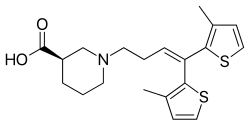 Tiagabine (Gabitril), a GABA transporter 1 (GAT-1) inhibitor and hence GABA reuptake inhibitor used as an anticonvulsant. | |
| Class identifiers | |
| Synonyms | GRI; GABA uptake inhibitor; GABA transporter inhibitor; GABA transporter blocker; GAT inhibitor; GAT blocker |
| Use | Epilepsy and other uses |
| Mechanism of action | GABA transporter inhibition |
| Biological target | GABA transporters |
| Chemical class | GABA analogues and others |
| Legal status | |
| In Wikidata | |
A GABA reuptake inhibitor (GRI), also known as a GABA transporter blocker, is a type of drug which acts as a reuptake inhibitor of the major inhibitory neurotransmitter γ-aminobutyric acid (GABA) by blocking the action of one or more of the GABA transporters (GATs), such as the GABA transporter 1 (GAT-1). This in turn leads to increased extracellular concentrations of GABA and an increase in GABAergic neurotransmission.[1]
Medical uses
Tiagabine is a GRI that selectively inhibits the action of GABA reuptake and its mechanism of action is the same as selective serotonin reuptake inhibitor (SSRI).[2] It is used as a treatment for partial seizures in adults and children over 12, and works by amplifying GABA's calming effects in the brain. This, however, comes with potential drawbacks. While generally well-tolerated, some users experience concentration issues, language difficulties, and even a higher risk of depression, hallucinations, and paranoia.[3]
GRIs may be used in the clinical treatment of seizures, convulsions, or epilepsy as anticonvulsants/antiepileptics, depression,[4] anxiety disorders[2] such as generalized anxiety disorder (GAD), social phobia (SP) also known as social anxiety disorder (SAD), and panic disorder (PD) as anxiolytics, insomnia as hypnotics, muscle tremors or spasms as muscle relaxants, and chronic pain as analgesics. They may also potentially be used as anesthetics in surgery.
The GRI CI-966 has been characterized as a hallucinogen with effects analogous to those of the GABAA receptor agonist muscimol (a constituent of Amanita muscaria (fly agaric) mushrooms) when administered at sufficient doses, which precluded its further development for medical use.[5]
Pharmacology
GABA is an amino acid that functions as the predominant inhibitory neurotransmitter within the central nervous system, playing a crucial role in modulating neuronal activity in both the brain and spinal cord.[6] While GABA predominantly exerts inhibitory actions in the adult brain, it has an excitatory role during developmental stages.[7] When the neuron receives the action potential, GABA is released from the pre-synaptic cell to the synaptic cleft. After the action potential transmission, GABA is detected on the dendritic side, where specific receptors collectively contribute to the inhibitory outcome by facilitating GABA transmitter uptake. Facilitated by specific enzymes, GABA binds to post-synaptic receptors, with GABAergic neurons playing a key role in system regulation.[8] The inhibitory effects of GABA diminish when presynaptic neurons reabsorb it from the synaptic cleft for recycling by GABA transporters (GATs).[9] The reuptake mechanism is crucial for maintaining neurotransmitter levels and synaptic functioning.[10] GABA reuptake inhibitors hinder the functioning of GATs, preventing GABA reabsorption in the pre-synaptic cell. This results in increased GABA levels in the extracellular environment, leading to elevated GABA-mediated synaptic activity in the brain.[11][12]
GABA, the brain's main inhibitory neurotransmitter, plays a crucial role in regulating neuronal activity by dampening down neuron firing. Disruptions in GABAergic neurotransmission, such as reduced synthesis, reuptake dysfunction, or receptor abnormalities, can lead to various pathologies in the central nervous system, including epilepsy, anxiety disorders, Parkinson's disease, and sleep disorders.[13][14][2] The inhibitory neurotransmitter GABA plays a complex role in modulating anxiety and stress, regulating sleep, circadian rhythms, mood, cognition, and perception. Low GABA levels are associated with emotional and behavioral disruptions, including short-term and/or long-term stress, anxiety disorders, and sleep disorders.[15]
List of GRIs
- Arecaidine
- CI-966[16]
- DABA
- Deramciclane (EGIS-3886)
- Dihydromuscimol
- EF-1502
- Gabaculine
- Guvacine
- Hyperforin[17]
- Muscimol (weak)
- Nipecotic acid
- NNC 05-2090
- NNC-711[16]
- SKF-89976A[16]
- SNAP-5114
- THAO
- Thio-THIP (weak)
- Thio-THPO
- THPO (weak)
- Tiagabine (Gabitril)[16]
See also
- GABA transaminase inhibitor
- GABA receptor agonist
- GABAA receptor agonist
- GABAA receptor positive allosteric modulator
References
- ↑ Bauer J, Cooper-Mahkorn D (2008-08-08). "Tiagabine: efficacy and safety in partial seizures – current status". Neuropsychiatric Disease and Treatment. 4 (4): 731–736. doi:10.2147/NDT.S833. PMC 2536540. PMID 19043517.
- 1 2 3 Loughlin, K. R., Generali, J. A. (2006). The Guide to Off-label Prescription Drugs: New Uses for FDA-approved Prescription Drugs. United Kingdom: Free Press.
- ↑ Cavanna, A. E., Ali, F., Rickards, H. E., & McCorry, D. (2010). Behavioral and cognitive effects of anti-epileptic drugs. Discovery medicine, 9(45), 138–144.
- ↑ Zanoli P (2004). "Role of Hyperforin in the Pharmacological Activities of St. John's Wort". CNS Drug Reviews. 10 (3): 203–218. doi:10.1111/j.1527-3458.2004.tb00022.x. ISSN 1080-563X. PMC 6741737. PMID 15492771.
- ↑ Hollister LE (1990). "New class of hallucinogens: GABA-enhancing agents". Drug Development Research. 21 (3): 253–256. doi:10.1002/ddr.430210311. ISSN 0272-4391. S2CID 143868762.
- ↑ Jewett BE, Sharma S (2024), "Physiology, GABA", StatPearls, Treasure Island (FL): StatPearls Publishing, PMID 30020683, retrieved 2024-02-15
- ↑ Allen MJ, Sabir S, Sharma S (2024), "GABA Receptor", StatPearls, Treasure Island (FL): StatPearls Publishing, PMID 30252380, retrieved 2024-02-15
- ↑ Gottlieb DI (1988). "GABAergic Neurons". Scientific American. 258 (2): 82–89. Bibcode:1988SciAm.258b..82G. doi:10.1038/scientificamerican0288-82. ISSN 0036-8733. JSTOR 24988982. PMID 2847312.
- ↑ Olsen RW, DeLorey TM (1999), "GABA Synthesis, Uptake and Release", Basic Neurochemistry: Molecular, Cellular and Medical Aspects. 6th edition, Lippincott-Raven, retrieved 2024-02-15
- ↑ Salters-Pedneault, K. (2023, June 13). How selective serotonin reuptake inhibitors (ssris) works. Verywell Mind.
- ↑ Zafar S, Jabeen I (2018). "Structure, Function, and Modulation of γ-Aminobutyric Acid Transporter 1 (GAT1) in Neurological Disorders: A Pharmacoinformatic Prospective". Frontiers in Chemistry. 6: 397. Bibcode:2018FrCh....6..397Z. doi:10.3389/fchem.2018.00397. ISSN 2296-2646. PMC 6141625. PMID 30255012.
- ↑ Niessen WM (2020-10-01). "Interpretation of tandem mass spectra of antiepileptic drugs using accurate-m/z data and m/z-shifts with stable-isotope labeled analogues". International Journal of Mass Spectrometry. 456 116409. Bibcode:2020IJMSp.456k6409N. doi:10.1016/j.ijms.2020.116409. ISSN 1387-3806. S2CID 224856466.
- ↑ Perucca E, Bialer M, White HS (2023-09-01). "New GABA-Targeting Therapies for the Treatment of Seizures and Epilepsy: I. Role of GABA as a Modulator of Seizure Activity and Recently Approved Medications Acting on the GABA System". CNS Drugs. 37 (9): 755–779. doi:10.1007/s40263-023-01027-2. ISSN 1179-1934. PMC 10501955. PMID 37603262.
- ↑ Motiwala Z, Aduri NG, Shaye H, Han GW, Lam JH, Katritch V, Cherezov V, Gati C (2022). "Structural basis of GABA reuptake inhibition". Nature. 606 (7915): 820–826. Bibcode:2022Natur.606..820M. doi:10.1038/s41586-022-04814-x. ISSN 1476-4687. PMC 9394549. PMID 35676483.
- ↑ Hepsomali P, Groeger JA, Nishihira J, Scholey A (2020). "Effects of Oral Gamma-Aminobutyric Acid (GABA) Administration on Stress and Sleep in Humans: A Systematic Review". Frontiers in Neuroscience. 14: 923. doi:10.3389/fnins.2020.00923. ISSN 1662-453X. PMC 7527439. PMID 33041752.
- 1 2 3 4 Borden LA, Murali Dhar TG, Smith KE, Weinshank RL, Branchek TA, Gluchowski C (1994). "Tiagabine, SK&F 89976-A, CI-966, and NNC-711 are selective for the cloned GABA transporter GAT-1". Eur J Pharmacol. 269 (2): 219–224. doi:10.1016/0922-4106(94)90089-2. PMID 7851497.
- ↑ Wonnemann M, Singer A, Müller WE (August 2000). "Inhibition of Synaptosomal Uptake of 3H-L-glutamate and 3H-GABA by Hyperforin, a Major Constituent of St. John's Wort The Role of Amiloride Sensitive Sodium Conductive Pathways". Neuropsychopharmacology. 23 (2): 188–197. doi:10.1016/S0893-133X(00)00102-0. PMID 10882845.