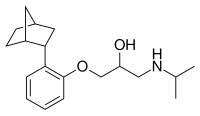
Bornaprolol
 | |
| Names | |
|---|---|
| IUPAC name
1-[2-(3-Bicyclo[2.2.1]heptanyl)phenoxy]-3-(propan-2-ylamino)propan-2-ol | |
| Identifiers | |
CAS Number |
|
3D model (JSmol) |
|
| ChEMBL | |
| ChemSpider | |
PubChem CID |
|
| UNII | |
CompTox Dashboard (EPA) |
|
InChI
| |
SMILES
| |
| Properties | |
Chemical formula |
C19H29NO2 |
| Molar mass | 303.446 g·mol−1 |
Except where otherwise noted, data are given for materials in their standard state (at 25 °C [77 °F], 100 kPa).
Infobox references | |
Bornaprolol is a beta-adrenergic antagonist.[1]
Synthesis

The reaction between 2-(Bicyclo[2.2.1]hept-2-yl)phenol [17152-43-1] (1) and epichlorohydrin [106-89-8] (2) in the presence of sodium metal gives (3). Opening of the oxirane by treatment with isopropylamine [75-31-0] (4) completed the synthesis of Bornaprolol (5).
References
- ↑ Cheymol, G; Jaillon, P; Lecoq, B; Lecoq, V; Cheymol, A; Krumenacker, M (1987). "Cardiovascular beta-adrenergic blocking effects of bornaprolol in humans: Relation to dose and plasma concentration". Journal of Cardiovascular Pharmacology. 9 (6): 694–8. doi:10.1097/00005344-198706000-00009. PMID 2442536. S2CID 38782602.
- ↑ Michaud, R.; Bornaprolol hydrochloride. Drugs Fut 1982, 7, 2, 91.
- ↑ Hardy, J.C. et al, Bull. Soc. Chim. Fr., Part 2, 1982, 304.
- ↑ DE2735570 idem Jean Mardiguian, U.S. patent 4,157,400 (1985 to Marpha Societe D'etudes Et D'exploitation De Marques S.A., Paris, Fr).