ACBI3
 | |
| Identifiers | |
|---|---|
IUPAC name
| |
| CAS Number | |
| PubChem CID | |
| ChemSpider | |
| Chemical and physical data | |
| Formula | C50H62N14O6S2 |
| Molar mass | 1019.26 g·mol−1 |
| 3D model (JSmol) | |
SMILES
| |
InChI
| |
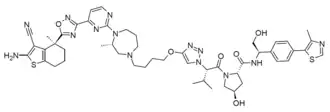
ACBI3 is an experimental anticancer drug which is one of the first examples of a proteolysis targeting chimera (PROTAC) against the protein KRAS.
Being a PROTAC, it is a bifunctional molecule with two halves joined by a linker; one half binds to its target, KRAS which is a key driver in certain types of cancer, while the other half binds E3 ligase which triggers the cell's natural protein degradation mechanisms. This causes the KRAS protein to be degraded.
In early stage testing, it was able to target 13 of the 17 most common mutated forms of KRAS found in cancer cells, allowing selective targeting of a wide range of cancer types. While this particular molecule is still at an early developmental stage, it is an important proof of concept that KRAS can be targeted with a PROTAC.[1][2][3][4]
See also
- Adagrasib
- K-Ras(G12C) inhibitor 6
- MRTX1133
- Olomorasib
- RMC-9805
- Sotorasib
References
- ↑ Popow J, Farnaby W, Gollner A, Kofink C, Fischer G, Wurm M, et al. (September 2024). "Targeting cancer with small-molecule pan-KRAS degraders". Science. 385 (6715). New York, N.Y.: 1338–1347. Bibcode:2024Sci...385.1338P. doi:10.1126/science.adm8684. PMID 39298590.
- ↑ Hamilton G, Eggerstorfer MT, Stickler S (2024). "Development of PROTACS degrading KRAS and SOS1". Oncology Research. 32 (8): 1257–1264. doi:10.32604/or.2024.051653. PMC 11267056. PMID 39055890.
- ↑ Kumar H, Sobhia ME (August 2024). "Interplay of PROTAC Complex Dynamics for Undruggable Targets: Insights into Ternary Complex Behavior and Linker Design". ACS Medicinal Chemistry Letters. 15 (8): 1306–1318. doi:10.1021/acsmedchemlett.4c00189. PMC 11317996. PMID 39140051.
- ↑ Li Y, Yang L, Li X, Zhang X (August 2024). "Inhibition of GTPase KRASG12D: a review of patent literature". Expert Opinion on Therapeutic Patents. 34 (8): 701–721. doi:10.1080/13543776.2024.2369630. PMID 38884569.